VN
 EN
07/11/2026, 11:20
Business economics
Hanoi apartments: Prices drop, buyers still bottom-fishing
Apartment selling prices in Hanoi simultaneously adjusted in Q3/2026, but liquidity has not improved as mortgage rates remain high and buyers continue to exercise caution.
This movement indicates a significant gap between search demand and the actual willingness to disburse funds.
Cautious Buyers
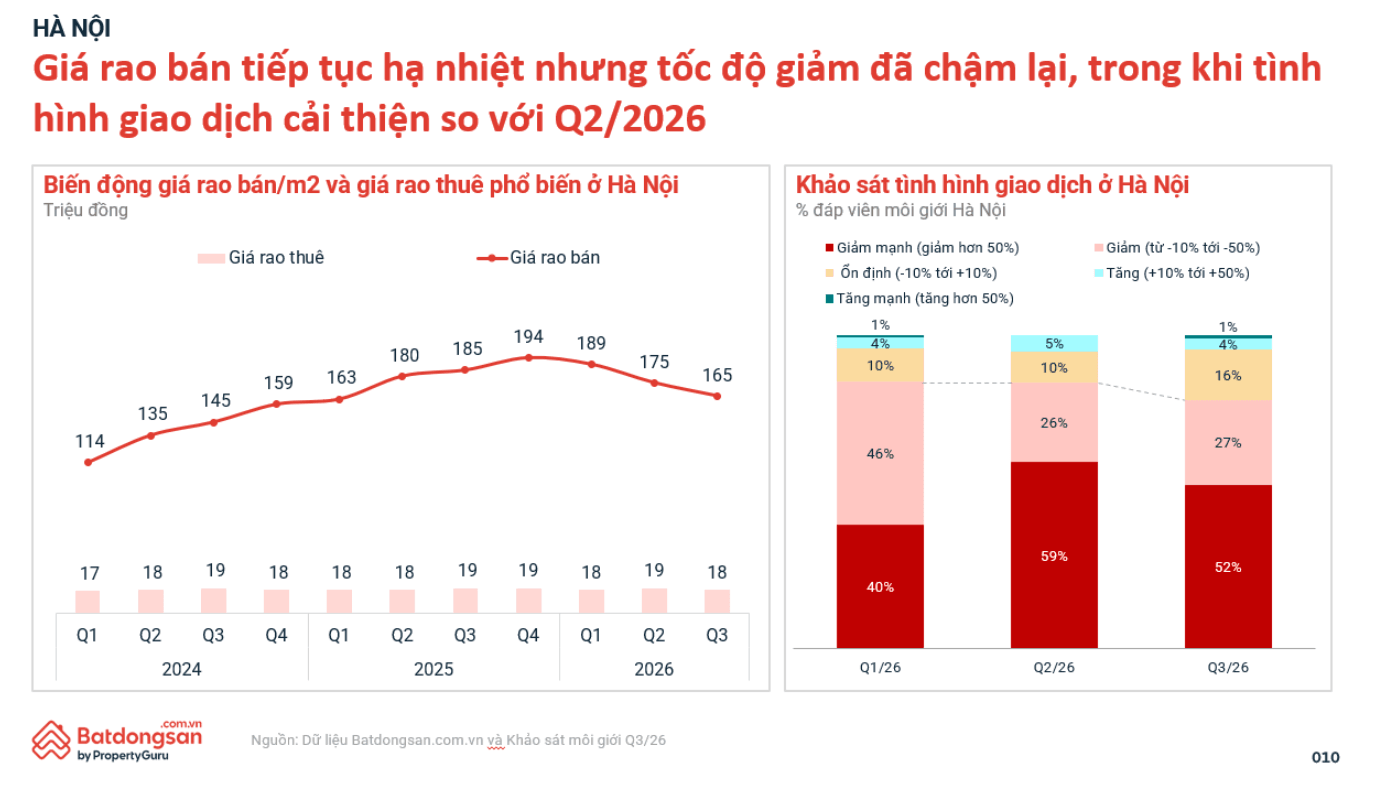
The real estate market in Q3/2026 continued to see a divergence among interest levels, asking prices, and liquidity. Data from Batdongsan.com.vn shows asking prices tending to adjust after a period of sharp growth, while the majority of buyers remain in a wait-and-see mode.
According to a survey of 530 brokers by Batdongsan.com.vn, 48% recorded a transaction volume drop of over 50% compared to the previous quarter. This rate is lower than the 50% recorded in Q2/2026, indicating that the slowdown in liquidity decline shows signs of leveling off, though not yet enough to confirm a market recovery.
Caution remains the defining trait of the market. Up to 63% of brokers reported that clients continue to observe and carefully deliberate before committing to transactions. High lending rates, concerns over policy and planning shifts, and cash flow constraints are key factors causing buyers to delay purchase decisions.
Mr. Dong Quang Canh, Senior Sales Manager at Batdongsan.com.vn, noted that the Hanoi real estate market is entering a phase of adjustment in buyer psychology and search behavior. Following controlled optimism in Q2, consumers became more prudent in Q3, tending to wait for more favorable developments before taking action.
Meanwhile, a recently released report by CBRE shows that Hanoi's apartment market in Q3/2026 continued to face liquidity pressure, even as new supply across the first nine months increased year-on-year. Some developers proactively delayed launching new inventory until subsequent quarters rather than pushing supply when market liquidity faced major challenges.
Specifically, Hanoi recorded approximately 6,200 new apartment launches in Q3, down 28% quarter-on-quarter and 40% year-on-year. Cumulatively over the first nine months, new launch supply reached around 22,820 units—an 8% increase compared to the same period in 2025 and up 20% compared to the first nine months of 2024.
Notably, over 50% of the new supply in the quarter originated from mega-urban projects in Van Giang (Hung Yen province), an area bordering Hanoi. For the nine-month period, this proportion stood at approximately 40%.
This supply shift indicates that evaluating Hanoi's apartment market requires factoring in mega-townships in adjacent areas rather than focusing solely on central city boundaries. This is also an important consideration when comparing price levels across regions.
Lower Prices, Yet Insufficient to Drive Demand
In terms of transactions, Batdongsan.com.vn data shows minor signs of improvement compared to the previous quarter. The share of brokers reporting a transaction drop over 50% decreased from 59% in Q2 to 52% in Q3/2026. Meanwhile, the proportion reporting stable transaction volume rose from 10% to 16%.
However, this trend has not been accompanied by a clear liquidity recovery. Apartments continue to dominate Hanoi's search structure, accounting for 52% of total interest. Private houses accounted for 18%, and land plots comprised 13%.
On the pricing side, all segments saw adjustments to varying degrees. Asking prices for apartments fell 5% quarter-on-quarter, land plots dropped 10%, villas declined 3%, while private houses remained largely flat.
CBRE's report also highlighted declines in both primary and secondary apartment prices in Q3. Average primary asking prices in the expanded Hanoi market stood at 86 million VND/sqm (carpet area, excluding VAT, maintenance fees, and discounts), down 9% quarter-on-quarter and 6% year-on-year.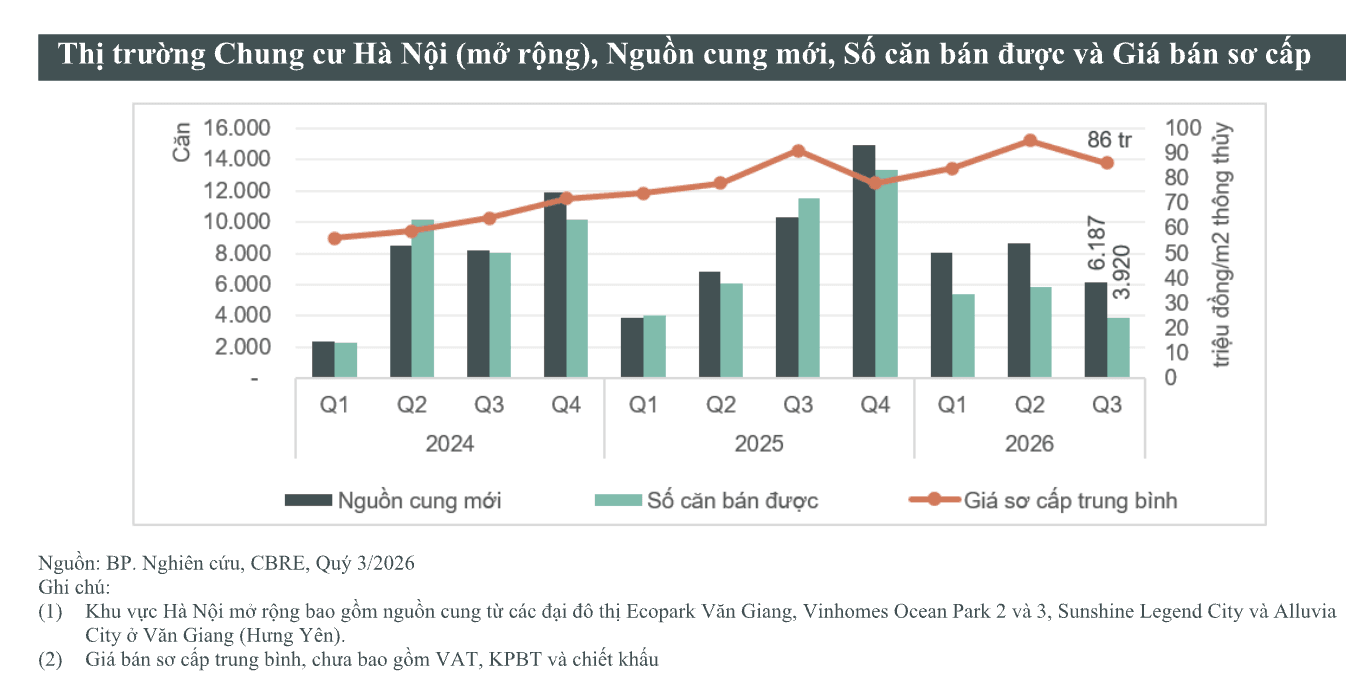
Primary apartment prices in Hanoi have dropped year-on-year. Source: CBRE
Looking strictly at projects within Hanoi's urban core, average primary prices reached 102 million VND/sqm, down 6% compared to Q2 and 3% year-on-year.
In the secondary market, average asking prices stood at roughly 60 million VND/sqm, down 5% quarter-on-quarter and 8% year-on-year. According to CBRE, secondary prices began adjusting in Q1/2026, but Q3 marks the first time this segment recorded a year-on-year drop following two years of rapid growth.
Adjustment pressure mainly stems from investors with high financial leverage who were forced to cut prices as borrowing costs exceeded mid-term affordability. Lower secondary prices have created more competitively priced supply, yet liquidity remains constrained due to cautious buyer sentiment, even among end-users.
Notably, the degree of adjustment differs between primary and secondary apartments. According to Batdongsan.com.vn, from the start of the year through September 2026, the secondary apartment price index dropped 15%—higher than the 9% decrease in the primary market.
Despite steeper price cuts, secondary apartments still accounted for an estimated 54% of transaction volume in Q3, compared to 46% for the primary segment.
This discrepancy reflects distinct buyer demographics. For primary units, discounts, interest subsidies, and grace periods on principal and interest are cited by brokers as major factors influencing buyer decisions.
In contrast, real housing demand accounts for 83% of demand in the secondary apartment market, compared to just 17% for investment purposes. Buyers tend to seek reasonably priced units in areas that have already adjusted, rather than relying on expectations of future price appreciation.
Nevertheless, financial pressure remains a substantial barrier across both segments. According to CBRE, floating mortgage rates at some commercial banks ranging between 13% and 15% per annum have created significant hurdles for buyers using financial leverage. To sustain liquidity, some developers have rolled out fixed-rate packages extending up to five years—even post-handover—to ease short-term capital costs.
Even so, financial support policies do not fully resolve buyer affordability. With borrowing rates remaining elevated, transaction decisions ultimately depend on self-owned capital, income stability, and long-term debt servicing capability.
Author: DIEU HOA - TRUONG DANG
RELATED TOPICS
RECOMMENDED TOPICS