VN
 EN
12/11/2026, 11:28
Legal environment
Ho Chi Minh City builds its own mechanism to renovate old apartment buildings
Ho Chi Minh City is drafting a dedicated resolution on the renovation and reconstruction of apartment buildings, supplementing project implementation mechanisms, support policies, and attracting investment resources.
Ho Chi Minh City is drafting a dedicated resolution on mechanisms, policies, and measures for the renovation and reconstruction of apartment buildings, based on the authority granted under the Urban Development Law. The draft contains outstanding proposals compared to current regulations, amidst the city implementing its old apartment renovation plan for the 2026–2030 period.
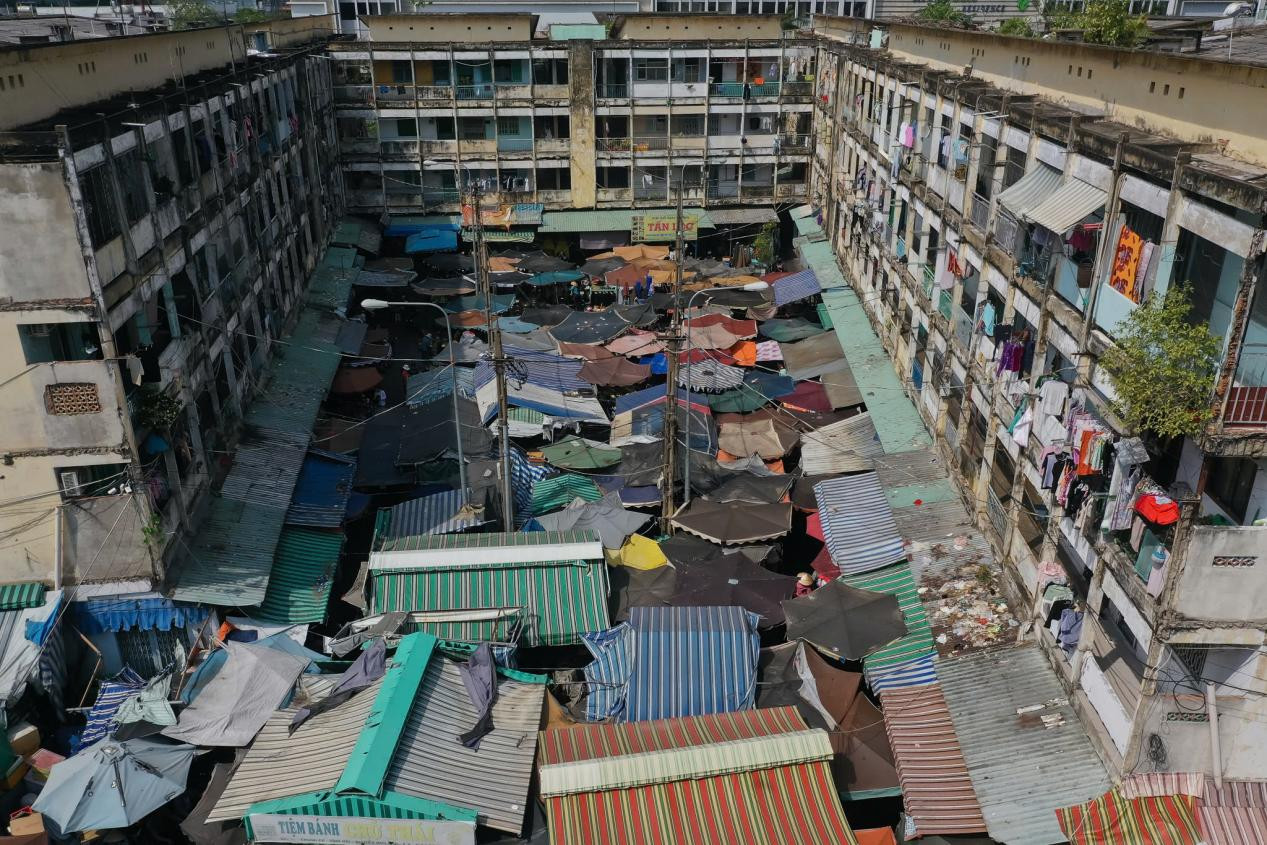
Vinh Hoi Apartment Building (blocks A, B, C) is currently undergoing relocation, temporary housing allocation, and detailed planning to serve renovation and reconstruction.
Accelerating renovation progress
According to information from the Ho Chi Minh City Department of Construction, review and inspection results in October 2026 showed that the city has 64 apartment buildings, comprising 106 blocks with 8,577 apartments, requiring relocation and demolition. These structures are scattered across 18 wards, ranging from central areas to locations such as Binh Quoi, Tan Son Nhat, and Vung Tau.
For the 16 Grade D apartment buildings inspected since 2017, HCMC has relocated 828 out of 1,194 households. Among these, 12 apartment buildings have fully relocated all 608 households, 2 apartment buildings have partially relocated 220 out of 367 households, and the remaining 2 apartment buildings still have 219 households that have not yet moved. For apartment buildings where relocation has not been completed, HCMC has requested Ward People's Committees to urgently review temporary housing needs, arrange accommodation, or provide rental cost support for residents according to regulations.
Local authorities must notify apartment owners and operating management units of the inspection results. At the same time, warning signs must be installed in areas with severely damaged structures, and fire prevention and fighting safety inspections must be stepped up while awaiting demolition and renovation.
To date, the Department of Construction has submitted to the HCMC People's Committee a draft plan to implement the Project on renovating and rebuilding old apartment buildings for the 2026–2030 period. The draft specifies timelines and responsibilities for each agency and locality regarding the relocation, demolition, and new construction investment for each project.
According to the proposed roadmap, HCMC will basically complete investment preparation steps for apartment buildings constructed before 1975 and during the 1975–1994 period, including inspection, planning, investor selection, site clearance, and construction procedures. Apartment buildings not subject to demolition are targeted for completion of repairs, upgrades, and reinforcements within 2027.
For the 64 apartment buildings recently identified as requiring demolition, the Department of Construction proposes completing investment, renovation, or rebuilding work between now and 2030. Particularly for the Vinh Hoi Apartment Building (blocks A, B, C) in Khanh Hoi Ward, relocation and temporary accommodation arrangements are being carried out alongside the preparation of a 1/500 detailed plan as a foundation for constructing renovation plans and inviting investors. The project currently has no investor.
Regarding relocation and resettlement work when renovating apartment buildings, lawyer Pham Thanh Tuan—a real estate legal expert—noted that identifying cases requiring demolition, preparing compensation plans, and organizing relocation need to be considered comprehensively.
According to Mr. Tuan, policies need to ensure the timely handling of unsafe structures while clearly defining the rights of property owners and consensus mechanisms. For cases that do not require emergency relocation, moving residents should be tied to temporary housing arrangements or financial payments allowing residents to secure their own accommodation.
Perfecting investment support mechanisms
Along with plans to renovate old apartment buildings, HCMC continues to study mechanisms to support businesses participating in apartment building reconstruction projects.
Previously, the HCMC People's Council issued Resolution No. 17/2025/NQ-HDND dated July 24, 2025, providing preferential mechanisms and support for investors participating in investment projects to renovate and rebuild apartment buildings in the area.
Under the resolution, investors receive 50% support for the construction cost of technical infrastructure within the project scope, up to a maximum of 10 billion VND per project. Additionally, they receive 50% support for relocation and forced relocation costs based on decisions by competent authorities.
Support for technical infrastructure construction costs is disbursed after the project is completed and inspected/accepted according to regulations. For relocation and forced relocation costs, support is provided after the investor completes the plan approved by competent authorities.
These are cost support policies for project implementation that have been enacted. For apartment buildings where an investor has not yet been selected, such as Vinh Hoi, the application of policies depends on completing investment procedures and meeting corresponding conditions.
In addition to existing mechanisms, the HCMC Department of Construction is studying a draft resolution on mechanisms, policies, and measures for renovating and rebuilding apartment buildings in the city, proposing breakthrough mechanisms compared to current provisions under the Housing Law.
The draft is built on the authority granted under the Urban Development Law, effective from October 1, 2026. Research content covers project implementation mechanisms, investor selection, compensation, support, and resettlement.
According to information provided by the Department of Construction at a press conference on October 29, the draft resolution was approved by the HCMC People's Committee and submitted to the HCMC People's Council for consideration. However, because many new policies require thorough review and evaluation, this topic was deferred to the December 2026 session.
Author: MAN NHI - TRUONG DANG (translates)
RELATED TOPICS
RECOMMENDED TOPICS