VN
 EN
10/11/2026, 11:02
Investment
New developments at Vietbank
Before officially transferring to the HoSE, the VBB stock of Vietnam Thương Tín Commercial Joint Stock Bank (Vietbank) had increased sharply. However, Vietbank's shareholders still chose to register to buy VBB shares at a high price after it landed on the exchange.
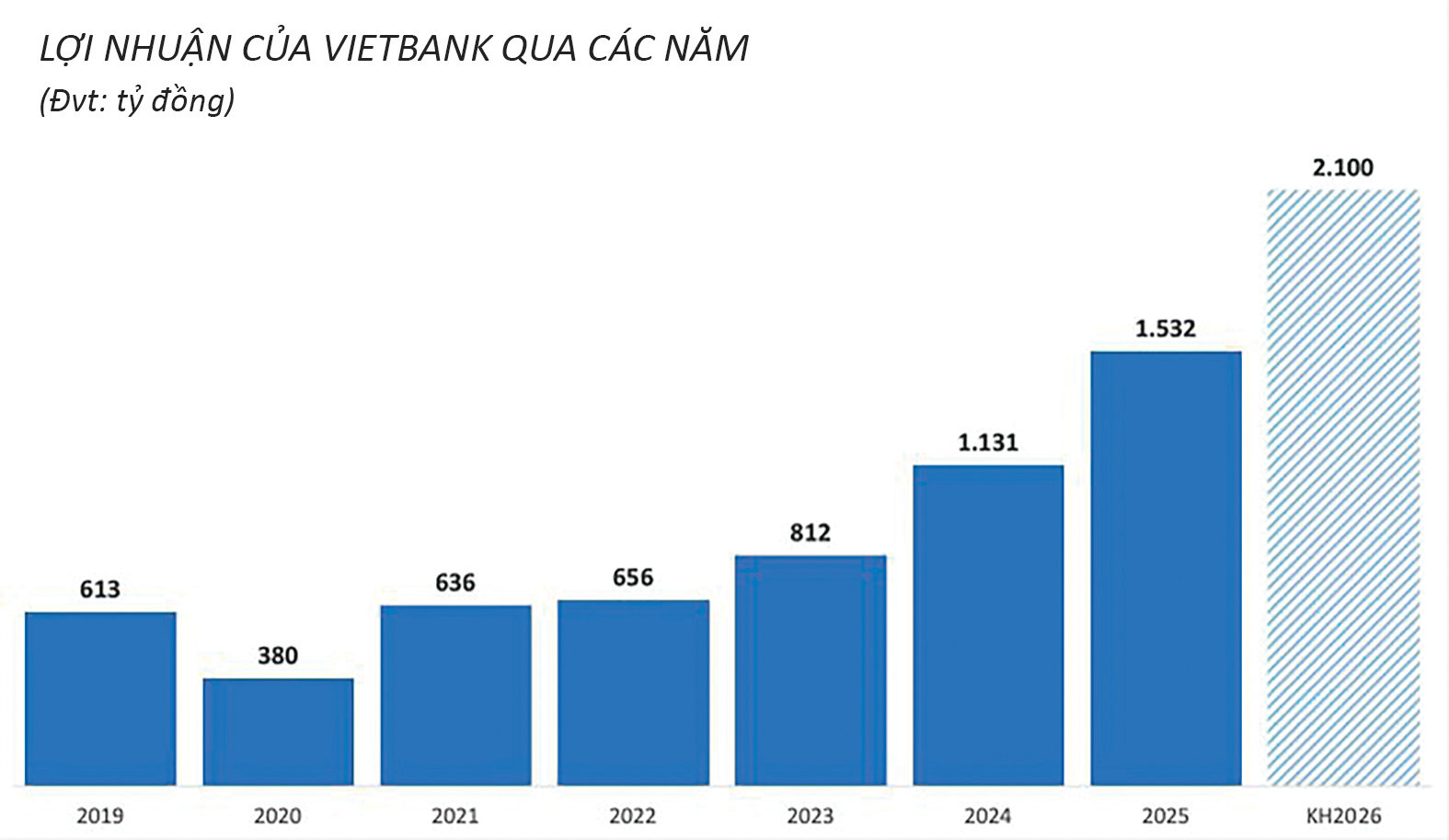 In 2026, Vietbank set a target for pre-tax profit of 2,100 billion VND, an increase of 37% compared to the performance in 2025. (Source: Financial Statements, compiled)
Vietbank was officially listed on HoSE on July 14, paving the way for a wave of remaining small banks currently trading on UPCoM to move to the listed stock exchange according to the roadmap.
Capital Increase Roadmap
VietBank has also been implementing an ambitious capital increase roadmap from 10,769 billion VND to around 15,548 billion VND through three issuance phases. The State Bank of Vietnam (SBV) has approved a maximum capital increase of nearly 4,779 billion VND, and Vietbank has completed Phase 1, issuing bonus shares to existing shareholders to increase charter capital by nearly 1,077 billion VND. It is expected that these bonus shares will be transferred to shareholders in the third quarter of 2026.
According to the bank's management, the transition from UPCoM to HoSE is considered a step marking a new development phase for Vietbank in the capital market. In addition, this move is expected to help Vietbank expand its ability to access institutional investors, investment funds, and individual investors, creating room for medium- and long-term capital mobilisation plans.
According to the roadmap approved by the SBV, Vietbank still has 2 issuance phases remaining: issuing over 296.1 million shares to existing shareholders at a price of 10,000 VND per share, expected to collect 2,961 billion VND from Q3 to Q4/2026, and issuing a maximum of over 74 million ESOP shares, expected at the end of this year or early next year. If the full plan is completed, the bank's charter capital will reach nearly 15,548 billion VND, 2.18 times higher than in 2024. This will serve as the foundation to help the bank enhance its financial capacity, increase its Capital Adequacy Ratio (CAR), and expand operational scale. However, this also creates significant dilution pressure on existing shareholders in the short term.
Moves by the Founding Family Shareholders
With a price level that rose sharply prior to listing and remains well-maintained, VBB stock received a "leveraging" momentum for liquidity and stock value when shareholder Tran Thi Lam, Chairwoman of Hoa Lam Group, registered to buy 22 million VBB shares. Ms. Lam is the wife of Mr. Duong Ngoc Hoa, founder of Vietbank, and the mother of Vietbank Chairman Duong Nhat Nguyen. Ms. Lam currently holds over 239,700 VBB shares, equivalent to 0.02% of charter capital. If the transaction is completed, her ownership stake at this bank will increase to 3.88%. Upon completion of Ms. Lam's transaction, the Vietbank Chairman's family will hold approximately 162 million VBB shares, equivalent to 14.5% of charter capital.

Vietbank was officially listed on HoSE on July 14, 2026.
Does the Chairman's mother increasing her stake right after the bank listed on the largest public exchange run counter to the publicization trend, or does it reflect shareholders' confidence in the bank's prospects? Or from another angle, does controlling ownership structure need to be consolidated before a dilutive roadmap to mitigate the impact of sharing the ownership "pie" and facing downward pressure on earnings per share (EPS, ROE) in the short term following the capital increase? A series of investment and transaction decisions between Vietbank and related parties, most recently total investments of over 130 billion VND into real estate properties owned by Ms. Tran Thi Lam, partly show that the "family-ruled" factor holds dominant sway at Vietbank and further explains the aforementioned share purchase registration. This also reveals why founding family shareholders decided to increase their share purchases right after listing rather than making way for foreign capital flows at a time when the market is driving the upgrade narrative and prospects for strategic foreign capital in banking—thereby accepting a missed strategic opportunity in capital mobilization.
On business operations, Vietbank reported impressive results for the first half of 2026, with pre-tax profit reaching 923 billion VND, up 79.4% year-on-year. As of June 30, 2026, Vietbank's total assets exceeded 205,000 billion VND, up over 4% from the beginning of the year; outstanding loans reached 120,294 billion VND, up 11%; customer deposits reached 132,369 billion VND, up 5.6%. However, asset quality is a point that requires monitoring, as according to Q1 financial statements, the non-performing loan (NPL) ratio rose by 0.43 percentage points from 2.92% to 3.35%, placing Vietbank among the group of banks with NPLs above 3%—significantly higher than the industry average (which increased from 1.87% to 1.99%).
At the same time, the ratio of accrued interest and fee receivables to total assets—an indicator of actual cash flow quality—rose sharply by 0.38 percentage points from 1.39% to 1.77%, among the highest increases across the entire banking system. The non-performing loan coverage ratio (LLR) dropped from 47.63% down to 45.06%, continuing at a level much lower than major banks. Accordingly, asset quality at Vietbank is a case that needs close monitoring in coming quarters, particularly if debt reclassification pressures persist and potential fluctuations lead to deteriorating indicators.
For 2026, Vietbank sets targets for total assets to increase by 17%; total credit balance to reach 134,000 billion VND, up 23.6%; total capital mobilization to reach 155,000 billion VND, up 23.9%; and keeping the NPL ratio below 2.5%. Pre-tax profit is targeted at 2,100 billion VND, up 37.1% compared to 2025. These targets outline the profile of a bank in a rapid credit growth cycle (recognizing interest income immediately) running ahead of the realization of credit risks (which typically manifest with a 12-to-24-month lag). Is Vietbank trading asset quality for scale growth amid thin capital and depleted provision buffers?
Author: LE MY - TRUONG DANG
RELATED TOPICS
RECOMMENDED TOPICS