 VN
 EN
07/10/2026, 02:00
Investment
Stock market transitioning to upgrade: A cyclical vision needed
Increasing profit-taking pressure as the stock market reached resistance levels caused the VN-Index to drop during the morning session on Monday, September 7.
In the transition period leading up to the market upgrade on September 21, a cyclical vision will enable investors to achieve long-term efficiency.
The September 2026 market upgrade milestone is opening up landmark opportunities for Vietnam's capital market. For investors, it is essential to dissect the layers of macroeconomic data and capture the "pulse" of foreign capital flows, as this is key to positioning financial strategies for the remainder of the year. MBS Research noted in its September 2026 Alpha Portfolio report that the investment picture reveals mixed bright and dark spots, requiring a flexible risk management mindset.

September 2026 marks not only a new milestone in the international status of Vietnam's capital market during its transition to an upgrade, but also a test of investment courage and asset allocation capability. (Illustrative photo).)
Macro Forecasts and the Upgrade Effect
Internationally, monetary tightening pressures show signs of cooling down. According to data from CME Group's FedWatch Tool, traders currently place only a 38% probability on the Fed raising interest rates at its September meeting. Reacting to these expectations, over the past month, the US Dollar Index fell nearly 2% and crude oil prices dropped 3.4%, according to MBS.
However, the latest update indicates that the probability of a Fed rate hike has risen sharply, remaining the primary input indicator global investors monitor, alongside the USD index and oil price fluctuations linked to the supply bottleneck at Hormuz.
Domestically, MBS suggests that positive macroeconomic signals and results from July and August are leading institutions to expand their outlook for Vietnam's economic prospects for the entirety of 2026.
In this context, the greatest reward for Vietnam's institutional reform efforts in the stock market was FTSE Russell's announcement that 27 Vietnamese stocks officially entered the FTSE All-Cap index during its August 21, 2026 review. This serves as a historic stepping stone, paving the way for Vietnam to officially transition from a secondary frontier market to a secondary emerging market on September 21, 2026. This upgrade contributes to repositioning Vietnam's status, expanding global market representation in the FTSE All-World basket from 48 to 49 countries.
Evaluating foreign capital flows, the MBS report highlights that net selling pressure eased significantly in August to around VND 2,000 billion (as of August 25), down sharply from the average of VND 13,600 billion in June and July. This creates a solid foundation to expect foreign capital to return strongly as passive and active funds begin portfolio rebalancing.
However, from a data-driven critical perspective, special attention should be paid to market seasonality in September. MBS Research clearly analyzes divergence across different phases:
- First half of September (up to around Sept 15–18): The market benefits from upgrade expectations; liquidity is likely to improve strongly, and capital flows will target the 27 newly added FTSE All-Cap stocks as well as high-weight stocks.
- Second half of September (after Sept 21): Market correction pressure will increase. This implies that "sell on the news" remains a tangible risk. Businesses intending to raise capital or manage investment portfolios should avoid FOMO (fear of missing out) during the latter half of the month.
What's in the Outperforming (Alpha) Investment Portfolio?
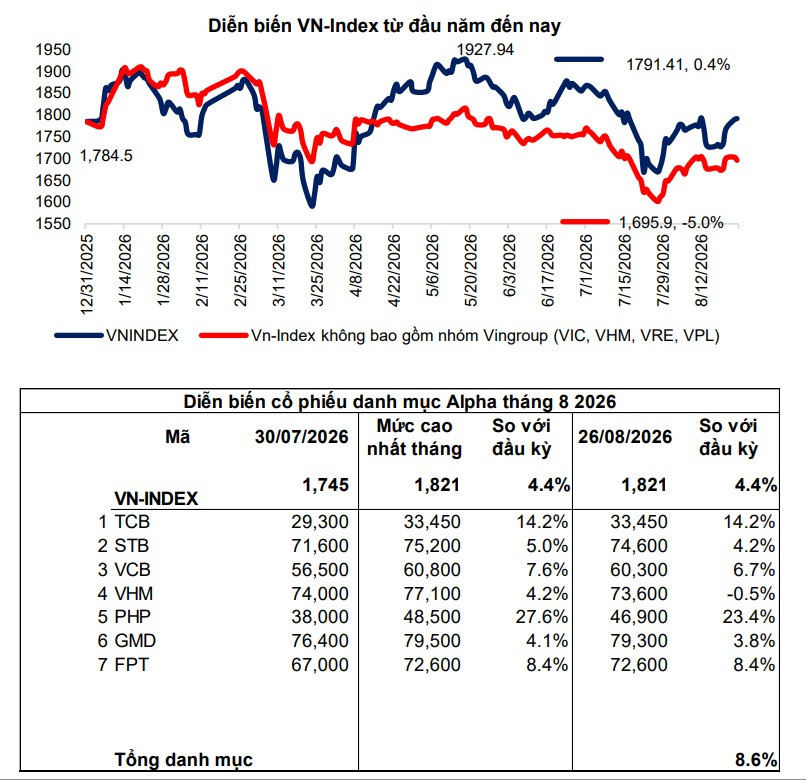
MBS's featured stock portfolio for September (comprising VHM, VCB, TCB, STB, FPT, GMD, PVD, VRE, VSC, and VGI) clearly reflects a selection strategy focused on companies with thick financial cushions.
For the banking group, asset quality serves as the strongest pillar. VCB's Q2 pre-tax profit reached VND 17,420 billion, up 57.9% year-over-year, accompanied by tightly controlled NPL ratios at 0.60% and a non-performing loan coverage ratio reaching 279%. TCB, despite facing pressure from real estate credit controls and shifting lending toward infrastructure construction, maintained Q2 pre-tax profit at VND 9,670 billion, up 22.4% year-over-year. For STB, strong profit growth expectations from post-2027 onward stem from resolving bad debts tied to Mr. Tram Be's 32.5% stake in 2026.
Technology and real estate sectors also present bright spots. FPT maintains attractive valuations with a 2026–2027 P/E ratio around 10.1x, along with sustainable contract backlog growth of 32% year-over-year. VHM benefits from the FTSE Global All-Cap basket and projected 2026 sales growth of 47%, driven by launches of major mega-projects such as Green Paradise and Global Gate Ha Long.
GMD recorded breakthrough net profit growth in Q2/2026, and drivers from this quarter will continue to create a turning point in operational scale, preparing GMD to absorb surging transport demand. GMD's gross margin is expected to expand due to price increases for new services at deep-water ports and pricing power in the Northern region given its estuary position; additionally, the divestment plan at Gemalink will bring not only windfall cash flows but also ensure stable cargo sources for future expansion phases.
VSC holds the highest upside potential in the portfolio, reflecting a "bottom-fishing" opportunity after a correction of over 50% from its peak fully priced in difficulties related to financial costs and SG&A expenses. MBS forecasts VSC's 2026–2027 net profit to grow by 8.5% and 26.2% respectively, driven by the "China 1" trend and robust transport revenue growth as HaiAn Green Shipping Line expands its fleet.
While the port sector is highly cyclical, VRE (Vincom Retail) and VGI (Viettel Global) represent companies entering a strong cash-flow harvest cycle.
Specifically, VRE's Q2/2026 net profit reached VND 1,608.5 billion, up 30.4% year-over-year, bringing the 6-month cumulative total to VND 3,214.8 billion (up 33.4% year-over-year). With a current P/E of 7.9x, significantly lower than its 3-year average of around 14x, combined with momentum from joining the FTSE index, VRE sits at a very attractive discount zone.
VGI has transitioned to a cash collection and expansion phase, with pure core operations improving noticeably. Notably, amid deep investor interest in State-Owned Enterprise (SOE) divestments, VGI stands out due to its high-quality assets, solid financial health, and clear profit growth narrative.
Importantly, PVD is highlighted from a governance perspective. Although PVD's 6-month net revenue surged 62.9% year-over-year to VND 6,437 billion, Q2 net profit dropped significantly by 32.1% to VND 163 billion. MBS directly attributes this to interest expenses multiplying 2.4 times and foreign exchange losses. This proves that during rapid asset expansion, accepting short-term margin trade-offs can occur. This serves as an important case study for corporate CFOs regarding FX hedging tools and leverage management in volatile macroeconomic environments.
September 2026 marks not only a new milestone in international positioning for Vietnam's capital market, but also a test of investment courage and asset allocation capability. Experts view opportunities as clearly present in leading sectors, yet the margin of safety and timing of decisions will determine capital efficiency for businesses and investors in the final stretch of the year.
Author: AN DINH - TRUONG DANG
RELATED TOPICS
RECOMMENDED TOPICS