VN
 EN
18/11/2026, 02:38
Investment
Vietnam stock market: Expectations for IPOs and listings
Securities companies going public, expected to create a wave in the market, have been gaining momentum since last year.
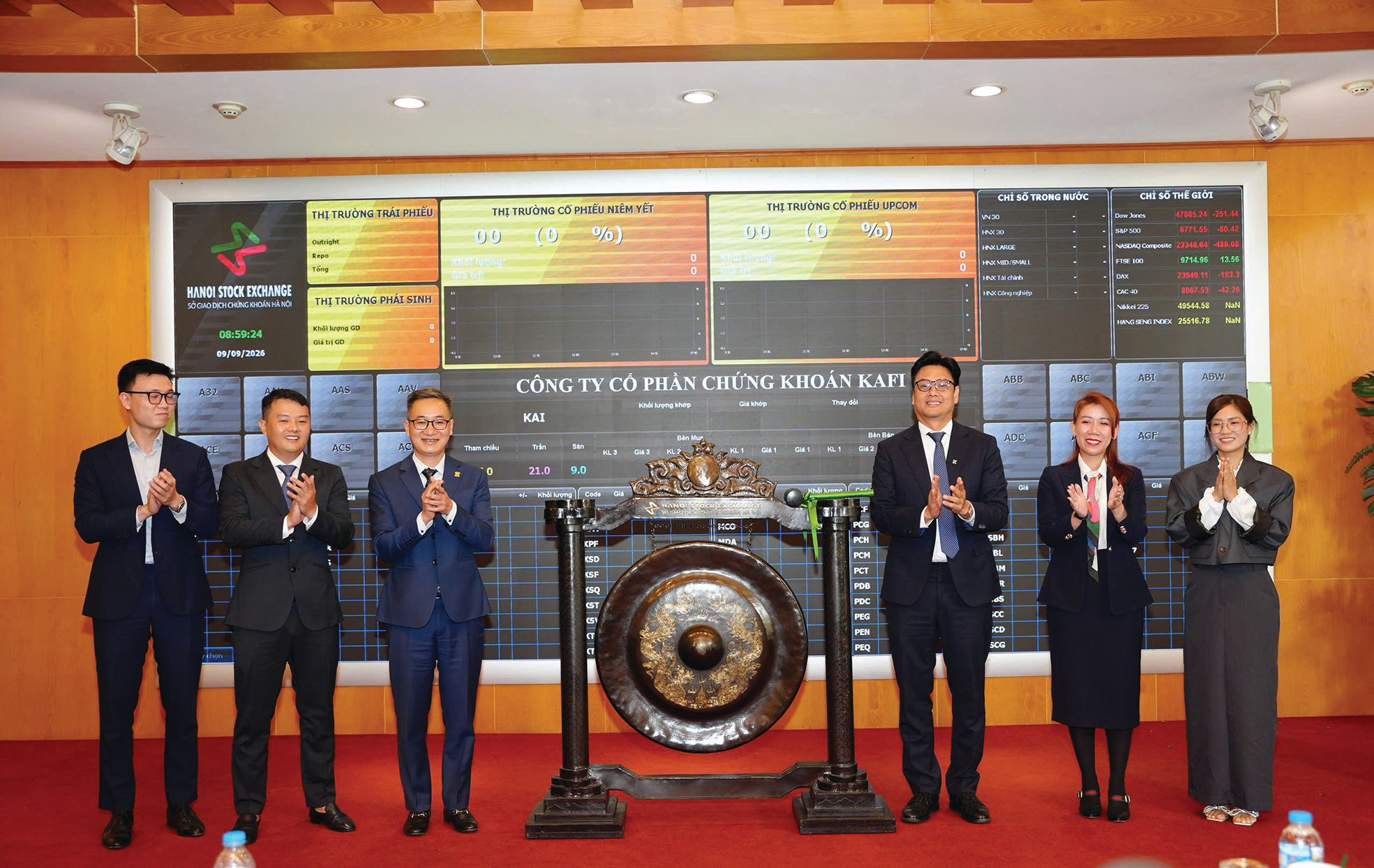
KAI shares of Kafi Securities Joint Stock Company officially traded on UPCoM on the morning of September 9. Photo: KAI
Billions of Securities Shares Listed
After becoming a public company in July 2026, Kafi officially listed 750 million KAI shares on the UPCoM market at a price of 15,000 VND per share, corresponding to a valuation of approximately 11,250 billion VND.
With a charter capital of 7,500 billion VND following its IPO, Kafi already has plans to increase its capital right after going public. Specifically, the company plans to offer 125 million shares to the public at a price no lower than 15,000 VND per share, thereby raising at least 1,875 billion VND. Concurrently, the company plans to issue an additional 3.75 million ESOP shares at 10,000 VND per share. If both issuances are completed, Kafi's charter capital will increase from 7,500 billion VND to 8,787.5 billion VND.
Prior to Kafi, LPBS also officially brought more than 1.4 billion LPS shares into trading. Earlier, in its June IPO, LPBS successfully distributed all 141.86 million shares to 1,005 domestic investors, collecting over 4,256 billion VND. Following the IPO, LPBS raised its charter capital from 12,668 billion VND to nearly 14,087 billion VND. According to LPBS executive leadership, listing on HoSE is an important milestone in the company's development, affirming its position and brand reputation in capital raising alongside trusted strategic partners.
It is evident that IPOs and market listings represent a significant step forward for securities firms. These are milestones prepared well in advance by companies to execute strategies aimed at boosting capital and expanding scale to capture the new growth cycle of the capital market.
Post-IPO Investment
While going public and trading shares on one of the three VNX exchanges is a major leap in operational strategy and long-term vision for securities firms—accompanied by compliance with and alignment toward new standard requirements—the opportunity for shareholders to hold company stock differs significantly from holding shares in the OTC market. Naturally, the goals of investors holding shares from the IPO stage through listing also vary.
From a corporate perspective, the IPO and listing milestone marks an organization's "maturation." For example, major IPO deals in the securities sector have propelled TCBS (TCX) and VPBankS (VPX) to new heights.
According to TCBS's financial statements, the company recently recorded its highest quarterly profit in operational history, with total revenue reaching 3,745 billion VND (up 41%) and pre-tax profit reaching 2,097 billion VND (up 21%). Notably, TCBS recently announced a plan to issue nearly 555 million dividend shares in September, raising its charter capital to 33,293 billion VND and surpassing SSI to lead the market.
For VPBankS, after listing, the company recorded a pre-tax profit of 2,673 billion VND in the first two quarters of the year—triple that of the same period—while entering the top 8 in broking market share on HoSE. VPBankS stated that as corporate capital-raising needs continue to rise amid government push for double-digit growth, its professional capacity, ecosystem, and financial potential leave plenty of room to expand advisory, bond, and stock issuance activities toward ambitious future goals.
While newly acquired capacity converts into concrete business performance, post-listing stock performance in a challenging market environment has not yet met expectations. From the perspective of shareholders—especially IPO investors holding shares for yield—post-IPO stock movements, including those in the securities sector, have prompted investors to rethink valuations.
Statistics from 22 years of continuous Bloomberg market data reveal that in the first 3 months post-listing, the average return of IPO stocks reached 18.93%. However, only 44.4% of tickers were profitable, while 55.6% suffered losses. After 6 months, average returns dropped to 8.72%, with only 34.6% remaining profitable. By 1 year, average returns turned negative at -2.19%, with only 28.4% of tickers staying profitable and 71.6% falling into a loss state.
Regarding individual performance, over 6 months, TCX stock declined by more than 6% compared to its listing price. VPX fell 14.97% over the same period. LPS dropped 22.83% from its listing price in less than a month. As for KAI, it dropped 13.33% from its reference price on its very first session.
Mr. Đào Nguyên Tường, former Investment Director at APS Asset Management, noted that multiple factors determine IPO quality beyond valuation alone. Among them, the role of strategic investors and the volume of freely transferable shares play a crucial role in stock pricing once listed on the exchange.
Despite varying characteristics and objectives across different IPOs and listings, there is no denying that significant competition from newcomers is exerting pressure on long-established, listed securities firms. The ambitions of newcomers to "dethrone" incumbents and "enter the top ranks" provide diverse perspectives on the true effectiveness of securities sector IPOs relative to short-term expectations.
Author: LE MY - TRUONG DANG
RELATED TOPICS
RECOMMENDED TOPICS