VN
 EN
18/11/2026, 11:00
Business economics
VIFC contributes to removing barriers to capital flows into Vietnam
Looking at a 5 to 10-year horizon, VIFC is expected to handle capital flows of up to hundreds of billions of USD. However, in the short term, VIFC must be viewed through a clear roadmap.
Mr. Richard D. McClellan, Executive Director of VIFC-HCMC, shared this perspective during a discussion panel on international finance and the role of international financial centers at the Fortune Southeast Asia 500 Summit 2026.
VIFC has begun operations
He stated that about two months ago, VIFC-HCMC passed a regulation enabling members to participate in a broader range of activities. In the coming weeks, another related regulation is expected to be approved. These steps will help VIFC expand its portfolio of products and services offered to the market.
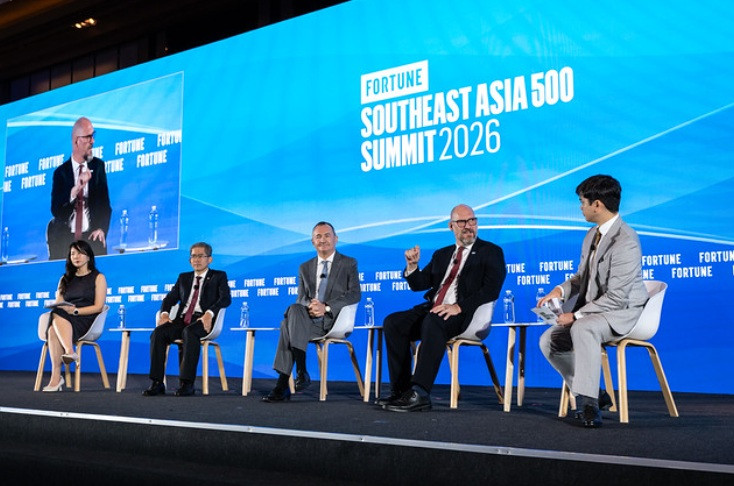
Panelists at the discussion on Vietnam's International Financial Center.
"VIFC is now ready to begin operations," he affirmed, adding that with a 5 to 10-year vision, he expects the center to handle capital flows reaching hundreds of billions of USD by providing a diverse range of products, services, and financial structures. However, to achieve that goal, VIFC needs a step-by-step development roadmap.
Therefore, instead of asking when the financial center will officially open, attention should be directed toward when each specific type of service can commence operations, as each sector has different requirements and implementation schedules.
In the short term, Mr. Richard D. McClellan highlighted three key milestones for VIFC-HCMC: first, completing the legal framework to establish a foundation for licensing banks and asset management entities; second, attracting businesses and financial institutions to register and join the system; and finally, bringing transactions into actual processing.
VIFC can contribute to dismantling policy and regulatory barriers affecting investment flows into Vietnam. However, it should be recognized that VIFC is not an independent entity standing outside the economy to support Vietnam, but rather a gateway that attracts and directs capital into the market. Investors do not necessarily have to invest directly in VIFC; they can invest in Vietnam through financial channels and structures established here.
Commenting on VIFC's overall role, Mr. Warrick Cleine MBE, Chairman and CEO of KPMG Vietnam & Cambodia, stated that Vietnam has created an economy open enough to attract capital into key projects and expand FDI flows. However, FDI is currently concentrated primarily in industrial projects. Therefore, Vietnam needs to continue restructuring its economy while guiding investment allocation to better align with reform programs and development goals in this new phase.
In this process, Mr. Warrick Cleine emphasized the International Financial Center's role in coordinating capital flows—not only into domestic projects but also in driving the comprehensive transformation of Vietnam's economy.
Mr. Pham Hong Hai, Deputy General Director of UOB Vietnam, shared that the Singaporean bank is currently constructing a building within the VIFC-HCMC area. This represents not just an infrastructure investment, but also a commitment to deep involvement in the market's development.
Mr. Hai noted that Vietnam holds many opportunities thanks to its high economic growth rate and deepening integration into global supply chains, with participation from enterprises from China, South Korea, Japan, the US, and Europe.
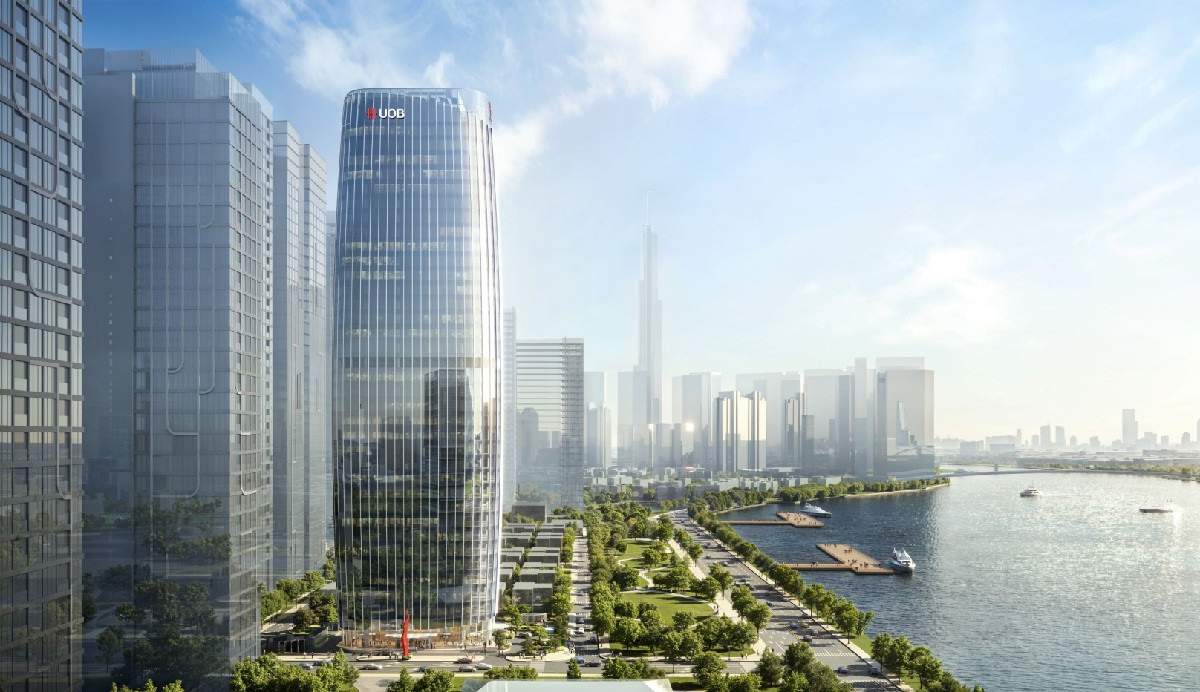
UOB Plaza Ho Chi Minh City building broke ground at VIFC - HCMC, marking a new milestone in the development of the international financial group in Vietnam. (Photo: UOB Vietnam).
According to him, UOB is currently collaborating with banks across ASEAN to assist foreign enterprises in expanding their operations in Vietnam, while also accompanying Vietnamese enterprises seeking to expand into international markets.
Capital control and attraction mechanisms
During the panel discussion, financial experts, bankers, and VIFC-HCMC executives also shared insights on the need for Vietnam to refine its operational mechanisms and legal framework for VIFC to effectively attract investment capital.
VIFC-HCMC must continue addressing issues related to capital management mechanisms, taxation, accounting standards, and cross-border currency convertibility, said Mr. Richard D. McClellan. The financial center executive noted that when entering the Vietnamese market, investors consider many factors, including the financial structure and operational methods of other regional IFCs, such as Singapore. Key issues that need clarification include reporting obligations, international accounting standards, tax structures, and capital management regulations.
"An International Financial Center is not a tax haven. Therefore, policies must be built on a balance between international standards and Vietnam's practical conditions," he emphasized.
Notably, regarding cross-border capital movement risks, Mr. Richard D. McClellan remarked that the view that "bringing money into Vietnam is easy, but transferring it out is hard" does not fully reflect Vietnam's current capital management mechanism. He noted that Vietnam has regulations controlling capital flows, and these regulations have a clear rationale. However, if investors choose the right investment channels and fully comply with approved procedures, transferring capital abroad is entirely feasible.
A more notable challenge lies in access to loan capital, particularly for large-scale projects. Mr. McClellan cited an example of a project needing to raise $2 billion, which would have to account for capital arrangement capabilities from banks in Vietnam, including issues related to credit granting criteria, regulatory rules, and the execution capacity of financial institutions. Therefore, he stressed that investors should work directly with financial and banking partners to understand capital mobilization mechanisms and applicable conditions.
Mr. Ashley Zhang, Chief Representative of the Institute of International Finance (IIF), evaluated that international financial centers serve three core functions, the most important being the mobilization of global capital, enhancing regional connectivity, and bridging financial gaps.
According to him, capital flows into emerging markets are increasingly volatile, influenced by institutional credibility, risk levels, and market conditions. For Vietnam, a capital gap of approximately $200 billion creates an urgent need to diversify capital mobilization and allocation channels to serve economic development.
"VIFC-HCMC should not be positioned as a direct competitor to established financial centers like Singapore or Hong Kong, but rather as a complementary link within the regional financial ecosystem.
ASEAN is actively building financial bridges, connecting domestic money and capital markets with international capital flows. To participate in this network, financial centers need to develop capabilities in capital coordination, payment processing, insurance, and multi-currency guarantees to meet cross-border investment and trade demands," the IIF Chief Representative concluded.
Author: LE MY - TRUONG DANG
RELATED TOPICS
RECOMMENDED TOPICS