VN
VN
 EN
EN
26/07/2026, 02:38
Business economics
Airport infrastructure investment to accelerate since 2022F
The airport infrastructure investment would be accelerated since 2022F. This would open up great opportunities for private investors, said VNDirect.

Long Thanh International airport (LTIA) has been officially assigned to ACV as the main developer in November 2020.
Solutions to the capacity shortage
The airfield assets maintenance project in Tan Son Nhat International airport (TIA) and Noi Bai International airport (NIA) with a total investment of VND4,000bn started in Jul-20 and has completed Phase 1 in Feb-21. Currently, the Airport Corporation of Vietnam (ACV) has finished 75% workload in Phase 2 of the project and expects to finish the whole project in Jan-22. Once completed, the project will help increase the exploitation capacity and prevent congestion when planes take off/land in TIA and NIA.
Besides the maintenance project in TIA and NIA, ACV is also preparing to start new projects in these key international airports to expand the capacity. In TIA, the Terminal 3 Tan Son Nhat is about to be started construction in Dec-21. T3 project is designed with a capacity of receiving 20 million passengers per year (67% of TIA’s designed capacity to total 50 million passengers per year) and is expected to help ease overload at terminal 1. The project has a total capital of VND10,990 billion. The feasibility study report on the construction of T3 has been completed in Dec-20, the engineering design has been completed in Mar-21.
The government has approved the Ministry of Defense to hand over the 16.05 ha of land in Tan Binh District’s Ward 4 of the project to ACV. ACV expects to finish the T3 project within 24 months. This would resolve the capacity shortage at TIA, which operated at 147% designed capacity in 2019 and might return to capacity shortage from 2022F.
ACV also finished the feasibility study report on the expansion of Noi Bai International Airport Terminal 2 from 10m p.a to 15m p.a (raising the total designed capacity of NIA from 25m p.a to 30m p.a) with a total investment of VND4.983bn. ACV has submitted the study report to the Ministry of Transportation (MOT) in October 2021. The project is expected to start construction in 4Q22 and finished in 3Q24. The project will help resolve the capacity shortage in NIA, which operated at 117% designed capacity in 2019 and is expected to operate at a higher utilization rate in 2022F.
Meanwhile, Long Thanh International airport (LTIA) has been officially assigned to ACV as the main developer in Nov-20. The total investment of LTIA is about US$15bn with a total capacity of 100m pax. The project includes 3 phases, in which phase 1 can serve 25m pax throughput with the investment cost of US$4.3bn (VND99,000bn). ACV has started the construction of phase 1 in December 2020 and expects to complete it in FY25F. The current progress construction of the project is as follows:
Opportunities for private investors
In August 2021, the Ministry of Transport (MOT) has submitted a plan for mobilizing social resources to invest in aviation structure. The most important change in the plan is the decentralization of investment approvals at airports to localities to actively manage the socialization of investment, thereby reducing pressure on State capital. In the plan, MOT proposed to decentralize the management of airports into three groups based on the importance of each airport:
As for group 1, national important international airports include Noi Bai, Da Nang, Cam Ranh, Tan Son Nhat, Phu Quoc and Long Thanh. The government through MOT and the Committee for Management of State Capital at Enterprises continues to own and assign ACV to manage, exploit and mobilize resources to investment.
With regards to group 2, airports are operating with a mixture of civil and military purposes including Tho Xuan, Chu Lai, Phu Cat, Tuy Hoa. The government through MOT, Ministry of Defense, and the Committee for Management of State Capital at Enterprises continues to own and assign ACV to manage, exploit and mobilize resources to investment.
Group 3 includes the remaining airports. The government plans to transfer the land use rights and ownership of aviation infrastructure at these airports to the People’s Committee of provinces to actively manage these airports, to maximize the potential, advantages, and resources of localities to develop these airports. According to the plan, MOT expects total private investment capital in 2021- 2030 to rise 5.1x times to VND141,193bn compared to the 2010-2020 period, the proportion of private capital in total investment in aviation structure also increases to 45.3% in the 2021-2030F period from 25.7% in 2010-2020 period.
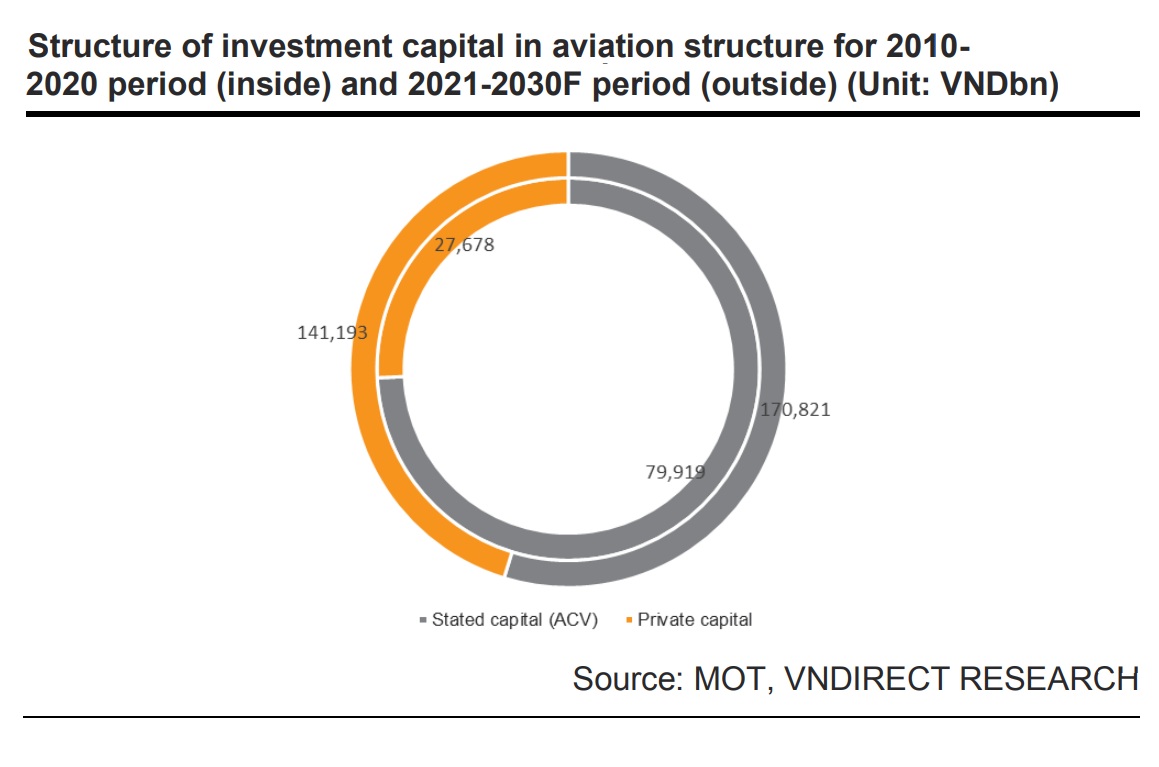
According to the government’s air transportation master plan, until 2030F Vietnam, there will be 28 airports including 15 domestic airports and 13 international airports (from 22 airports including 13 domestic airports and 9 international airports in 2021). Four new international airports until 2030F include LTIA and 3 upgraded domestic airports (Tho Xuan, Vinh, Chu Lai). Five new domestic airports will be developed, in which four airports are invested through BOT which are Phan Thiet, Quang Tri, Sapa, Lai Chau while Na San will be developed by ACV.
Private capital for upgrading some remaining airports that are estimated at VND76,500bn until 2030F is attracting investors. VNDirect believed these plans would open up great opportunities for private investors to engage deeply in the aviation infrastructure segment in the 2021-2030F period.
Positive long-term outlook
Given the airport infrastructure upgraded to free the bottleneck of capacity shortage and new airports to be developed until 2030F, the government expects total passenger volume throughput to increase by 9.6% p.a. in FY19- 30F, in which domestic passenger volume throughput would increase by 9.8% p.a. Meanwhile, international passenger volume would increase by 9.2% p.a., in a base-case scenario.
The government is also making a small allowance for both downside risk and upside risk of FY19-30F total traffic CAGR with an absolute value of 0.7% points. VNDirect believes this is an achievable growth because, besides the improving capacity at Vietnam’s airports, the potential growth of Vietnam air traffic demand is also huge, given the strong growth of Vietnam aviation in the past.
Author: NGOC ANH
RECOMMENDED TOPICS