VN
VN
 EN
EN
16/07/2026, 02:00
Business economics
ASEAN Perspectives: Whoever gets the chips rules the trade
Thanks to the AI boom, tech-exposed economies like Singapore, Malaysia and Vietnam are better positioned in trade.
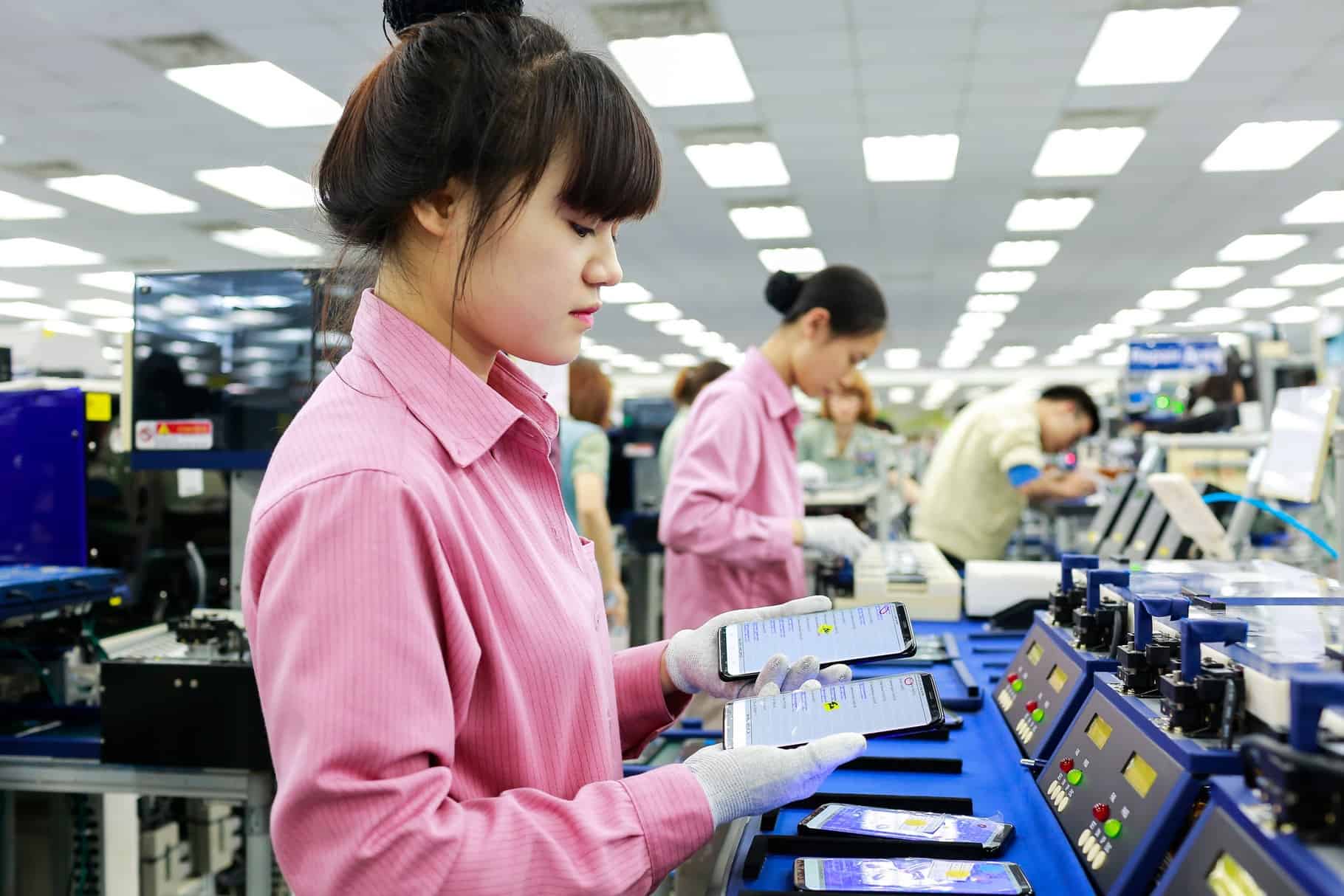
Manufacturing at Samsung Vietnam
ASEAN’s increasing share of the global electronics export market is one of the many good reasons to believe the region is in an advantageous position to benefit from the AI-driven tech upturn. HSBC maps a comprehensive overview of ASEAN’s electronics weights. Singapore, Malaysia, and Vietnam stand out naturally given their heavy exposure to the electronics industry. This is followed by Thailand and the Philippines, which are among the early developers but have seen stagnating development in recent years. Indonesia, on the other hand, has minimal exposure.
But we also need to delve into details, as exporting the “right” products that are in high demand is crucial. In today’s AI-driven world, memory chips have gained more prominence, as they are key for storing and retrieving vast volumes of data quickly and efficiently for powerful AI processors. True enough, Korea (28% global share) and mainland China (27%) are the frontrunners in the advanced semiconductor space.
In ASEAN, in HSBC’s view, Singapore is the only economy with a sizeable share of memory chips. Thanks to an accumulative USD40bn of investments since 1998 from the US tech giant Micron, which produces 98% of its 3D NAND chips in Singapore, the Lion City possesses 8.5% of the global share. Singapore is set to benefit even more, as Micron has announced an exit from its consumer business to double down on advanced memory chips used in AI data centres with an investment of SGD30.5bn.
But this is not the only semiconductor space where Singapore has an edge. It also has an advantage in logic chips, traditionally known as the ‘brains’ in electronic devices. Long dominant in this space, Singapore now accounts for 15% of the global processor chip and close to 20% of global amplifier chip exports.
Across the Causeway, Malaysia also stands out as an early mover in the semiconductor landscape. While it may not be a widely known story, MNC tech giants poured investments in as early as the 1970s, turning Penang into the “Silicon Vally in the East”. Despite not being a major player in memory chips, Malaysia is a leading player in logic chips. The country alone accounts for 10% of global processor chip and 16% of amplifier chips exports – the latter has seen a growing market share in recent years. But more strikingly, Malaysia almost doubled its share in parts of integrated circuits (ICs) in a year, lifting its share to an impressive 40% by 2024.
“When Singapore and Malaysia are leading ASEAN in their semiconductor exports, Thailand and Vietnam also have their own edge outside of semiconductors. For example, Thailand specializes in the hard-disk drives (HDD) space. It accounts for 17% of global storage units for automatic data-processing machines, comparable to the EU and just dwarfed by mainland China”, said HSBC.
While its value cannot be compared to semiconductors, it has gained more significance as one of the key elements required in the rapid expansion of data centres. Singapore has traditionally been host to ASEAN’s data centres, but Malaysia and Thailand have emerged to catch up quickly. But for Thailand, to reap the benefits of the AI wave, it is vital to transform from exporting hard disk drives (HDDs) to solid-state drives (SSDs), as the latter provides faster data access speeds and reduced latency than traditional HDDs.
But in HSBC’s view, Vietnam is choosing a different path: it has elevated its importance in final electronics assembly, specialising in finished consumer electronics, thanks to supply chain diversification from tech MNCs like Samsung. While mainland China remains in the dominant position for many of these exports, Vietnam’s share of consumer electronics, including smartphone, printers and computers, has seen a notable jump from almost none to 8-15% in 15 years. Besides consumer electronics, Vietnam also strives to climb up the value chain, targeting the IC segment. However, unlike Singapore and Malaysia, it has seen a dwindling share of global processor chips, despite billions of dollars of investment from Intel.
Alas, ASEAN’s positive structural gains in the tech landscape does not come without risks. If the Middle East conflict is prolonged and energy prices don’t come down soon, it will push up production costs for chip makers and ultimately affect AI-related demand. On top of that, the fate of potential sectoral tariffs on semiconductors continues to serve as the Sword of Damocles. HSBC has discussed extensively previously that if this were to be implemented, this would pose more downside risks to trade for tech-exposed economies like Vietnam, Malaysia and Thailand, whose electronics exports to the US are sizeable as a percentage of their respective GDP.
“While ASEAN needs to buckle up to weather near-term energy volatilities, we see pockets of trade opportunities for those who have strengthened their positions in the tech supply chain. But there is no room for complacency, as the same tech-exposed economies are trying to avoid being the victims of their own success in the event the AI boom is disrupted by sustained high energy prices and potential tariff verdicts”, emphasized HSBC.
Author: NGOC ANH
RECOMMENDED TOPICS