VN
VN
 EN
EN
15/07/2026, 09:53
Business economics
Breakthroughs in Ha Noi’s digital technology industry
Recognising the digital technology industry as a key economic sector, Ha Noi is actively leveraging its strengths and reforming its methods of operation to achieve breakthroughs one step at a time. Digital technology products and services are increasingly bringing visible changes across all sectors.
Tran Thu Phuong, a resident of Cua Nam Ward, said: “Since the city put its Intelligent Traffic Control Centre and AI-powered traffic surveillance camera system into operation, I have noticed that people are complying with traffic rules much better than before.”
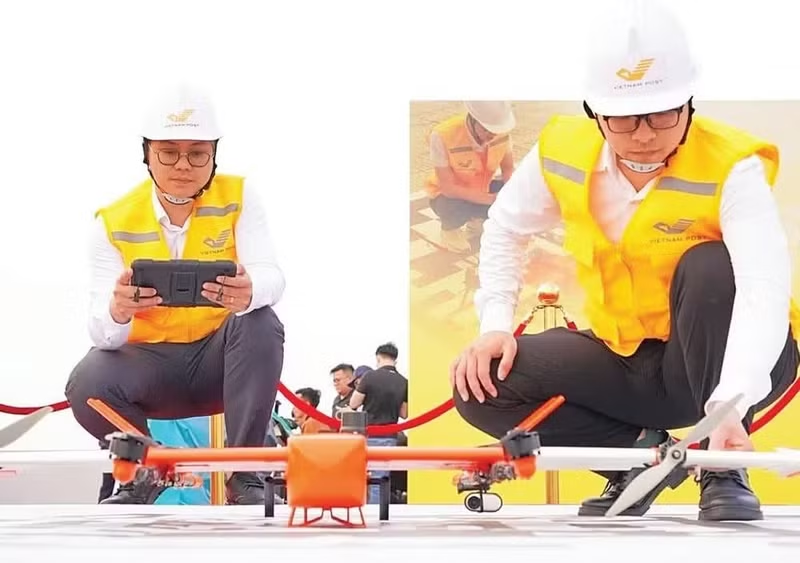
Recently, Duc Giang General Hospital has begun using unmanned aerial vehicles (UAVs) to transport biological samples, medicines, and medical supplies. The drones can travel at speeds of up to 60 kilometres per hour, operate within a 15-kilometre radius, and are equipped with real-time monitoring cameras. They help shorten transport times, particularly during emergencies, natural disasters, and traffic disruptions.
The digital technology industry is an economic and technical sector built on the integration of science and technology, innovation, and digital transformation to create digital technology products and services.
In early 2026, to establish a new development space for the sector, the Ha Noi government and the technology company FPT commenced construction of a digital technology and mixed-use park in Tay Tuu Ward and Phu Dien Ward, with a total investment of over 50 trillion VND (1.9 billion USD).
The core of the project is a concentrated digital technology park for innovation and digital transformation covering approximately 168.9 hectares.
It will host research, development, and production activities for key digital technology products and services, including digital data, artificial intelligence, big data, the Internet of Things (IoT), blockchain, and the metaverse.
The project will also accommodate educational institutions, technology incubators, and collaborative spaces linking research institutes, universities, and businesses.
According to Ha Noi Vice Chairman Truong Viet Dung, the digital technology park is intended to become a key pillar of the capital city’s innovation ecosystem, supporting the goal of transforming Ha Noi into one of the nation’s leading centres for science and technology and the digital economy.
At the same time, Ha Noi is attracting a series of major projects in the digital technology industry. Most notably, a semiconductor chip manufacturing plant developed by Viettel Group recently broke ground on a 27-hectare site in the Hoa Lac Hi-Tech Park. The facility is expected to serve strategic national industries such as aerospace, telecommunications, IoT, and automation.
In the second quarter of 2026, Viettel is also expected to begin operating the first phase of the An Khanh Data Centre, with a total investment of 17.5 trillion VND (665 million USD).
More recently, MITAC Viet Nam inaugurated a high-tech manufacturing complex at the South Ha Noi Supporting Industrial Park, with an initial investment of 66 million USD. The complex specialises in producing electronic components as well as assembling motherboards for cameras, tablet computers, and IoT devices.
According to Billy Ho, Chief Executive Officer of MITAC Holdings Corporation, the company will focus on cloud computing and artificial intelligence in the next phase, with the aim of developing highly practical technology products for international markets and mainstream consumers.
As part of efforts to implement a Politburo resolution on Ha Noi’s development in the new era, the city has decided to allocate 4% of its total budget expenditure to science and technology, innovation, and digital transformation, higher than the minimum of 3% stipulated by the National Assembly.
The city has also launched the Ha Noi Technology Exchange (HanoTEX), the DTMarket Digital Transformation Marketplace, and the Ha Noi Innovation Centre Joint Stock Company.
Cu Ngoc Trang, Director of the Ha Noi Department of Science and Technology, noted that while the supply of technologies is growing rapidly, the capacity for transactions, commercialisation, and diffusion remains limited.
One reason is the lack of a well-organised, transparent market with mechanisms that foster trust. Therefore, the city is not limiting itself to policy-making and is also taking a more proactive role in directly organising and operating the technology market.
To make more effective use of scientific and technological resources, the city has announced a list of 30 grand challenges addressing bottlenecks related to urban development, economic growth, and social welfare. These challenges are designed to promote the application and mastery of emerging and strategic technologies such as artificial intelligence, IoT, big data, semiconductors, and 5G/6G networks.
The objective is not merely to apply technology but also to create new products, services, and economic models capable of generating practical value across sectors and addressing the challenges facing the city.
On that basis, the Ha Noi Department of Science and Technology is strengthening cooperation with leading universities and directly commissioning solutions to the capital’s grand challenges, with the aim of developing technology products that can be applied immediately during the 2026-2030 period and will contribute positively to the development of both the capital and the nation.
Author: NDO
RECOMMENDED TOPICS