VN
VN
 EN
EN
10/07/2026, 02:38
Business economics
Improving Institutions to Advance Vietnam’s Value Chains
Vietnam is entering a critical stage where reforming its growth model is no longer optional but urgently necessary. This phase focuses on a “revolution” in policy effectiveness and governance quality, where responsiveness and the ability to use data will determine national competitiveness.
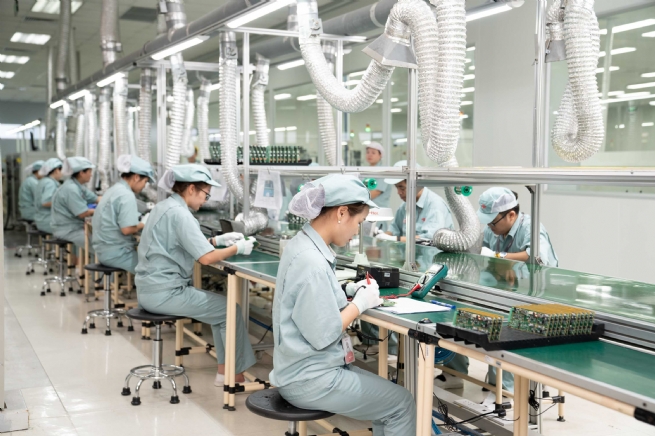
Resolution 57-NQ/TW is viewed as the driver of new productive forces
The consecutive issuance of key resolutions, including Resolution 57, Resolution 79, and Resolution 80, demonstrates Vietnam’s determination to turn institutions and data into strategic strengths. As the global economy becomes more multipolar and highly competitive, this direction is considered essential for helping Vietnam move beyond the middle-income trap and build momentum for a new development cycle.
In modern economics, infrastructure now extends beyond “electricity, roads, schools, and clinics” to include data systems and enabling institutions. For the first time, Resolution 79-NQ/TW requires data to be treated as a strategic resource, equal to land and minerals, a change that reshapes the foundation of development.
At the same time, the Government’s role is shifting from “management” and “licensing” to “service” and “commitment.” The use of Service Level Agreements (SLA) with businesses reflects this approach, with clear timelines for handling administrative procedures, land approvals, customs clearance, and tax refunds. Experts note that when institutions move slowly, opportunity costs reduce the effectiveness of investment. Cutting administrative procedures by just 10-15% could significantly improve the efficiency of social capital use, creating room for stronger growth.
The official launch of the National Data Center has laid the foundation for an interconnected system linking land, tax, and customs data, helping reduce uncertainty costs for businesses. If physical infrastructure supports the movement of goods, digital infrastructure acts as an “information highway,” a key condition for restructuring national supply chains in an era when trade depends on data and algorithms.
Resolution 57-NQ/TW is viewed as the driver of new productive forces, as it formally identifies science, technology, and digital transformation as pillars of growth rather than supporting sectors. Unlike previous slogans, this resolution is supported by clear and coordinated governance mechanisms, addressing inconsistencies between central and local policy implementation.
After just one year of implementation, a series of directives and official dispatches were issued to remove bottlenecks, delivering measurable results: telecommunications infrastructure and internet speeds improved significantly, placing Vietnam among global leaders in fixed broadband. The digital economy’s share in 2025 is estimated at 18.72% of GDP, close to the 20% target. Notably, Resolution 193/2025/QH15 allows the Government to use the budget as “seed capital,” sharing risks with enterprises in strategic sectors such as semiconductors and AI. Decree 180/2025/ND-CP on public-private partnerships in science and technology has created a new policy framework, enabling domestic enterprises to move into higher value-added stages such as R&D and design, instead of remaining in assembly and processing.
To join global value chains, technology is necessary but not sufficient. Resolution 80-NQ/TW on cultural development adds another dimension to competitiveness. Building a generation of entrepreneurs grounded in Vietnamese business ethics, and developing cultural and digital content industries, is strengthening the country’s “soft power.”
Dr. Pham Anh Tuan, Deputy Director of the Institute of Vietnam and World Economy, suggests establishing a controlled regulatory sandbox for AI, blockchain, data, and digital finance, along with greater investment in training a high-tech workforce. At the same time, strategic capital should be mobilized from both the public and private sectors; innovation funds and a national semiconductor fund should be established; and Public-Private Partnership (PPP) models should be expanded for key projects. The development of innovation centers and high-tech parks in Hanoi, Ho Chi Minh City, Da Nang, and the southern key economic regions should be closely linked with deeper international cooperation in technology transfer, technology security, and national data standards.
In addition, the shift toward green growth under a circular economy model has become a requirement of international markets. Financial support policies and preferential credit under Decision 29/2025/QD-TTg for STEM students and enterprises investing in green technology are helping domestic mechanical engineering firms adjust their operations. Optimizing processes, reducing waste, and improving energy efficiency not only lower production costs but also serve as a “ticket” for Vietnamese enterprises to join the supply chains of multinational corporations with strict ESG (Environmental - Social - Governance) standards.
The Government has also strengthened the use of Key Performance Indicators (KPIs) in public administration, recognizing that without measuring the effectiveness of each policy and each ministry, resources cannot be used efficiently. The year 2026 has been defined as a shift from “launch” to “deep implementation,” requiring the highest level of execution discipline from the central government to local authorities.
Achieving double-digit growth and restructuring national supply chains requires comprehensive solutions: modern institutions, synchronized digital infrastructure, and an innovative workforce. The new resolutions have set the strategic direction; what remains is effective implementation and alignment within the business community. When policy truly moves from paperwork to practice, Vietnam can emerge as a sustainable, self-reliant, and distinctive value hub in the global digital era.
Author: VBF
RECOMMENDED TOPICS