VN
VN
 EN
EN
09/07/2026, 11:15
Investment
Industrial park infrastructure demand surges amid land constraints
As industrial land in many key localities becomes increasingly scarce, expanding development space and improving infrastructure quality have become urgent priorities to maintain investment appeal. Seizing this trend, several domestic enterprises have taken early steps to deepen their involvement in industrial park development, helping to supplement the market with high-quality infrastructure supply.
Land constraints and the need for in-depth development
The northern region continues to serve as a major manufacturing hub of the country, with provinces such as Bac Ninh, Hai Phong, and Thai Nguyen consistently ranking among the top in attracting foreign direct investment (FDI). By the end of 2025, Bac Ninh alone had attracted over 46.8 billion USD in cumulative FDI, with the presence of major corporations such as Samsung, Amkor, Foxconn, and Canon, forming a large-scale and highly interconnected production ecosystem.
However, rapid development has also placed pressure on industrial land availability. In many key industrial parks, occupancy rates have reached high levels, while demand for production expansion and new investment continues to grow. This necessitates not only expanding development space but also improving land-use efficiency and infrastructure quality.
In this context, the expansion of administrative boundaries following the merger of Bac Ninh and Bac Giang has created a new, larger development space, particularly in previously bordering areas. This not only adds industrial land but also opens up opportunities to restructure development space along regional connectivity lines, forming more integrated industrial–urban–service corridors.
This is seen as a dual advantage, allowing the locality to leverage its existing industrial foundation while gaining room to plan next-generation industrial parks in a more synchronised and modern manner, meeting the increasingly stringent requirements of international investors.
Creating new momentum for modern industrial park development
Alongside local development orientations, the role of enterprises in investing in industrial park infrastructure is becoming increasingly prominent. Notably, some companies with a background in infrastructure construction have gradually expanded into industrial real estate development, adopting a structured and sustainability-oriented approach.
Among them, FECON has been steadily advancing into this promising sector. With experience in delivering large-scale technical infrastructure projects, particularly in foundations and underground works, the company holds advantages in developing projects with high technical and quality requirements.
Beyond focusing solely on land, FECON Invest—part of the FECON ecosystem—aims to develop industrial parks based on an integrated model, linking production infrastructure, support services, and urban space. This approach seeks to better serve the growing workforce in industrial zones and meet the needs of both domestic and international investors.
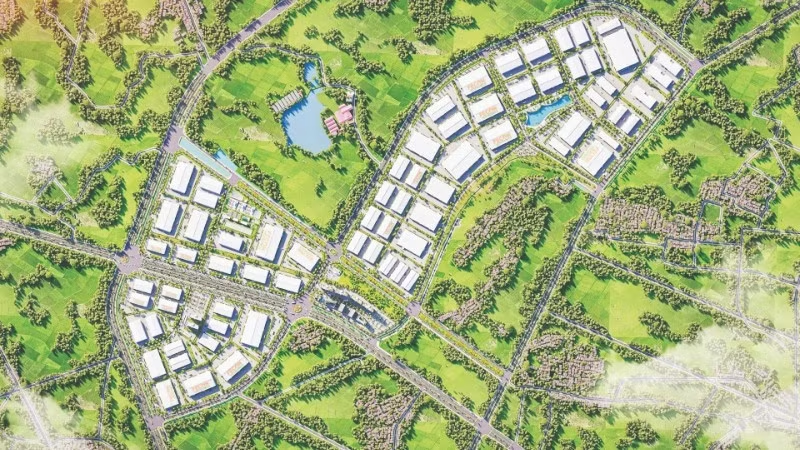
Since 2025, FECON Invest has commenced construction of the FECON IP Hiep Hoa Industrial Cluster, covering 75 hectares, marking its first step in an industrial real estate development strategy. Continuing this direction, the FECON IP Hoa Yen Industrial Park is set to break ground in early April, demonstrating the company’s consistent investment strategy in Bac Ninh—a locality with strong growth potential following boundary expansion.
The FECON IP Hoa Yen Industrial Park project spans 256.68 hectares and is planned as a multi-sector industrial park, prioritising high-tech industries, processing and manufacturing, and environmentally friendly production sectors. The project also integrates a neighbouring urban service area with full social infrastructure, contributing to the development of a comprehensive ecosystem.
This approach reflects a shift in industrial park development thinking—from merely providing production space to creating a holistic socio-economic environment. This is also a key factor in enhancing attractiveness to investors, particularly amid intensifying competition for FDI among localities.
The participation of capable enterprises not only adds high-quality industrial infrastructure supply but also supports localities in realising modern and sustainable industrial development strategies.
In the long term, as local planning orientations and corporate investment strategies are implemented in sync, new industrial spaces will gradually take shape with higher quality, better connectivity, and greater added value.
Viet Nam continues to be a destination for global investment flows and supply chains. The development of green, synchronised, and modern industrial parks, integrated with urban areas and services, is expected to create new growth drivers, enhance the competitiveness of the northern region, and promote balanced and sustainable economic, social, and environmental development.
Author: NDO
RECOMMENDED TOPICS