VN
VN
 EN
EN
26/07/2026, 02:38
Business economics
Opportunities to boost economic momentum
Viet Nam’s GDP in the first quarter of 2026 grew by 7.83%, considered a bright spot amid global economic volatility. Leveraging drivers such as public investment, domestic consumption, exports and the shifting supply chain wave will be key factors in strengthening economic momentum in the time ahead.
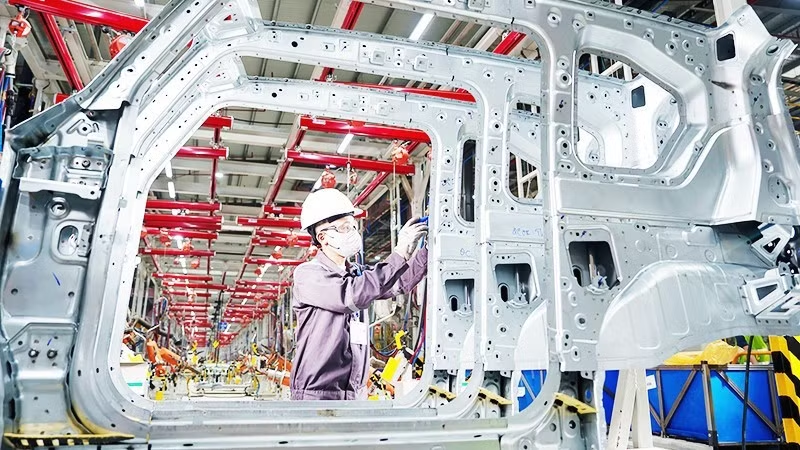
Looking back at the first quarter of the first quarter of 2025, GDP growth was only 7.07%. Typically, the first quarter records the lowest growth, while the third and fourth quarters are the acceleration phase of the economy.
Bright spots on the growth map
Assessing the first quarter of 2026, according to Nguyen Thi Mai Hanh, Head of the National Accounts System Department under the General Statistics Office, the failure to reach the 9.1% growth target stemmed from multiple causes. Geopolitical tensions in the Middle East increased risks to the global energy market, pushing up oil prices and input fuel costs, thereby raising production costs for businesses. This impact was most evident in energy-intensive sectors such as transport, logistics and manufacturing, and also indirectly affected construction, trade and services. Rising input costs alongside incomplete demand recovery narrowed profit margins, forcing businesses to be more cautious in expanding production and investment.
In this context, unresolved internal bottlenecks have weakened the economy’s ability to absorb and convert growth drivers. Domestic capacity still shows limitations, reflected in low labour productivity, weak business competitiveness and modest participation in global value chains. The business environment and institutional framework have yet to make a strong breakthrough to effectively support production, investment and business activities.
However, several key sectors continued to add positive colour to the overall economic picture. The processing and manufacturing industry maintained strong growth, while export activities remained vibrant, providing a solid foundation for domestic production.
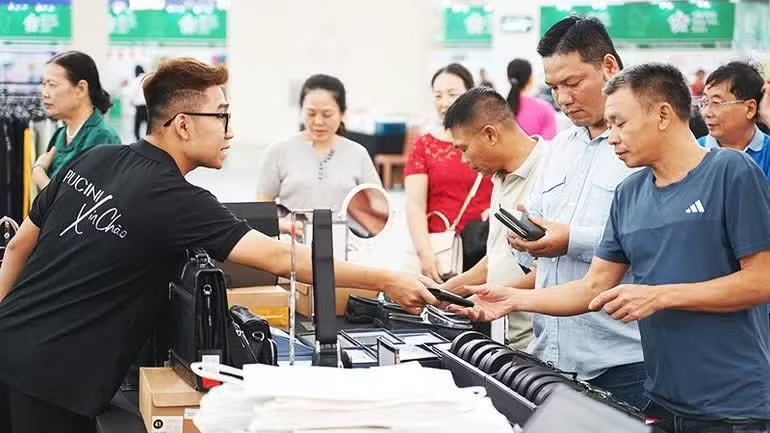
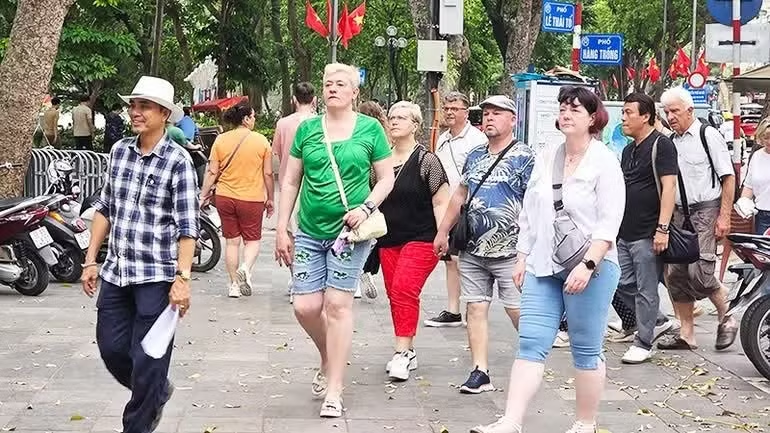
Notably, consumption demand was significantly boosted by seasonal effects from the extended Lunar New Year holiday. Household consumption played a fundamental and leading role. This was reflected in strong growth in total retail sales of goods and consumer service revenue, estimated at around 10.9% (7% excluding price increases), while international arrivals to Viet Nam rose sharply, reaching nearly 6.8 million in Q1, up 12.4% year-on-year.
“The positive recovery of domestic consumption and tourism has effectively offset adverse fluctuations from external markets,” Hanh noted.
Strengthening investor confidence
According to calculations by the General Statistics Office, to achieve the full-year growth target under Resolution 01, the economy must make significant efforts in the remaining quarters, with quarterly growth exceeding 10.5%. Public investment continues to serve as seed capital driving long-term production capacity, particularly through mega infrastructure projects such as Long Thanh International Airport, high-speed railways, ring roads and expressways. These are not merely government expenditures but also a process of productive accumulation for the economy, helping reduce logistics costs, attract foreign direct investment (FDI) and private investment into surrounding satellite areas.
Domestic consumption is expected to improve thanks to wage reform policies and consumption stimulus programmes implemented by provinces and cities nationwide. Strong activation of purchasing power in a market of over 100 million people will drive the development of services, accommodation, food services and e-commerce, ensuring the domestic economic cycle remains resilient even when exports face difficulties.
Flexible fiscal policy, combined with monetary policy, will serve as an effective risk management tool. Proactive use of fuel tax instruments and the price stabilisation fund acts as a “safety valve” to curb cost-push inflation. By controlling energy price increases, the Government directly supports profit margins for transport and manufacturing businesses, preventing ripple effects on the general price level, thereby protecting consumer purchasing power and macroeconomic stability.
At the same time, leveraging free trade agreements (FTAs) and the global supply chain shift will benefit key sectors such as electronics, components and green textiles. If effectively implemented, these sectors will serve as major sources of foreign currency, helping stabilise the balance of payments and promote industrial production.
The application of AI and automation is no longer just a trend but a necessity. Amid fluctuating input material prices, technology enables manufacturers to shift from labour-intensive to knowledge-intensive models, directly improving total factor productivity (TFP) and creating new growth space through digital business models.
From a cautious perspective, Dr. Can Van Luc, Chief Economist of BIDV, noted that the global situation remains complex, and Viet Nam’s export growth for the year is likely to fall short of initial expectations. Exports in 2026 may grow by around 10–12% (compared to a target of about 16%) due to weak global demand, potential supply chain disruptions and rising inflationary pressures. Imports and foreign investment inflows are also expected to grow more slowly than planned. Achieving a 10% GDP growth target this year will therefore be highly challenging.
In the short term, priority should be given to preventing oil price shocks and supply chain disruptions from turning into major inflationary shocks. A rapid response team should be established, with contingency scenarios to ensure sufficient fuel supply, diversify oil and gas imports, and strengthen inspections to prevent speculation, hoarding and unreasonable price increases.
According to the General Statistics Office, in the first quarter of 2026, the agriculture, forestry and fisheries sector grew by 3.58%, contributing 5.6% to total gross value added; the industry and construction sector grew by 8.92%, contributing 44.08%; and the services sector grew by 8.18%, contributing 50.32%.
In the medium and long term, the focus should be on strengthening energy security through supply diversification, increasing strategic reserves, promoting energy efficiency, accelerating the implementation of the revised Power Development Plan VIII, and completing the legal framework for the energy market in general, and oil and gas in particular, to enhance strategic autonomy and energy security.
From a macroeconomic perspective, it is necessary to develop growth and inflation scenarios aligned with different policy responses. At the same time, timely support mechanisms should be introduced for businesses and sectors heavily affected by rising fuel, transport, insurance and input costs. This is considered a foundation for Viet Nam to maintain growth momentum, seize recovery opportunities and proactively respond to global economic fluctuations.
According to Prof. Dr. Hoang Van Cuong, a member of the 15th National Assembly, geopolitical tensions in the Middle East may also present new opportunities for Viet Nam. As investment environments in some regions become less stable, Viet Nam can leverage its political and economic stability to attract international capital, particularly in finance as new international financial centres are being formed. Changes in global supply chains and trade markets may also enable Viet Nam to expand exports to the Middle East.
In the current context, Viet Nam needs to maintain macroeconomic stability, keep inflation under control and ensure relative exchange rate stability. These are key factors in strengthening investor confidence, reducing concerns over external shocks, and laying the foundation for sustaining economic growth.
Author: NDO
RECOMMENDED TOPICS