VN
VN
 EN
EN
23/07/2026, 02:00
Business economics
Removing bottlenecks for cooperatives to accelerate growth
Resolution No. 68-NQ/TW on the development of the private economic sector has opened up opportunities for deeper linkages with the private sector, placing cooperatives under pressure to reform governance, undergo digital transformation, and participate in the market with the mindset of a modern economic entity.
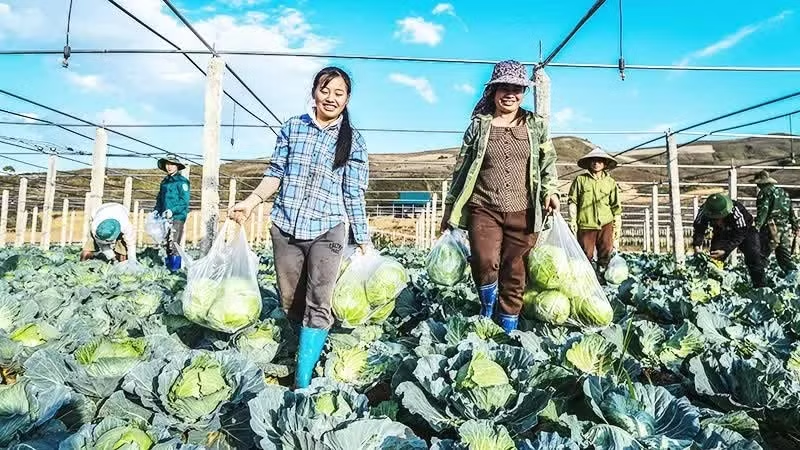
During the early days of the bamboo shoot harvest season in Binh Minh Commune, Quang Ngai Province, the atmosphere at Binh Minh Agricultural Cooperative was rather subdued. Bags of sesame and peanuts stored by local residents still lay idle awaiting traders. Plans to build a processing and packaging area and install a new technology oil-pressing production line remain unfinished.
Under Decision No. 641 issued by Quang Ngai Province in 2024, the cooperative had previously been approved for support worth more than 2.8 billion VND for trade promotion, warehouse and workshop investment, bamboo shoot processing, and installation of a modern production line. Seizing the opportunity, Binh Minh proactively leased land, developed machinery investment plans, and sought product consumption partners. “The entire implementation plan fell into confusion because we had already prepared everything, but in the end could not carry it out due to a lack of capital to build the factory,” said Vo Xuan Anh, Director of the cooperative.
Behind the story of one local cooperative lies the shared concern of thousands of cooperatives nationwide: how to secure a place in linkage chains with the private economy when resources remain limited, production fragmented, and competitiveness still low.
Cooperatives: “Soft infrastructure” in new context
Politburo Resolution No. 68-NQ/TW identifies the private economy as an important driver of the national economy. From this Resolution emerges a question: where will cooperatives stand and how will they connect to participate in new value chains?
According to the Viet Nam Cooperative Alliance, agricultural cooperatives account for around 67%, continuing to play an important role in rural development and organising production for farmers. However, only about 4,700 cooperatives participate in value linkage chains, equivalent to less than 20%. Cao Xuan Thu Van, Chairwoman of the Viet Nam Cooperative Alliance, said that in the current context, no economic sector can develop independently. Enterprises need stable raw material areas, while farmers need sustainable output markets. Meanwhile, technology requires an application environment, and finance needs feasible and transparent business models. “If they cannot participate in linkage chains, most cooperatives will remain trapped in the vicious circle of ‘small-scale production — low value — high risk’,” Van stressed.
That reality is visible in many localities. Many cooperatives still mainly stop at raw material production, lacking deep processing, lacking brands, and heavily dependent on traders. Mai Thi Thu from the Ha Noi Farmers Support Centre said many cooperatives currently “can grow products but cannot sell them” because they cannot forecast markets and have no specialised trade promotion departments.
According to Nguyen Thi Hoang Yen, Deputy Head of the Department of Cooperatives and Rural Development under the Ministry of Agriculture and Environment, fragmented production is a major bottleneck causing enterprises to remain hesitant about investing in agriculture. When raw material areas are small and scattered, production costs rise, quality becomes difficult to control, and increasingly stringent export market standards become harder to meet. Moreover, risks from natural disasters, diseases, and market fluctuations also make linkage chains vulnerable to disruption.
Yen said there needs to be a shift from isolated linkages to integrated ecosystem building. Enterprises will play the role of market leaders, while cooperatives serve as the foundation for organising production. In her analogy, enterprises are the “hard infrastructure” with logistics, processing and markets, while cooperatives are the “soft infrastructure,” directly connecting farmers, standardising processes and maintaining stable raw material areas.
In the Mekong Delta, many rice cooperatives have linked with enterprises to participate in the one-million-hectare high-quality, low-emission rice project. Farmers no longer produce spontaneously but cultivate according to orders and technical standards while receiving guaranteed output markets. In Son La and Lam Dong, many agricultural cooperatives have applied electronic diaries, traceability systems, e-commerce sales, and partnerships with major supermarket chains.
These models show that when organised systematically and connected in the right direction, cooperatives can fully create higher added value for Vietnamese agricultural products.
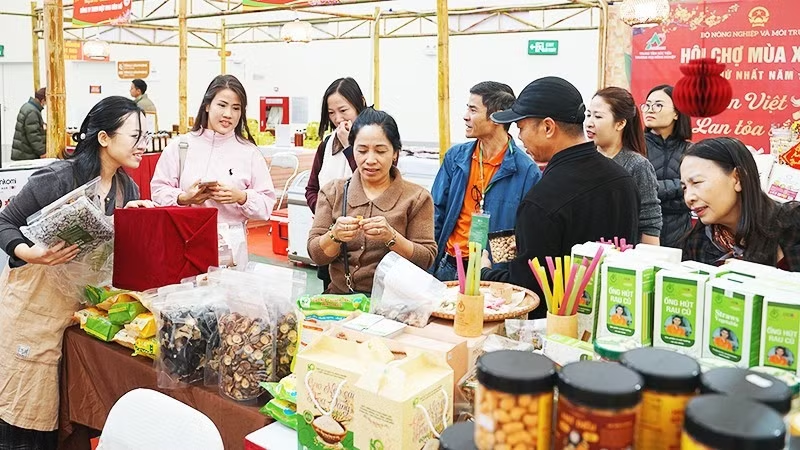
The goal of becoming genuine economic entities
According to Nguyen Quang Hoa, Head of the Rural Development Sub-department of Quang Ngai Province, after policies were approved, funding had not yet been supplemented with target allocations, causing difficulties for local authorities in supporting cooperatives. Capital has become a chronic bottleneck preventing the transition from small-scale production to modern value chains. Meanwhile, the market is changing very rapidly. Without timely investment in technology, processing, and digital transformation, cooperatives will struggle to compete even in the domestic market.
From a financial perspective, Deputy Governor of the State Bank of Viet Nam Nguyen Ngoc Canh said the banking sector has implemented many solutions to unblock capital flows for the cooperative sector. Currently, short-term lending interest rates for priority sectors, including cooperatives, stand at around 4% per year. Unsecured loan limits have also been raised to 5 billion VND for cooperatives, while high-tech agricultural projects can borrow up to 70–80% of project value.
However, access to capital remains difficult because many cooperatives are small-scale, lack financial transparency, and have not built sustainable linkage chains. Many experts believe that for cooperatives to participate deeply in the private economic ecosystem, the most important requirement is improving institutions and creating a transparent and stable linkage environment. Do Manh Khoi, Deputy Head of the Department of Private Enterprise and Collective Economy Development under the Ministry of Finance, said linkages between cooperatives and enterprises are a symbiotic relationship. For enterprises, cooperatives help form stable raw material areas, reduce costs, and meet market standards. In return, enterprises bring technology, capital, governance, and markets to cooperatives.
To promote these linkages, it is necessary to reform administrative procedures, develop public-private partnership mechanisms, formulate value chain-based policies, and promote digital and green transformation. More importantly, intermediary organisations such as the Viet Nam Cooperative Alliance and the Viet Nam Chamber of Commerce and Industry (VCCI) need to strengthen their roles in market connectivity and governance support for cooperatives. “Nearly 80 years ago, President Ho Chi Minh affirmed that cooperatives were the way for people to ‘pool their strength and capital together to do business’,” Khoi recalled.
Cao Xuan Thu Van emphasised that this spirit remains fully relevant today, though in an entirely different context. “Market pressure is opening up major opportunities for the cooperative economic sector. If cooperatives previously mainly solved the problem of mutual support in production, they now must operate with the mindset of a modern economic entity that understands governance, linkages, branding and competition,” Van said.
In the new development trend, cooperatives can no longer merely play a role in supporting production but must become genuine economic entities within linkage chains with private enterprises. Only then can the cooperative economy truly become an important link in the ecosystem connecting the collective economy and the private economy. Ultimately, value lies not only in output but also in competitiveness, technology, and the sustainable development of millions of rural residents.
As of March 2026, Viet Nam had more than 35,000 cooperatives with nearly 7 million members.
Author: NDO
RECOMMENDED TOPICS