VN
VN
 EN
EN
15/07/2026, 11:10
Business economics
Resolutely implementing tasks that must and need to be done immediately without delay
The second plenum of the 14th Party Central Committee reviewed, discussed in a democratic, frank, and in-depth manner, and decided on many particularly important issues of foundational significance for successfully implementing the Resolution of the 14th National Party Congress, all of which are “tasks that must and need to be carried out immediately without delay,” as emphasised by Party General Secretary To Lam.
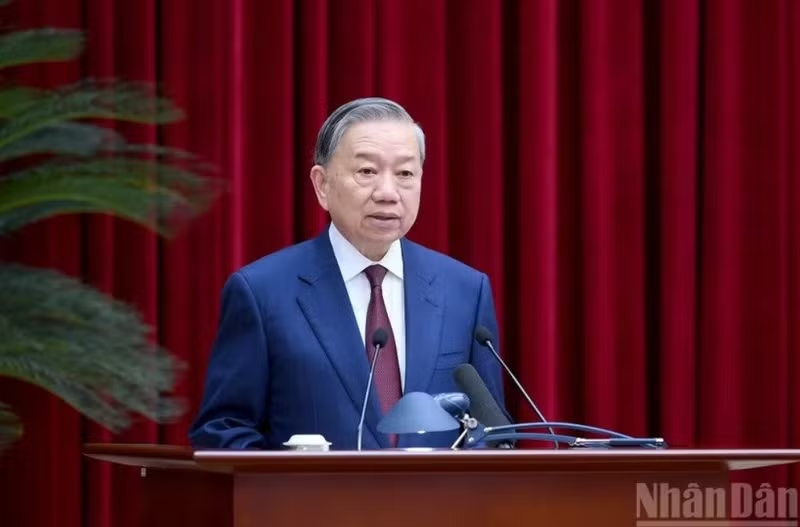
Alongside several issues concerning the organisational structure of the State apparatus and plans to nominate personnel for leadership positions in State agencies of the 16th tenure (2026–2031), as well as providing opinions on socio-economic development plans for the remainder of the term, the plenum adopted a number of important documents. These include discussions, revisions, and finalisation for early issuance and implementation of regulations on political and ideological work; resolutions on renewing and enhancing the effectiveness of inspection, supervision, and Party discipline; and on continuing to strengthen the Party’s leadership in the fight against corruption, wastefulness, and negative phenomena in the new period.
Based on the principle of selectively inheriting and refining the structure and content of existing documents, removing outdated elements, and supplementing new viewpoints, new content, and new regulations of the Central Committee and State law, as well as content verified in practice, the newly issued regulations and resolutions must be consistent and unified with the Resolution of the 14th National Party Congress and suited to the realities of Party building and national development in the new phase.
According to the Party General Secretary, these constitute the “legal corridors,” “operational rules,” “disciplinary principles,” and “standards of conduct” to bring the Party’s resolutions into life, creating a solid foundation for realising the nation’s two centenary strategic goals.
In particular, the Regulation on political and ideological work within the Party is an entirely new regulation with no precedent, aimed at unifying and concretising the Party’s viewpoints on Party building in terms of politics, ideology, and ethics in the new context.
Since the sixth National Party Congress, political and ideological work has undergone comprehensive and profound renewal, clearly reflected in the Platform, the Party Statutes, and congress resolutions, and further specified in resolutions, directives, conclusions, and regulations, implemented synchronously from the central to grassroots levels.
However, in reviewing practice, the Party has frankly acknowledged and pointed out limitations in political and ideological work. Statistics on Party discipline enforcement during the 13th Congress term show that violations related to political and ideological issues account for a significant proportion. This reality indicates that ideological degradation is often the “root cause” leading to other violations in ethics, lifestyle, economic matters, and positions of authority.
The country is entering a new revolutionary phase with intertwined opportunities and challenges. The global situation continues to evolve in a complex and unpredictable manner, while the explosion of multi-dimensional information, especially in cyberspace, has significant impacts on the thinking and awareness of officials, Party members, and the public.
With a spirit of action to achieve strategic goals, the Party has identified that political and ideological work plays an increasingly important role, not only in the immediate term but also as a long-term strategic task.
Emphasising the “four steadfast commitments” (the creative application and development of Marxism–Leninism and Ho Chi Minh Thought; the goals of national independence and socialism; the Party’s renewal policy; and the Party’s organisational and operational principles), the Regulation is not only aimed at “countering” but, more importantly, at “building,” while unifying and concretising viewpoints on Party building in politics, ideology, and ethics in the new context. It institutionalises requirements, principles, and responsibilities of Party organisations and members in studying, disseminating, and acting upon Party resolutions.
At the closing session, Party General Secretary To Lam summarised and highlighted five core areas: political and ideological work within the Party; the goal of achieving double-digit economic growth; promoting the strengths of the two-tier local government model; inspection, supervision, power control, and the fight against corruption, wastefulness, and negative phenomena; and ensuring national defence, security, foreign affairs, and international integration in the new period.
Among these, political and ideological work within the Party is placed at the forefront, serving as the foundation, basis, and driving force for successfully accomplishing other tasks. Revolutionary practice has shown that when thinking is clear, unity of will and effective action will follow.
Alongside ideological work, inspection, supervision, and discipline constitute key elements to ensure decisive, accurate, and effective action, contributing to strengthening public trust, consolidating national unity, and enhancing internal strength to meet the requirements of rapid and sustainable development.
With the established foundation, this Party Central Committee plenum further concretises strategic thinking and vision, from objectives to action, “laying the operational groundwork for the entire term.”
With the established foundation, this Party Central Committee plenum further concretises strategic thinking and vision, from objectives to action, “laying the operational groundwork for the entire term.”
Immediately following the success of the 14th National Party Congress and the election of the 16th National Assembly, implementing the outcomes of the second plenum will accelerate progress and breakthroughs to achieve set goals.
This requires synchronised implementation across the Party and the entire political system. First and foremost, each Party organisation and member must translate awareness into responsibility, exemplary conduct, and unified action, contributing to building a strong Party, continuing to renew leadership methods, acting more decisively, and enhancing the Party’s leadership and governance capacity as well as the State’s capacity for governance and development facilitation, while continuously improving the quality of cadres and Party members.
The path ahead remains challenging as the country faces high demands for renewing the growth model, improving institutions, enhancing personnel quality, reorganising development space, and effectively operating the two-tier local government model. The responsibility of each Party organisation and member is first to fully grasp the message of the second plenum on “tasks that must and need to be carried out immediately without delay,” and together with the entire Party, people, and armed forces, act in line with the motto: strategic autonomy; steadfast commitment to the two centenary strategic goals; unity, determination, and resolute action for the prosperous and happy life of the people.
Author: NDO
RECOMMENDED TOPICS