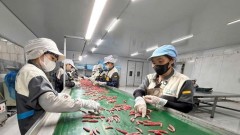
Vietnam seeks breakthrough reforms to build two million enterprises by 2030
Vietnam faces the challenge of doubling enterprises by 2030, with experts stressing institutional reforms and breakthrough policies as crucial to unlocking private...
Previously, many enterprises encountered difficulties in utilising the Science and Technology Development Fund for business due to institutional obstacles. The Law on...
According to the latest statistics from the United Nations Environment Programme (UNEP), the construction sector accounts for nearly 40% of global CO2 emissions, with...
In recent years, durian cultivation has been expanding in the Mekong Delta city of Can Tho, with a total area of nearly 13,000 hectares, ranking third among the city’s...
Innovation not only enables Vietnamese private enterprises to overcome the limitations of old growth models but also lays the foundation for deeper participation in...
After nearly 40 years of reform, Viet Nam’s private sector has made remarkable progress in both scale and quality, steadily affirming its role in the...
New mechanisms and policies, especially the Law on Science, Technology and Innovation and the Law on Digital Technology Industry, are expected to create an environment...
Under the direction of the VCCI, Business Forum Magazine, in partnership with TAT Law Firm and Intellectual Property and Innovation Magazine, held the Forum "Improving...
In Viet Nam, although more than 70 per cent of listed companies have begun to integrate Environmental, Social, and Governance (ESG) standards into their business...
For generations, traditional handicrafts such as weaving and brocade embroidery have been deeply intertwined with the lives of ethnic minority communities in Tuyen Quang...
For the first time, a controlled testing mechanism has been enshrined in the Law on Science, Technology and Innovation. This is regarded as a policy breakthrough,...
Resolution No. 68-NQ/TW of the Politburo (dated May 4, 2025) reaffirms the pivotal role of the private sector in the country’s development process. In Ca Mau, the...
According to statistics from the Ministry of Agriculture and Environment, there are more than 5,400 craft villages nationwide, of which the Red River Delta region alone...
The city aims to establish itself as Vietnam’s leading innovation hub through the proposed Hanoi Innovation Center, which is designed to foster stronger connections...
According to Brian Lee Shun Rong, an economist from Maybank Group, Vietnam is rolling out a series of ambitious policy reforms to accelerate the growth of its...
To close the infrastructure gap, Vietnam must scale market innovation and build investor confidence in bonds as a viable, long-term funding tool.
The Law on Science, Technology and Innovation has been passed, designating enterprises as the centre of the innovation system, offering a range of preferential policies...
Addressing critical bottlenecks is essential to help the private sector become a key driver of Viet Nam’s future double-digit economic growth. In response to four key...
For the first time, innovation has been codified into law and placed on an equal footing with science and technology, marking a decisive shift in Viet Nam’s development...
After the merger, Ho Chi Minh City is reshaping its industrial production model towards smart, high-tech industry, using knowledge as a new growth driver to move towards...
Resolution No. 68-NQ/TW (dated May 4, 2025) of the Politburo on private sector development has been enthusiastically welcomed by the business community. Numerous...
Some 90% of Vietnamese agricultural products are still exported in raw form, according to the Ministry of Agriculture and Environment. This remains a...