VN
VN
 EN
EN
26/07/2026, 02:38
Business economics
Tobacco tax policy and the challenge of market management
The introduction of a mixed excise tax on tobacco from 2027 is expected to help guide consumption, protect public health and increase state revenue. However, it also raises the risk of rising illicit tobacco trade, requiring coordinated and decisive enforcement measures.
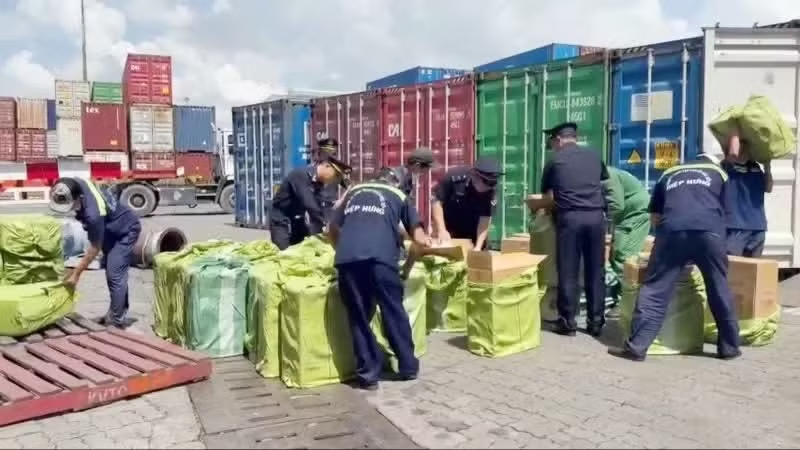
Tax hikes bring dual impact on the market and consumer behaviour
The Law on Special Consumption Tax No. 66/2025/QH15 introduces, for the first time, a mixed tax method for tobacco, combining a 75% ad valorem rate with a specific tax applied progressively from 2027 to 2031. Accordingly, from 2027, each pack of 20 cigarettes will incur an additional 2,000 VND (0.08 USD) per year, reaching a total increase of 10,000 VND (0.38 USD) by 2031.
According to Le Thi Duyen Hai, Vice Chairwoman and Secretary General of the Viet Nam Tax Consultants’ Association, the policy aims to achieve multiple objectives: “The mixed tax approach for tobacco targets consumption control, public health protection and state budget revenue.”
Projections indicate significant impacts. The male smoking rate is expected to decline from 42.1% in 2025 to 38.6% by 2030, while the tax share of retail price will rise from 36% to 59.4%. Tobacco excise revenue is projected to increase from 18.2 trillion VND (695.6 million USD) in 2025 to 39.1 trillion VND (1.49 billion USD) by 2030.
The addition of a specific tax component is seen as key to narrowing the price gap between low-cost and premium products, thereby discouraging consumption of cheaper, lower-quality cigarettes. However, higher taxes may also push some consumers towards illicit products, which are not subject to taxation and thus remain cheaper.
Experience from countries such as Malaysia suggests that sharp tax increases without effective market controls can fuel smuggling. Domestically, higher legal prices could weaken the competitiveness of local manufacturers, reducing output and market share.
Meanwhile, budget data show that tobacco-related revenue continues to grow steadily by 6–8% annually, largely driven by state-owned or state-invested enterprises. However, tax revenue from imported tobacco does not accurately reflect actual consumption, as foreign cigarettes account for around 20–22% of the market but contribute only about 12% of total budget revenue from this category.
Illicit tobacco is estimated to cause annual tax losses of 5–6 trillion VND (191.1–229.3 million USD), while also posing health risks due to lack of quality control.
Strengthening anti-smuggling control and enforcement effectiveness
In the face of the rising risk of illicit tobacco, experts argue that tax increases must be accompanied by a comprehensive set of measures, particularly non-tax solutions.
Le Thi Duyen Hai emphasised the need to strengthen public awareness of the harmful effects of tobacco, particularly products of unknown origin, while tightening anti-smuggling controls and increasing penalties to ensure effective deterrence.
Proposals include revising Decree 98/2020/ND-CP to significantly raise fines for illicit tobacco trading. Current penalties of 1–3 million VND (38–115 USD) are considered too low, even below potential profits. Raising fines at least tenfold is suggested to ensure deterrence.
Other recommendations include increasing fines to up to 100 million VND (3,820 USD) for trading 500 packs of smuggled cigarettes and lowering the criminal prosecution threshold from 1,500 to 500 packs.
Not only should efforts focus on smuggling, but retail violations—such as failing to display signage, selling to those under 18, or operating in unauthorised locations—must also be dealt with strictly. Current fines of 500,000 to 1 million VND (19.1–38.2 USD) are considered insufficient to deter such practices, which in fact serve as loopholes allowing illicit tobacco to infiltrate the market.
In the context of rapid growth in e-commerce, it has become increasingly urgent to introduce additional regulations governing the sale of tobacco products on digital platforms. Enforcement measures should also be expanded to cover not only sellers but also platform operators, in order to ensure transparency and fairness.
Le Duc Tuan, Deputy Head of the Planning Division at the Anti-Smuggling Investigation Department (General Department of Customs), said that after 11 years of implementing Directive No. 30/CT-TTg issued by the Prime Minister on strengthening efforts to combat tobacco smuggling, the situation has seen positive progress, although it continues to present complex and evolving challenges.
According to him, tobacco smuggling prevention and control has consistently received close direction from the Government, along with coordination among multiple forces, including the police, border guards and the coast guard. “These forces have worked together to dismantle numerous large-scale tobacco trafficking and transportation cases, handing over suspects and evidence to the police for handling in accordance with the law.”
However, smuggling activities continue to occur along various routes, with increasingly sophisticated methods. In the northern region, key hotspots include Quang Ninh, Lang Son and Lao Cai, with commonly smuggled brands such as 555, Esse and Marlboro. In central Viet Nam, traffickers take advantage of complex terrain, transporting goods by boat across the Se Pon River before distributing them in smaller quantities. Meanwhile, the south-western border remains a “hotspot” for cigarette brands such as Jet, Hero, Scott and Nelson.
Customs authorities have recorded 1,663 violations, seized more than 23.3 million packs of cigarettes, prosecuted 12 cases and destroyed over 18.7 million packs. These figures are significant, but also reflect the large scale of the illicit tobacco market.
Experts note that for tax policy to be effective, market control must be prioritised. This requires not only strengthening enforcement capacity but also improving institutions, tightening penalties and changing consumer behaviour.
At the same time, strict enforcement of smoke-free zone regulations and higher penalties for smoking in public places are also seen as measures to help promote more civilised consumption habits.
Clearly, the mixed tobacco tax policy is a necessary step in line with international trends. However, to achieve the dual objectives of public health protection and increased budget revenue, a comprehensive set of solutions is required, in which smuggling control and stronger enforcement play a pivotal role.
Author: NDO
RECOMMENDED TOPICS