VN
VN
 EN
EN
16/07/2026, 02:00
Business economics
Viet Nam proactively secures fuel supply amid Middle East tensions
The conflict in the Middle East is pushing the global energy market into a period of intense volatility, creating what is described as the most severe energy bottleneck in history.
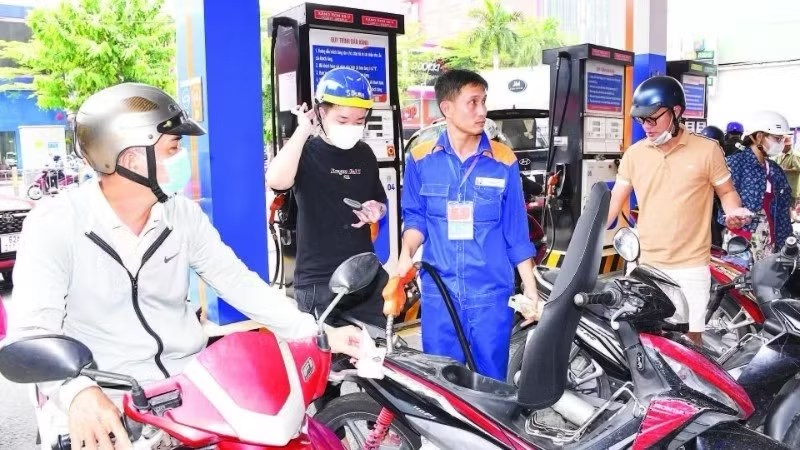
As a net importer of petroleum products, Viet Nam has taken steps to ensure domestic supply and prevent widespread shortages.
According to the International Energy Agency (IEA), the crisis in the Strait of Hormuz is disrupting approximately 11 million barrels of oil and 140 billion cubic metres of gas per day, driving global crude oil prices above 100 USD per barrel and sending overall energy prices sharply upward.
Widespread impact
On March 22, the IEA warned that disruptions in the Strait of Hormuz are creating the most severe energy bottleneck on record, affecting not only fuel prices and supply but also spilling over into inflation and import costs, and weighing on economic growth, with a scale and severity believed to exceed even the oil shocks of the 1970s, which destabilised the global economy.
Supply disruptions have forced many refineries in Asia to cut capacity, while gas prices in Europe have surged by more than 60%.
In response, the IEA has coordinated the release of around 400 million barrels of oil from strategic reserves, the largest strategic reserve release to date, and stands ready to deploy additional reserves if necessary.
The agency emphasised that these measures are primarily intended to ease immediate pressures, while the fundamental solution remains the restoration of normal operations in the Strait of Hormuz.
Amid rising uncertainty over energy supply, many countries have swiftly introduced measures to mitigate related impacts. For instance, the Hungarian government has imposed retail price caps on petrol and diesel, while also releasing stocks from national oil reserves to ensure supply.
Slovenia has introduced fuel purchasing limits, under which private motorists may purchase no more than 50 litres per day, while businesses and priority groups are capped at 200 litres per day.
To ease price pressures, several countries, including Germany and Austria, have combined price regulation with tax policies, while also controlling the frequency of price adjustments to limit market volatility.
Spain, for its part, has taken robust action by rolling out a support package worth around 5 billion EUR and reducing VAT on energy from 21% to 10%.
In Asia, the region most heavily affected, where around 80% of oil and LNG supplies pass through the Strait of Hormuz, countries are focusing on reducing consumption and securing supply.
The Republic of Korea and Japan have stepped up price controls and increased stockpiling. Sri Lanka has introduced fuel quotas, while the Philippines has implemented a four-day working week in the public sector. Thailand is considering price caps and restrictions on vehicle use.
Increasing strategic reserves
Viet Nam has moved early and in a coordinated manner to implement response measures. In particular, fuel price management has been conducted flexibly, closely tracking global market developments, while effectively combining the price stabilisation fund with tax and fee measures to limit sharp fluctuations. This has helped control domestic fuel prices, curb inflationary pressures, and maintain macroeconomic stability.
The Ministry of Industry and Trade has issued a series of directives to the nationwide fuel production, trading, and distribution system, requiring advance supply planning, strict implementation of import and stockpiling plans, and maintaining uninterrupted retail operations to ensure supply at all times.
As experience has shown, economies dependent on imported energy are highly vulnerable to geopolitical shocks. According to experts, in the short term Viet Nam should continue prioritising measures to secure fuel supply, while maintaining flexible price management and effective domestic market management.
Over the longer term, it is essential to increase strategic reserves, improve energy efficiency, and accelerate the development of renewable energy in order to remain prepared for any future disruptions.
A recent conclusion issued by the Politburo clearly states the need to encourage frugal energy use to maintain supply stability, reduce volatility in domestic input and fuel prices that could negatively affect production, business activities, and people’s livelihoods, and promptly develop a long-term national strategy on the supply and stockpiling of fuels and raw materials.
Bui Ngoc Bao, Chairman of the Viet Nam Petroleum Association, noted that to increase national reserves, the Ministry of Industry and Trade should propose that the Government review foreign contractor tax (FCT) policies applied to bonded warehouses. According to businesses, these taxes are a major barrier for foreign companies seeking to store petroleum products in Viet Nam’s bonded facilities.
Recent use of the price stabilisation fund has had only a limited impact in the face of sharp and sustained fluctuations in fuel prices. By contrast, if the fund had been used to build reserves when oil prices were around 60 USD per barrel, it would have been far more effective. Therefore, the Ministry of Industry and Trade should consider establishing a centralised reserve fund, financed from the price stabilisation fund, to procure fuel reserves when prices are low.
Author: NDO
RECOMMENDED TOPICS