VN
VN
 EN
EN
23/07/2026, 02:00

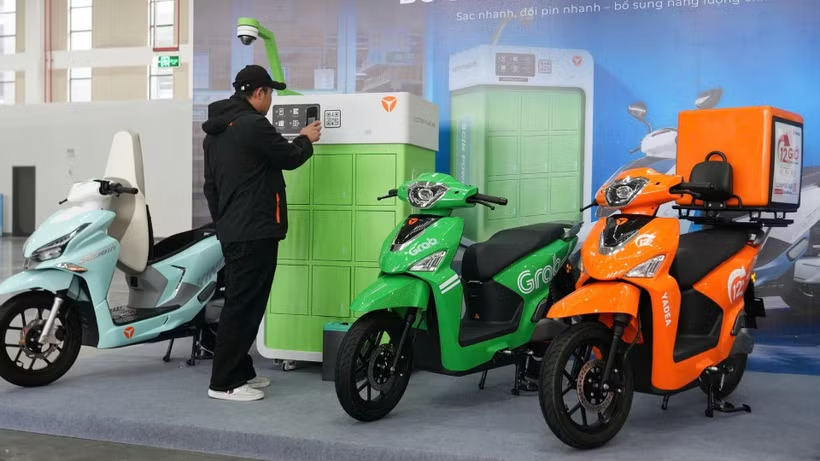
This transition not only helps protect the environment but also forms part of a strategy to build new industrial value chains and enhance economic resilience. As global energy markets experience significant volatility, improving energy efficiency and reducing dependence on fossil fuels have become strategic imperatives for many countries.
Geopolitical tensions in many regions, particularly the Middle East – home to many critical energy transit routes – have put global energy supplies at risk, leading to severe price volatility.
For developing economies such as Viet Nam, where energy demand continues to rise sharply, ensuring energy security is becoming ever more urgent. In this context, efforts to conserve energy and promote the transition to clean and sustainable energy sources are seen as a crucial pathway to mitigating external risks and strengthening economic autonomy.
Transport is among the largest energy-consuming sectors. With tens of millions of petrol- and diesel-powered vehicles in use, the sector not only consumes enormous amounts of fuel but is also a significant source of emissions, especially in major cities such as Ha Noi and Ho Chi Minh City. Therefore, the shift to clean-energy transport, particularly electric vehicles, is regarded as an inevitable trend in the broader energy transition.
In Viet Nam, the push for green transport is clearly reflected in various national development strategies, aligned with green growth objectives and the commitment to achieving net-zero emissions by 2050.
Notably, the Prime Minister has called for a nationwide energy-saving campaign, emphasising the promotion of electric vehicles and other forms of clean energy.
In this context, electric vehicles are viewed not merely as a new technological solution but as a key component of a broader strategy to ensure energy security, reduce emissions and promote sustainable development.
Refining policy to drive the EV industry
At a recent roundtable on the role of EVs in addressing energy security and sustainable development, Pham Van Quan, Deputy Director of the Industry Agency under the Ministry of Industry and Trade, noted that EVs are not simply a technological product but a new industry requiring coordinated development in infrastructure, institutions and the production ecosystem.
Under this approach, EV development goes beyond promoting green transport adoption; it is also linked to building a new industrial value chain encompassing vehicle manufacturing, supporting industries, charging infrastructure and related services.
In recent years, the Ministry of Industry and Trade has worked with relevant ministries and agencies to build a legal framework supporting EV market growth. A key focus has been the development of technical standards for related equipment and infrastructure. By the end of 2025, Viet Nam had issued 18 standards and technical regulations covering charging stations, charging points and EV batteries. However, this legal framework will need further refinement to keep pace with the market’s rapid growth.
One major issue is the development of charging infrastructure. In practice, investment in charging stations still faces obstacles related to planning, investment procedures, grid connection and construction regulations. The Ministry is therefore working with relevant authorities to remove these bottlenecks and create more favourable conditions for businesses to invest in charging infrastructure.
At the same time, a range of incentives has been introduced to encourage EV adoption, including tax breaks and registration fee reductions. Manufacturers of EV parts also benefit from supportive policies aimed at developing the supporting industries.
Significantly, the Ministry is also developing programmes to promote battery energy storage systems, a key component of the EV ecosystem. Advances in battery technology not only improve EV performance but also enable energy storage from renewable sources such as solar power, thereby enhancing national energy security.
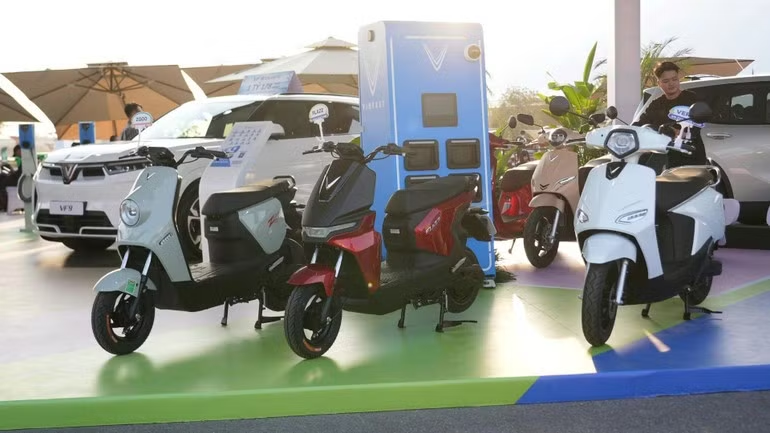
Electric vehicles and the urban environmental challenge
Alongside government policy direction, local authorities and businesses are actively driving the transition to green transport. In Ha Noi, one of the cities with the highest vehicle density, the city government aims to convert all taxis to electric or environmentally friendly energy by 2030.
According to Nguyen Quang Huy, Deputy Head of the Transport Management Division at the Ha Noi Department of Construction, the city currently manages more than 14,000 licensed taxis, of which around 8,600, or nearly 60%, have already switched to electric vehicles. This figure is expected to rise further as taxi firms gradually replace their fossil-fuel vehicles.
To support this transition, the city is developing policies to assist transport operators, including preferential loan interest rates, reduced parking fees and expanded charging infrastructure.
In parallel, Ha Noi is promoting the use of technology in transport management, building shared data systems and establishing service quality criteria for taxis, including requirements on the proportion of vehicles using clean energy. Alongside local policies, business participation is playing a crucial role in advancing the EV market in Viet Nam.
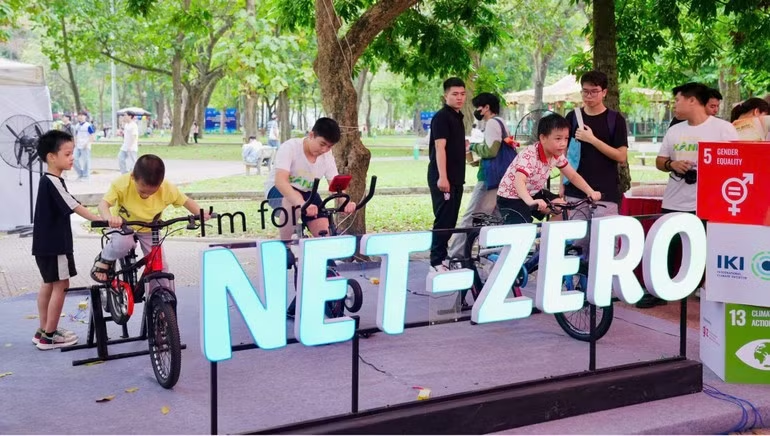
Hoang Ha, Chief Executive Officer of VinFast Electric Motorbikes Viet Nam (Vingroup), stated that the company is working towards a comprehensive green mobility ecosystem, spanning vehicle production, charging infrastructure and electric transport services.
Currently, the charging network developed by the company and its partners comprises around 150,000 charging ports nationwide for both electric cars and motorbikes. More high-capacity charging stations are expected to open in the near future to meet growing demand.
Alongside infrastructure development, electric transport services are also expanding, including electric taxis, electric buses and ride-hailing platforms using EVs. These models not only help reduce emissions in urban transport but also drive significant changes in consumer behaviour.
According to economic and energy experts, the transition to electric vehicles offers substantial sustainability benefits, particularly in large cities.
Dr Vo Tri Thanh, Director of the Institute for Brand and Competitive Strategy, noted that the green transition is becoming a global trend, closely tied to emissions reduction commitments and sustainable development goals. Within this strategy, energy and transport are closely interconnected and play pivotal roles. Shifting to electric transport can significantly reduce greenhouse gas emissions and air pollutants.
In major cities such as Ha Noi, transport is a key contributor to air pollution, alongside construction and industrial production. Therefore, the development of clean transport can help improve urban living conditions.
However, experts caution that electric vehicles are only truly green if the electricity used to charge them is generated from clean energy sources. This underscores the need for a holistic approach, aligned with renewable energy development strategies and improved energy efficiency.
Moreover, the success of this transition depends on multiple factors, including investment costs, access to charging infrastructure, supportive government policies and changes in consumer behaviour.
Author: NDO