VN
VN
 EN
EN
26/07/2026, 02:38
Business economics
A foundation for educational integration
Viet Nam had recorded 423 international joint training programmes at undergraduate level across more than 67 disciplines, along with 77 joint programmes at 32 colleges nationwide by mid-2025. Economics and management account for more than half of these programmes, followed by science, engineering and technology—fields closely aligned with human resource development needs in a globalised context.
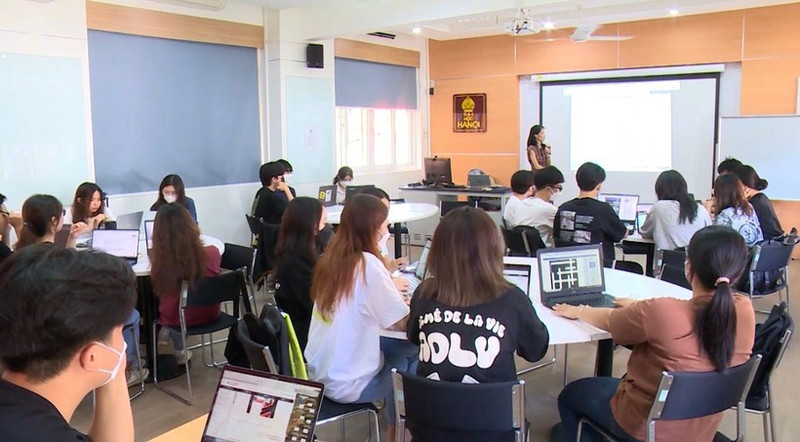
Viet Nam currently hosts five foreign-invested universities in operation, enrolling around 20,000 students. These institutions have become key hubs for the direct integration of the national higher education system into the global academic landscape.
According to Nguyen Thu Thuy, Director General of the Department of International Cooperation under the Ministry of Education and Training, Viet Nam aims by 2030 to have more than 20% of joint programmes linked with universities ranked among the world’s top 500, while also establishing additional foreign university branches in the country.
To ensure quality and manage risks, Decree No. 124/2024/ND-CP on foreign cooperation and investment in education has been issued, tightening requirements ranging from institutional rankings and financial capacity to academic accountability. This underscores that educational integration is a component of a long-term development strategy, rather than a simple expansion in the number of partnerships.
In the 2024–2025 academic year, 200 higher education institutions nationwide achieved domestic accreditation, while 16 met international accreditation standards—an increase of nearly 50% compared with several years earlier. Of the 2,609 accredited training programmes, 694 met international standards, reflecting sustained efforts to standardise education for deeper global integration.
Educational integration, however, extends beyond universities. A large-scale education services market is rapidly emerging. By August 2025, Ho Chi Minh City alone had licensed 1,961 foreign language and IT centres, attracting nearly 270,000 learners, while Ha Noi and other localities recorded hundreds or even thousands of similar establishments.
According to the Ministry of Education and Training, by the end of 2025 the education sector’s database had largely been completed and connected to the National Database, storing 24.55 million learner and teacher records and covering around 26 million pupils and students, 1.6 million teachers and more than 50,000 education institutions nationwide. Data systems have continued to be linked with population, insurance and other national platforms, gradually forming an integrated governance structure.
At higher education level, the HEMIS system now covers 470 training institutions, managing more than 25,000 programmes, over 100,000 staff records and nearly 3 million learner profiles. From a technical standpoint, a data-driven governance platform has already been established.
Yet a gap remains: most data are used primarily for reporting and internal management rather than as a regulatory tool for an integrated system. Learners and parents lack reliable platforms for comparison and choice, while society lacks effective tools to oversee quality and accountability. As a result, the education market has yet to be able to self-regulate through information transparency, remaining heavily reliant on advertising, titles and promises.
This gap has become evident through a series of recent cases, ranging from difficulties in recognising qualifications from international joint programmes to tuition fee disputes and violations in advertising and training delivery at foreign language and skills centres.
Deputy Chairman of the Viet Nam Association of Universities and Colleges Le Viet Khuyen noted that the absence of a transparent, public data system means risks are often detected only after students complete their studies. “Current management still tends to focus on dealing with incidents after they have occurred, whereas what is more necessary is a system designed to prevent risks before learners make their choices,” Khuyen observed.
Minister of Education and Training Nguyen Kim Son has stressed that all education institutions must connect to and update the shared data system, with non-compliant units barred from enrolment from 2026. At the same time, the education sector must complete a digital qualifications database integrated with citizen data, serving both governance and lifelong learning while significantly reducing administrative procedures for the public.
According to Professor Nguyen Dinh Duc of Viet Nam National University, Ha Noi, “integration is only sustainable when standards are enforced as common ‘rules of the game’, rather than being dependent on titles or commitments.” When data are standardised and information on programmes, qualifications, learning outcomes and training capacity becomes mandatory, integration is no longer a “gamble” for learners but a controlled and regulated process.
Author: NDO
RECOMMENDED TOPICS