VN
VN
 EN
EN
10/07/2026, 15:29
Culture- travel
A joyful spring across the Central Highlands
In the Central Highlands, spring carries a very distinctive character. Local people call it the “ning nong” season, the time of “eating for the year and drinking for the month”, usually beginning in late November of the previous year and lasting until March or even April of the following year.
When wild sunflowers spread their golden colour across the roads and the goddess H’Jan gradually puts an end to the sudden rains, when fields have been harvested, rice has been stored in granaries, and ripe coffee cherries have been picked, spring in the Central Highlands begins.
The opening beats of the festival season
Spring arrives like a long-awaited promise, a reward for a year of “selling one’s face to the soil and one’s back to the sky” for the people here.
In the final days of the year, travelling along National Highway 14 or following the red basalt earth roads, one easily encounters groups of people carrying baskets of rice and maize back to their homes. Children run alongside cheerfully, elders walk leisurely, and all share the joy of a plentiful harvest.
On a coffee farm in Ia Grai Commune in Gia Lai Province, Ksor Bot has just finished the harvest, with sacks of bright red coffee cherries piled up in the corner of his house. He smiles warmly: “After a year of hard work, seeing the coffee sacks filling the storehouse makes me feel relieved. Spring is the time when the whole family rests, eats, and celebrates. People in the Central Highlands live wholeheartedly during the festival season so that we can regain our strength for the new crop.”
During these months, people in the Central Highlands allow themselves time to rest and “eat” and “drink” in compensation for a year of labour. The air is filled with the intoxicating aroma of jar wine and the smell of grilled meat beside the fire.
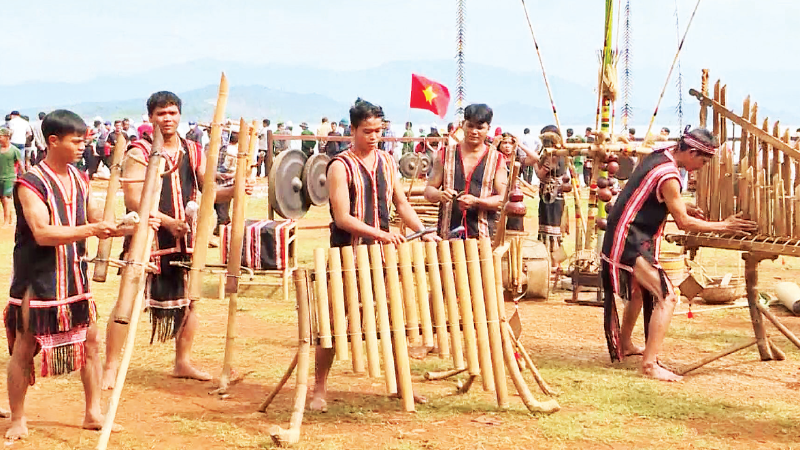
Yet what captivates visitors most is not the wine, but the legendary sound of gongs echoing through the mountains and forests. Village elders say: “The sound of the gongs at this time makes squirrels forget to dig their burrows, gibbons forget to swing on branches, and cobras forget to crawl, leaving talented young men and beautiful young women lost in wonder.”
From the new rice ceremony to the grave-leaving ritual and the water-source worship ceremony, the sound of gongs resonates month after month, turning the Central Highlands into an endless epic of stone mountains and ancient forests. The gong is not merely music; it is the heartbeat of the community. Each beat is an invitation, a connection between humans and spirits, between villages and the surrounding mountains and forests.
What intoxicates visitors most is not the wine, but the legendary sound of gongs echoing through the mountains and forests.
Inside a stilt house in Bi Village in Ia O Commune in Gia Lai Province, elder Ksor Bong sits beside the fire, slowly sipping jar wine as he recalls: “In the past, our spring had no calendar, only the rhythm of the land and sky. When wild sunflowers bloom yellow and birds call to announce the harvest, the village knows that the festival season has arrived. Elders rest, young people sing and dance, and children run about freely. Spring is the time to thank heaven and earth and to strengthen the bonds of the village.”
His story blends with the wind of the vast highlands, making listeners feel more clearly the close bond between humans and nature. In the flickering firelight, elders raise cups of jar wine, young people perform the xoang dance (a traditional Central Highlands circle dance), and women hum traditional songs. Together they create a vivid cultural space where tradition and the present meet.
Visitors arriving in the Central Highlands during this season are often surprised by the generosity and openness of the people. They do not measure time by days and hours but live fully in the spirit of the festival season.
Preserving identity and faith
Spring in the Central Highlands is often described as the season of festivals. Each ceremony and each gong beat carries a message of unity and faith in nature and life.
From the new rice ceremony expressing gratitude for the harvest, to the grave-leaving ritual bidding farewell to the departed, and the water-source worship ceremony praying for abundant water, each ritual is closely linked to both daily life and spiritual beliefs.
During the grave-leaving ritual, the sound of gongs resonates like a farewell message, a bridge connecting the living and the deceased. At the water-source ceremony, the gong echoes like a prayer for clear streams to nourish the village. In the new rice ceremony, it becomes a song of gratitude to heaven and earth and a celebration of the harvest.
Beyond the gongs, spring in the Central Highlands is also lively with xoang dance circles around the communal rong house. During village festivals, young men in colourful brocade costumes join the energetic dance, hand in hand with graceful young women. The xoang circle is both a dance and a circle of unity, where everyone moves together and shares the joy.
Children run around excitedly, eagerly watching every ritual and every gong beat that forms the identity of the village. Young people listen as elders recount khan epics, long heroic tales that remind new generations of their roots and the heroes of the mountains and forests.
Each festival is an opportunity for the village to strengthen its bonds and for younger generations to understand their origins more clearly. In the glow of the fire, with gongs echoing and xoang dances swirling, young people realise they carry the spirit of the mountains and forests in their blood and must live in a way worthy of their ancestors.
As Y Phuc, a young Gia Rai man in his early twenties, shared: “We dance xoang to connect with the past and to keep our identity alive. Each spring, the sound of gongs and the dance remind us that we belong to the village and the mountains, and that we have a responsibility to continue what our ancestors have passed down.”
Beside rising kitchen smoke, the aroma of jar wine mingles with folk songs echoing around the fire. Jar wine is the soul of the celebration, the element that connects people together. People gather around the wine jar, drinking through bamboo straws and sharing the joy of the festival.
Grilled meat, bamboo-tube rice, and roasted chicken are indispensable dishes, carrying the simple yet rich flavours of the mountains. Every piece of food and every sip of wine represents sharing and warm hospitality.
Visitors are often drawn into the xoang circle, the flavour of jar wine, and the laughter of the villagers. Even after leaving, the lingering essence of the mountains remains in their memories. That is why the land and people of the Central Highlands leave such unforgettable impressions.
Beyond the majestic natural scenery, the generosity with which people live and share is also what captivates strangers. Villagers open their arms, inviting guests to drink jar wine and join the xoang dance. In those moments, the distance between strangers disappears, leaving only the harmony of gong rhythms, wine, and laughter.
Tran Thu Ha, a visitor from Ha Noi, shared emotionally: “Spring here is unlike anywhere else. I feel as if life slows down, blending with the sound of gongs, the flavour of jar wine, and the smiles of the people. Spring in the Central Highlands is truly a season of sharing and human warmth.”
After saying this, she takes a bamboo straw and drinks a sip of fragrant wine, her eyes shining with surprise and delight. She adds that in Ha Noi, spring arrives quickly and passes quickly as people soon return to their busy routines.
In the vast forests of the Central Highlands, spring is not only the change of the seasons but also an occasion for people to express their natural generosity. In the echoing gongs and the vibrant xoang dance, one can feel the powerful vitality of a culture that has endured for thousands of years and continues to thrive with the rhythm of the modern era.
That spring does not belong only to the Central Highlands; it is also an essential part of the rich and diverse cultural identity of Viet Nam.
Author: NDO
RECOMMENDED TOPICS