VN
VN
 EN
EN
26/07/2026, 02:38
Business economics
A significant milestone in Vietnam-India relationship
Marking 10 years of the India-Viet Nam Comprehensive Strategic Partnership is a significant milestone in bilateral relations between Vietnam and India.
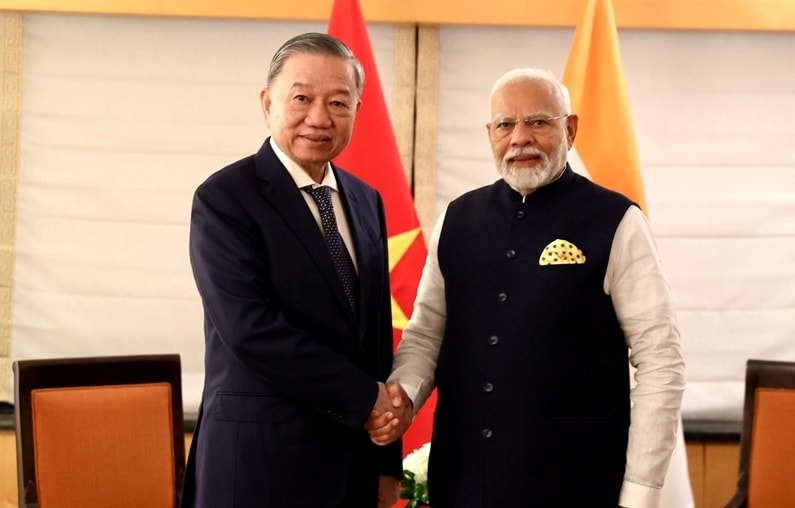
Party General Secretary To Lam and Indian Prime Minister Narendra Modi
Mr. Tshering W. Sherpa, Ambassador of India to the Socialist Republic of Viet Nam has an interview with the Business Forum Magazine on this content.
- The year 2026 marks the 10th anniversary of the establishment of the Vietnam-India Comprehensive Strategic Partnership. Could you please give your assessment of the trade and investment situation between the two countries in recent years, as well as the development orientations for the near future? In 2026, what programmes or activities are the two countries planning for this anniversary?
India was one of the first countries with whom Viet Nam elevated the relationship to Comprehensive Strategic Partnership (CSP) in 2016. Our friendship and close relations predate 1972 when our diplomatic relations was established. For us, it is only natural for both civilizations, with shared Buddhist and Cham linkages, historical people-to-people ties, contemporary aspirations and strategic convergences, to enjoy the highest level of friendship that there is.
If you observe this timeline from 2016 to present, our bilateral trade has exactly doubled! From approx. USD 8 billion in 2015-2016 to approx. USD 16 billion in 2024-2025. These are impressive developments and show the amount of synergy between the two sides. However, this is just the beginning and the potential for mutual trade and investments is immense.
Trade & commerce is a sector where our mutual ambitions have not realized its full potential. We both need to walk the talk towards promoting reliable, efficient and resilient supply chain systems. The vision of self-reliance of India and the economic vitality of Viet Nam has much to offer to the business community on both sides. Indian infrastructure giants have expressed interest to be a part of the developmental and infrastructure evolution of Viet Nam, a strategic friend of India. We remain engaged with relevant authorities in both India and Viet Nam to look at ways to enhance mutual trade.
Marking 10 years of the India-Viet Nam Comprehensive Strategic Partnership is a significant milestone in our relations. To ensure that the milestone, in 2026, is commemorated in a befitting manner, both sides are working on various steps including political level engagements, trade and commercial activities, cultural exchanges and an impetus to science and technology to name a few. 2026 will herald many new developments and initiatives between our two sides.
- India continues to implement its Act East policy, strengthening comprehensive and substantive cooperation with ASEAN. In your view, how has this policy impacted ASEAN in general and Vietnam in particular?
India formulated its policy on the East almost four decades ago and, in 2014, updated that framework into an active, result-oriented policy of Act East. Viet Nam holds a very prominent place in our Act East policy, as it does in our Indo-Pacific Vision. Viet Nam is an important partner and friend of India in the ASEAN setting.
India is one of the few countries with whom there is a country-specific ASEAN Summit mechanism viz. the India-ASEAN Summit. The last edition, i.e., the 22nd edition was recently held in Kuala Lumpur in October 2025. We are also involved with ASEAN at Senior Officials Meeting (SOM) format. In all these interactions, India coordinates closely with Viet Nam.
In the recently concluded India-ASEAN Summit in Kuala Lumpur, my Prime Minister reiterated India’s support for ASEAN Unity, ASEAN Centrality and the ASEAN Outlook on the Indo-Pacific. He also complimented ASEAN on adoption of the ASEAN Community Vision 2045. Signifying the importance for close collaboration for mutual progress, Prime Minister of India stated that the ‘21st century belongs to India and ASEAN’, and announced that the year 2026 be designated as ‘Year of ASEAN-India Maritime Cooperation’. This was unanimously agreed to by all ASEAN members.
All these steps point towards the mutual confidence that India and ASEAN enjoy at the highest political levels. Because we both support evolution and not expansionism, and have our shared interests pegged in promoting peace, stability and prosperity of the region. Our shared respect for international law, including UNCLOS 1982, and a rules-based order is a strong commonality.
- With significant room for cooperation in the new era, which potential areas are Vietnam and India planning to prioritize in the time ahead? What opportunities will these cooperation plans bring to the businesses of the two countries?
India and Viet Nam are two rapidly growing economies. Both countries have a huge demographic dividend and aspirational societies with evolving entrepreneurial skills.
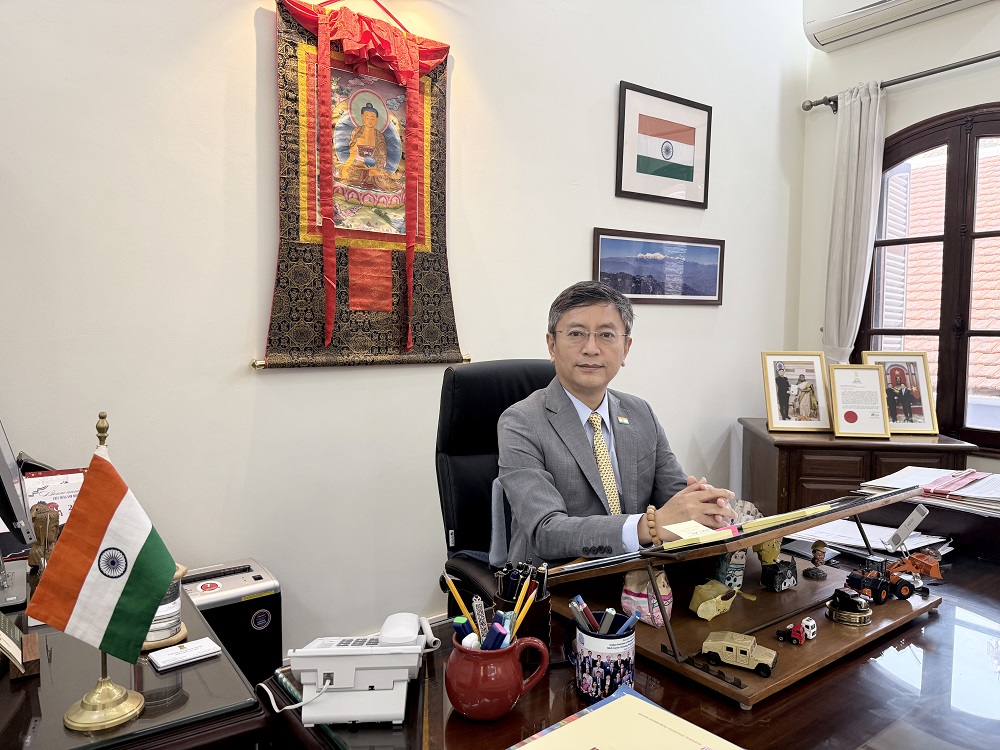
Mr. Tshering W. Sherpa, Ambassador of India to the Socialist Republic of Viet Nam
We are noticing significant collaboration between the two sides in digital public infrastructure, fintech, EV, automobiles, pharmaceuticals, and electronics, among others. Financial innovation and digital payments are other exciting domains.
Innovation, critical and emerging technologies, renewable energy and healthcare (pharma and medical tourism) are some areas which hold much promise. AI, quantum computing, next-gen chip design, critical minerals, advanced manufacturing, space technologies, digitization to deliver good governance and data & cyber-security are some of its subsets. We will work together with the Government of Viet Nam in realizing the potential in these critical and novel areas. We are looking forward to welcoming domain specific experts and delegations from India to realize this untapped potential.
At present, businesses of both countries still face many difficulties in the verification of product quality, corporate credibility, and addressing differences in standards. In your opinion, what are the solutions to overcome these challenges to promote trade between the two countries?
India and Viet Nam are aware about certain procedural hindrances being faced by the businesses from each side. These are case-to-case basis and not general in nature. In my opinion, the best way forward is two-pronged.
First, at G2G level, we take steps to continuously upgrade our respective systems on policy changes that have taken place. We do that through the sector-specific frameworks viz. trade, information technology, science & technology, including health and pharma, agriculture, etc., we have bilaterally constituted.
Second, at B2B level, as the Embassy of India in Viet Nam, we endeavour to facilitate as much B2B meetings, both, in India and in Viet Nam, as possible. The Embassy is a window for the business community on both sides. Sitting together and discussing issues iron out a lot of doubts and foster greater confidence and trust among parties involved. Creating stronger linkages between the business communities on both sides is a priority.
Yes, quicker decision making is an aspect that we would welcome. Time is of essence.
- What difficulties and challenges are Indian businesses facing in their operations in Vietnam? What are your recommendations to address these challenges, as well as solutions to further improve Vietnam’s investment and business environment?
Like I said, India and Viet Nam are two rapidly growing economies and aspirational societies with evolving entrepreneurial skills. I would not classify the issues faced by Indian businesses in Viet Nam as “difficulties” or “challenges”. For me, it is more of a difference in respective approaches and to some extent procedures. Of course, language barriers do exist. My task is simple, to keep engaging at the G2G and B2B level and foster confidence and trust. The complementarities and linkages far outweigh the challenges.
We expect a number of business delegations from India, along with governmental officials, to visit Viet Nam in 2026. There have been a number of policy changes on both sides, and it is essential we make use of the changes to further streamline the bilateral processes for our mutual benefit.
At the systemic level, a review of our trade practices that must happen is the ASEAN-India Trade in Goods Agreement (AITIGA) which was signed in 2009. We are working with Viet Nam and other ASEAN Member States on updating and reviewing this trade framework to align with changing and contemporary times. The review will provide more resilience to trade and businesses vis-a-vis market fluctuations in an increasingly uncertain world. We look towards the continued constructive and positive support of Viet Nam in the ongoing AITIGA review. This is a very important step to enhance mutual bilateral trade and investments in Viet Nam and within the ASEAN.
Thank you so much!
Author: Ngoc Anh reports
RECOMMENDED TOPICS