VN
VN
 EN
EN
10/07/2026, 02:38
Business economics
A stepping stone for the open port model at Cai Mep - Thi Vai
Two adjacent ports in the Cai Mep - Thi Vai area have just announced cooperation to create a longer wharf scale, helping to raise exploitation capacity, improve service quality and enhance the ship receiving capacity of both sides. Furthermore, this cooperation is considered to be a premise for the open port model in this area, while partly achieving the goal of developing an international transshipment port at Cai Mep - Thi Vai.
 |
|
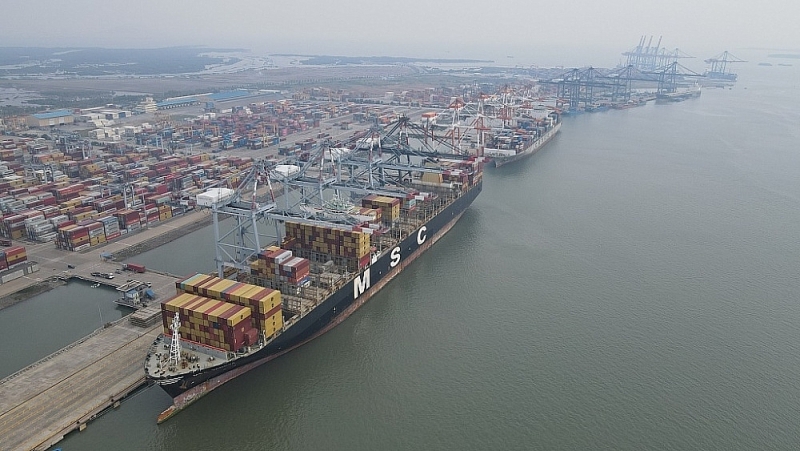
The cooperation to form a common terminal between TCTT and CMIT enables both sides to strengthen exploitation capacity, improve service quality and enhance ship receiving capacity. Photo: TL |
Inadequacies in planning
Mr. Le Ngoc Khanh, Vice Chairman of the People's Committee of Ba Ria - Vung Tau province, said that due to many reasons, the planning of the Cai Mep - Thi Vai port cluster previously revealed many limit ations, especially many container port projects in Mep area are only planned and designed with a wharf about 600 m long. Meanwhile, the strong development trend of the world shipping industry has led to a requirement to increase the size of mother ships. In addition, the Vung Tau - Thi Vai navigation channel is also regularly invested in dredging and upgrading by the Ministry of Transport. Especially, most recently, dredging 15.5 m to Cai Mep International Port (CMIT) has enabled the area Cai Mep wharf to welcome many super-large container ships with a length greater than 350 m to handle cargo.
In reality, each wharf at Cai Mep can only receive 1 mother ship with a length of over 350 m. With the remaining wharf length, each port is unable to receive another mother ship and can only operate barges, causing a waste of investment. On the other hand, the ports are separated by hard fences, making it impossible for the parties to take advantage of the excess capacity. Goods circulating between neighboring ports still have to go around different gates, consuming time and wasting money…
Explaining more about this, Mr. Vu Hong Hung, Director of Tan Cang - Cai Mep Thi Vai, also said that in recent years, Cai Mep port area has had a fairly good growth rate of container throughput at the 2D level. The number of mother ships calling at Cai Mep ports have reached 44 trips/week, of which 2 ports, CMIT and Cai Mep Thi Vai (TCTT), receive a total of 14 trips/week. The size of ships calling at Cai Mep port is increasing; some ships have a length of up to 400 meters, and shipping lines are tending to build and put into operation larger ships. At the same time, shipping lines also have a great need to connect goods between trains.
Meanwhile, the two ports TCTT and CMIT are located adjacent to each other in the Cai Mep deep-water port area, which has only 600 m of wharf in each, so when operated individually, they can only receive 1 mother ship with a ship length of over 350 m. With over 20 m of remaining wharf, TCTT and CMIT ports cannot receive one more container ship and can only operate barges or in an idle and redundant state. Thus, the two ports cannot take advantage of each other's excess capacity.
Collaborate to solve challenges
The above reality shows that combining the exploitation of ports with advantages and similar designs will solve the problem of improving exploitation efficiency and excess design capacity of the ports, helping reduce time and logistics costs, while attracting shipping lines and import-export businesses to use the Cai Mep - Thi Vai port cluster.
Mr. Vu Hong Hung said that the wharves of TCTT and CMIT ports have similar advantages in terms of wharf infrastructure. Therefore, from 2023 up to now, the two ports have piloted cooperation to transport ships and barges back and forth to each other's wharves, circulating goods between the two ports and have released 13 container ships with a throughput 33,740 TEU, ensuring absolute safety, implemented in accordance with the policies and regulations of the Ministry of Transport and the General Department of Customs. With initial successes in cooperation, CMIT and TCTT have taken further steps in comprehensive cooperation on common wharves, taking advantage of each party's idle capacity.
According to Mr. Hung, the wharf cooperation between TCTT and CMIT ports will form a connected wharf with a length of 1,200 m, which enables to accommodate 3 container ships at the same time, Each port contributes 200 m of wharf and jointly exploits a common wharf B3, 400 m long. This not only benefits each port but also optimizes added value for customers and shipping lines. The connection will increase the capacity of the two ports by 30–40%, equivalent to 900,000 TEUs/year, helping to increase the efficiency of wharf exploitation as well as increase revenue for the state budget of the two units.
Also, according to Mr. Hung, this cooperation consolidates the belief of shipping lines and customers about service quality, helping ports ensure compliance with their commitments to shipping lines regarding ship release productivity and shipping time of arrival and departure time, reducing operating costs of shipping lines in the area, and improving the prestige, capacity and service quality of Vietnamese ports in the Cai Mep - Thi Vai area.
"This not only marks an important step in cooperation to make the most of capacity and idle capacity to increase exploitation capacity for each side, but also a breakthrough with a new cooperation model between ports, opening up new opportunities and new potential in seaport exploitation in the Cai Mep - Thi Vai area, as well as a new and promising future for each port," Mr. Hung emphasized.
Mr. Le Ngoc Khanh also believes that the opening of hard fences and coordinated exploitation between TCTT port and CMIT will be an important step towards forming a management mechanism and coordinating joint exploitation between all harbors in the Cai Mep - Thi Vai area, which is particularly an open port mechanism in the near future and a free trade zone orientation associated with the Cai Mep - Thi Vai port cluster.
Author: Customsnews
RECOMMENDED TOPICS