VN
VN
 EN
EN
22/07/2026, 11:00
Business economics
Agricultural exports target double-digit growth
Conclusion No. 18-KL/TW, adopted at the second meeting of the 14th Party Central Committee, established a 10–12% growth target in export turnover for the agriculture, forestry, and fisheries sectors during the 2026–2030 period.
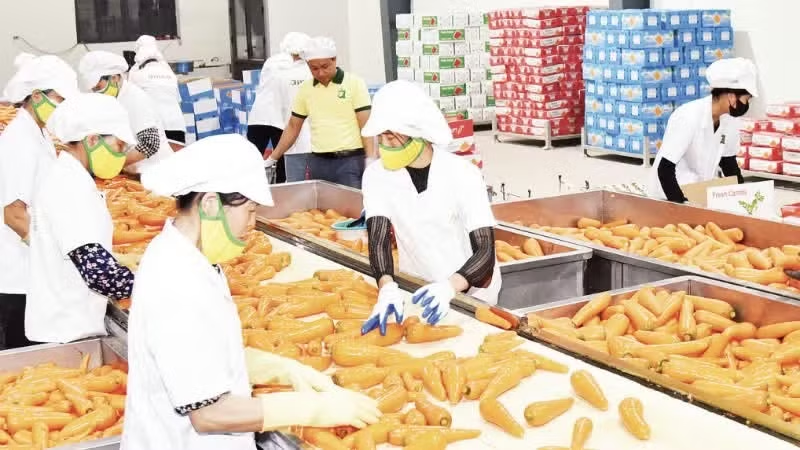
Amid continued volatility in global agricultural trade, achieving this target will be a formidable task for the sector.
The 2021–2025 period marked one of the most impressive growth cycles for Viet Nam’s agricultural, forestry, and fisheries exports. In 2025 alone, export turnover reached a record 70.09 billion USD, rising 12% from 2024.
Positive growth, but limited room for breakthroughs
Tran Gia Long, Deputy Director General of the Planning and Finance Department under the Ministry of Agriculture and Environment, stated that export turnover of agricultural, forestry, and fishery products was estimated at 30.69 billion USD in the first five months of 2026, climbing 9.2% year-on-year. Of the total, agricultural products accounted for 16.38 billion USD, up 6.1%; forestry products, 7.65 billion USD, up 4.5%; fisheries products, 4.65 billion USD, up 10.6%; and livestock products, 308 million USD, up 43.2%.
Growth was driven by several key export markets. China remained the largest buyer, accounting for 20.5% of total exports and recording a growth of 28.4%, while exports to the European Union (EU) rose by 4.2% and those to Japan increased by 3.5%.
Despite the encouraging performance in the first five months of the year, the Ministry of Agriculture and Environment has set an export target of only 74–75 billion USD for 2026, equivalent to a growth of 5.6–7% compared with 2025, falling short of the double-digit growth orientation for the coming period.
Explaining this trend, many economists noted that during the 2021–2025 period, Viet Nam’s agricultural exports benefited from surging international demand and relatively high prices for many agricultural commodities. As a result, export turnover repeatedly achieved new record highs.
However, growth prospects are expected to narrow in the coming years as importing markets impose increasingly stringent requirements on traceability, certificates of origin, emissions reduction, and sustainable development. At the same time, prolonged geopolitical instability is likely to severely disrupt supply chains, logistics costs, and consumer demand across many markets. Moreover, with export turnover having eclipsed 70 billion USD, maintaining double-digit growth will be considerably more difficult than in previous years.
According to Ngo Xuan Nam, Deputy Director of the Viet Nam Sanitary and Phytosanitary Notification Authority and Enquiry Point, the trend towards stricter technical barriers is evident across most major agricultural import markets. China, for example, is shifting from document checks and end-product inspections to monitoring entire supply chains based on data and risk assessments. To maintain its market share in this billion-consumer market, Vietnamese agricultural products must undergo a comprehensive upgrade to comply with increasingly rigorous requirements and regulations.
Alongside China, 2026 also marks significant changes in the EU market, with a series of regulations related to environmental protection, sustainable development, and supply-chain transparency coming into force, including the EU Deforestation Regulation (EUDR) and the Digital Product Passport (DPP).
Meanwhile, the US market presents even greater uncertainties as reciprocal tariff policies and trade defence measures are deployed more frequently and unpredictably. This was partly reflected in the first five months of 2026, when agricultural exports to the US fell by 3.6% year-on-year.
In addition, competition for market share in potential markets such as ASEAN and the Middle East is becoming increasingly intense, as many major exporting countries simultaneously expand their commercial presence, exerting pressure on several of Viet Nam’s key export sectors.
Staying close to markets and upgrading supply chains
To achieve the 2026 export target and lay the foundation for double-digit growth during the 2026–2030 period, Deputy Minister of Agriculture and Environment Dang Ngoc Diep said the ministry has instructed relevant agencies to closely monitor market developments and changes in import policies to provide timely information and guidance to businesses, cooperatives, and farmers, helping them adjust production and seize export opportunities.
The ministry is also expediting negotiations to open new markets, diversify export destinations, develop markets for agricultural by-products, and effectively implement agricultural product traceability systems.
“In addition, the ministry will continue implementing measures to respond to the impact of military conflicts in the Middle East and the US reciprocal tariff policy to ensure export stability,” Diep stressed.
A new measure expected to inject momentum for agricultural export growth is the deployment of agricultural counsellors to key markets such as China, Japan, and the Republic of Korea.
According to Deputy Minister of Agriculture and Environment Hoang Trung, agricultural counsellors will serve as a bridge between domestic regulators, businesses, and host markets. They will also help overcome technical barriers, provide timely market information, and strengthen policy advisory capacity for Viet Nam’s agricultural sector.
However, for market information to translate into export growth, the proactive role of businesses remains decisive.
Nguyen Dinh Tung, General Director of Vina T&T Group, said that the more challenging the market and the greater the competitive pressure, the more businesses must improve compliance and responsiveness to secure market share.
In recent years, Vina T&T Group has invested heavily in export-standard production areas, developed growing-area codes, digitalised cultivation records, and implemented smart traceability systems.
According to Tung, when shipments of Vietnamese pomelos, fresh coconuts, and mangoes recently arrived in Australia, company representatives travelled to Melbourne and Sydney to monitor quarantine procedures and product quality inspections before the goods entered retail distribution systems. At the same time, they held meetings with distributors and conducted on-site surveys at supermarkets to gather information on consumer trends and feedback.
When market information from government agencies, the network of agricultural counsellors, and businesses’ practical experience in importing countries is effectively integrated, it will forge stronger linkages across commodity value chains. This will provide an important foundation for Vietnamese agricultural products to enhance adaptability, increase value, and expand growth opportunities in the years ahead.
Author: NDO
RECOMMENDED TOPICS