VN
VN
 EN
EN
26/07/2026, 02:38
Business economics
Asia’s growth winner defies tariff saga
While 2025 was a rollercoaster year for Vietnam, it defied tariff concerns with yearly growth as high as 8%, in line with HSBC expectations.
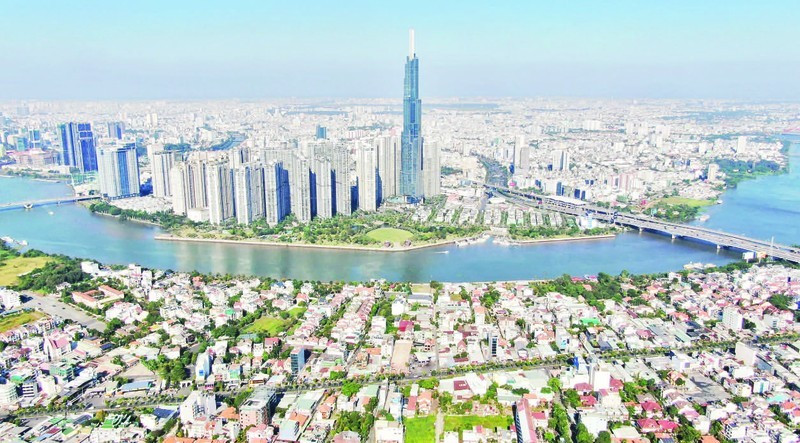
While 2025 was a rollercoaster year for Vietnam, it defied tariff concerns with yearly growth as high as 8%
This would easily place Vietnam as the growth champion in Asia. Although Vietnam was widely expected to be one of the economies with high tariff risks, its trade was not disrupted, but ballooned to a record high instead. Its trade surplus also remained sizeable. Despite facing a 20% headline tariff from the US, Vietnam captured even more market share for certain goods, such as footwear, textiles and consumer electronics.
2025: Joined the ‘8% club’
2025 can be characterised as a rollercoaster year. When the ‘liberation day’ announcement first hit in April, Vietnam was widely regarded as one of the economies most exposed to the tariff risks in Asia, probably next after only China. However, Vietnam has defied the tariff typhoons and proved its economic resilience with remarkable GDP growth, hitting a high of 8% for 2025, largely in line with HSBC’s expectation of 7.9%. With the second-fastest growth in 15 years, this likely easily placed Vietnam as the growth champion, not only in ASEAN, but also in Asia, in 2025.
While 2025 was all about the on-and-off tariff shocks, Vietnam’s trade flourished to a record high of USD928bn, an 18% y-o-y increase. This could be attributed to the powerful impact of frontloading, but we think this is only part of the story. The frontloading impact to the US market has gradually faded, though in Vietnam’s case, export growth is still much stronger than others at a pace of 30% y-o-y on a 3-month-moving-average basis. But it’s not only about frontloading, it’s also about the significance of exporting the ‘right’ products.
There may have been too much news about AI, but it’s largely holding up global trade. Demand for AI-driven chips amid the escalation of the US-China chip race has reshaped the global semiconductor landscape. Therefore, there’s no better time to export the electronics products as a way to shield from the tariff impact. Fortunately, Vietnam is in the league, though its exports are still concentrated in low-end consumer electronics. Vietnam’s electronics exports now account for 35% of its total export basket, jumping from only 5% in 2010. Meanwhile, its textiles and footwear exports fell from its peak of 30% in 2005 to a little over 10% now, reflecting Vietnam’s export journey up the value chain.
In addition to shipping the ‘right’ products, Vietnam has gained more share in the US market. Vietnam’s exports to the US jumped almost 30% y-o-y in 2025, defying tariff concerns. Despite being subject to a headline tariff of 20%, Vietnam has captured even more share in the US market in products such as phones, textiles and footwear.
Concerns about ASEAN’s rising imports from China, are not as simplistic as they may sound. The issue is not only how much ASEAN countries import from China, but also about how they can translate this into surging exports with cheaper inputs, and if they can reap the benefits in end-consumer markets like the US. Vietnam has set a good example of how to firmly grasp the ‘China1’ opportunity to its benefit. While Vietnam’s trade deficit with China widened to USD116bn, its trade surplus with the rest of the world also widened, to USD136bn, resulting in a sizeable trade surplus of USD20bn.
Related to tariffs, the FDI performance is also worth flagging. While new registered FDI fell 12% y-o-y in 2025, the absolute level remained high by historical standards. Beyond the headline number, the shift in investment composition is more interesting. The main culprit of lower investments is Korean FDI, which plunged to a 14-year-low, despite being an early mover. However, Chinese FDI has partially picked up the slack, surging to the position of top investor with a share of 30%, narrowly beating Singapore.
Despite defying the tariff challenges, risks remain, which may cloud Vietnam’s trade prospects. We have constantly asked ‘what’s next’, but there is still little clarity. One ambiguity that matters to Vietnam is the US announcement of a 40% tariff on ‘transshipments’ without a precise definition and how it would be enforced. Another that matters to many Asian economies is the fate of potential semiconductor tariffs.
Trade is strong, but it’s more than trade: Vietnam’s domestic resilience is also holding up. Private consumption grew 8% on the back of a high base while investment accelerated to almost 9% in 2025. The push for infrastructure development serves as a traditional playbook that Vietnam relies on.
On the tourism front, despite missing its earlier target, Vietnam has welcomed a record high number of over 21 million tourists, generating tourism receipts worth USD40bn, equivalent to 7% of GDP. Its tourism recovery has been strong, with tourist numbers almost at 120% of 2019’s level. This is largely aided by a swift return of Chinese tourists, which is impressive considering that Vietnam does not have a visa-free scheme with mainland China.
Elsewhere, inflation remains in check. Headline inflation rose 0.2% m-o-m (3.5% y-o-y) in December, largely driven by a 1% rise in foodstuff prices. This reflects the ongoing food supply disruptions due to earlier flooding, but the impact should not last. Overall, inflation remains largely benign at 3.3% for 2025, in line with HSBC expectations. It benefits from low oil prices and stable food costs, though the latter saw some recent pickup in momentum.
What to expect for 2026?
Vietnam’s 2021-25 average GDP growth reached 6.2%, missing its target of 6.5-7% growth set in the 5-year socioeconomic development plan for the period, but this was due only to the slow growth in the pandemic-hit 2021. Over the medium term, Vietnam strives to become an upper-middle income country by 2030 and ultimately a high-income one by 2045.
In November 2025, a series of socioeconomic targets for 2026 were approved by the National Assembly, providing a sneak peak of what to expect for the 2026-30 period. The 2026 growth target is set at “at least 10%” with a GDP per capita of USD5,400-5,500. “Note that the double-digit growth target is on top of the high GDP growth of 8% last year, requiring a hard push to achieve broad-based growth, encompassing trade outperformance, significant investments and strong consumption”, said HSBC.
All in all, HSBC expects GDP growth to hit 6.7% in 2026 and inflation to remain benign at 3.5%.
Author: NGOC ANH
RECOMMENDED TOPICS