VN
VN
 EN
EN
26/07/2026, 02:38
Business economics
Businesses call for removal of barriers to ICD development
Businesses say the current legal framework still contains many ambiguities and should be promptly refined in a more open and streamlined direction to reduce administrative procedures and accelerate investment in inland container depot (ICD) development.
The Ministry of Construction has officially announced the opening of Cai Mep ICD. The facility is located in Cai Mep Industrial Park, Phuoc Hoa Ward, Phu My Town, Ba Ria–Vung Tau Province (now Tan Phuoc Ward, Ho Chi Minh City). The investor is Cai Mep International Logistics Joint Stock Company.
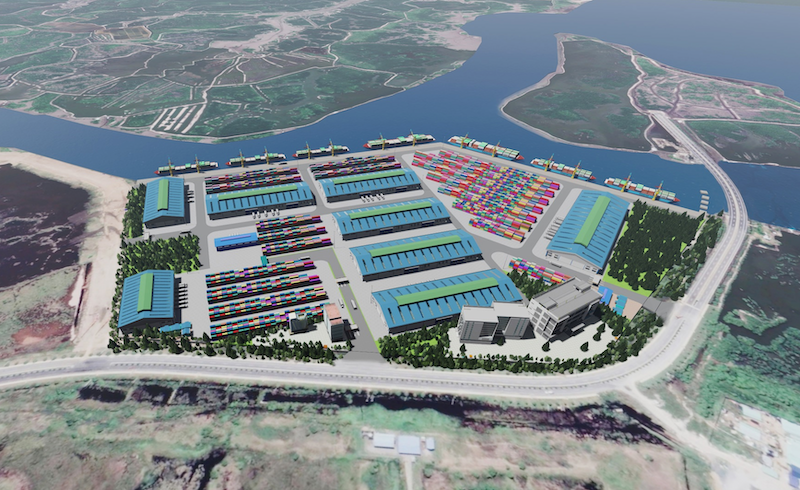
Relevant state management agencies will exercise their sectoral oversight responsibilities at Cai Mep ICD in accordance with the law.
Cai Mep ICD is authorized to provide logistics services and conduct import-export customs procedures in accordance with Government Decree No. 38/2017 on the investment, construction, management and operation of inland container depots, as well as the relevant Investment Registration Certificate and Business Registration Certificate issued by competent authorities.
The investor holds the rights and responsibilities of a port operator as stipulated in Decree 38/2017 and related legal regulations. It is also responsible for operating the ICD in compliance with approved purposes and investment phases, while ensuring safety, security, fire prevention, and environmental protection.
Relevant state management agencies will exercise their sectoral oversight responsibilities at Cai Mep ICD in accordance with the law.
The Ministry of Construction has assigned the Vietnam Maritime and Waterways Administration to inspect and supervise the ICD’s operations in line with applicable legal provisions.
Cai Mep ICD is the first inland container depot in the Cai Mep–Thi Vai area, capable of receiving cargo via both road and sea transport. As a multifunctional ICD, it is equipped with facilities and equipment suitable for handling various types of cargo, including containers, bulk goods, and project cargo.
Located within Cai Mep Industrial Park, the ICD covers a total area of 38.6 hectares. With 1,100 meters of wharf length, including two transshipment berths accommodating vessels of up to 25,000 DWT and ten barge berths handling up to 5,000 DWT, the facility can serve container ships, container barges, bulk carriers and project cargo vessels, meeting diverse berthing and cargo handling demands.
The opening of Cai Mep ICD marks a significant addition to Southern Vietnam’s logistics infrastructure. Currently, the country has 17 operational ICDs, while Decision No. 979/QĐ-TTg sets a target of 125 ICDs nationwide for the 2021–2030 period, with a vision to 2050. However, the business community believes that the institutional framework governing ICDs needs to be further detailed and completed. A draft decree on ICD investment, construction, management and operation has yet to be promulgated, despite expectations from businesses.
In practice, companies argue that the current requirement to reconfirm compliance with ICD planning is unnecessary. Once a project has received investment policy approval or investor approval, it is inherently aligned with the master plan. Requiring a repeated confirmation only prolongs procedures without adding regulatory value.
Moreover, the process for selecting investors—whether through bidding, auction, or direct appointment—and the procedures for approving ICD construction projects remain unclear. This uncertainty deters businesses, particularly for large-scale projects requiring synchronized infrastructure.
Notably, regulations concerning the conversion of customs clearance points into ICDs lack consistency. For instance, it remains unclear whether the announcement of an ICD’s opening should precede or follow recognition as an official customs clearance location. Different interpretations among ministries and agencies have created difficulties for both local authorities and enterprises.
Experts and businesses therefore advocate simplifying investment procedures through a “single-window” mechanism. This would require closer coordination between the Ministry of Construction, responsible for infrastructure management, and the Ministry of Finance, specifically the General Department of Customs.
Clear technical criteria for Class I, II and III ICDs should also be established. Such clarity is crucial for enterprises when preparing project proposals, determining total investment capital, and forecasting operational efficiency.
Instead of imposing extensive pre-approval licensing requirements, the State should shift toward a post-audit model—conducting inspections and supervision once ICDs are operational. This approach aligns with ongoing administrative reform efforts and supports the socialization of logistics infrastructure investment.
“The demand for ICD development is substantial, but state capital is limited. Therefore, practical incentive policies are needed to encourage leading private enterprises to invest in green and smart ICDs, in line with Resolution No. 68-NQ/TW on private sector development,” an expert emphasized.
Author: THY HANG - TRUONG DANG
RELATED TOPICS
RECOMMENDED TOPICS