VN
VN
 EN
EN
15/07/2026, 02:00
Business economics
Developing human resources for the logistics sector in a new era
Logistics is often described as the lifeblood of the economy, ensuring the flow of goods, connecting production with markets, and enhancing national competitiveness. As Viet Nam enters a new stage of development, there is an urgent need to build a highly skilled logistics workforce capable of harnessing artificial intelligence (AI) and big data.
A significant gap between labour supply and demand
According to research by the Viet Nam Logistics Business Association (VLA), Viet Nam’s demand for logistics personnel could reach approximately 2.2 million people by 2030. Of this figure, around 1.6 million workers will be required by logistics service providers, while nearly 600,000 will be needed to support logistics operations within manufacturing and commercial enterprises.
Meanwhile, current training capacity remains relatively limited. Nationwide, only around 30 universities offer logistics degree programmes or specialised logistics courses, with a combined annual intake of approximately 3,000 students. The college system, which provides training in related fields, can accommodate only an additional 800–1,000 learners each year.
The substantial gap between market demand and the available supply of qualified personnel is creating increasingly visible pressure on the logistics sector. Many companies are compelled to recruit workers from other industries and retrain them to meet operational requirements. According to experts, the core issue is that workforce quality has yet to keep pace with the rapid development of the industry.
Amid constant change in global supply chains, businesses no longer require employees who can merely perform routine tasks. Instead, they need personnel capable of analysing data, managing systems, operating technology, and handling unexpected situations in an increasingly complex business environment.
Hoang Dinh Kien, Chief Executive Officer of Hoa Phat Logistics Joint Stock Company, said that universities are currently providing students with a solid foundation of professional knowledge. However, graduates still need more practical skills.
According to Kien, logistics is an industry closely linked to the movement of goods and influenced by numerous variables. During operations, unforeseen situations involving transportation, warehousing, freight forwarding, and commercial procedures frequently arise. Therefore, problem-solving capability is the factor that ultimately determines an employee’s value.
“Knowledge is a necessary condition, but practical experience and a sense of responsibility, adaptability, and problem-solving skills are the sufficient conditions for a logistics professional to develop sustainably over the long term,” Kien noted.
The AI wave is bringing profound changes to the logistics sector. Technologies such as AI, the Internet of Things (IoT), big data, cloud computing, and blockchain are gradually transforming business operations. From optimising transport routes, forecasting market demand, and managing inventory to coordinating vehicles, supporting customer service, and managing supply-chain risks, AI is becoming increasingly embedded within the modern logistics ecosystem.
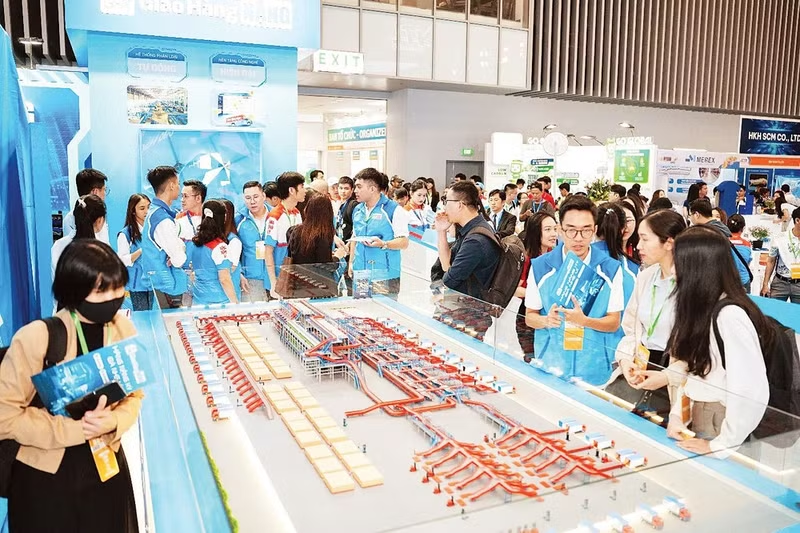
According to Nguyen Anh Duong of the Institute for Policy and Strategy Studies under the Central Policy and Strategy Commission, digital transformation in logistics is no longer a future trend but an essential requirement for improving competitiveness. AI can help enterprises forecast demand, optimise transport schedules, improve vehicle utilisation, and reduce operating costs.
This transformation also means that many repetitive tasks will gradually become automated. The logistics labour market of the future will favour personnel who can apply technology effectively, harness data, and use AI as a decision-support tool.
“At a minimum, students must know how to use AI in their work and understand management thinking when AI is integrated into a company’s operational systems,” Kien emphasised.
Narrowing the gap between universities and businesses
According to Van Ha, Secretary-General of the Viet Nam Association for Logistics Manpower Development (VALOMA), many universities have proactively reformed their curricula in recent years to make them more practice-oriented. In addition to theoretical modules, numerous specialised courses involving direct participation from businesses have been incorporated into teaching programmes.
Beyond sharing professional experience, companies are also working with universities to introduce management software, simulation models, and enterprise resource planning (ERP) systems, enabling students to gain exposure to real working environments while still at university.
A wide range of activities, including specialised seminars, career talks, and scientific research competitions, are being organised regularly to help students stay updated on industry trends and improve their ability to adapt to practical requirements. Experience has shown that early exposure to businesses delivers clear benefits.
According to Phan Truong An, a student at CMC University who completed an industrial engineering internship at Foxconn, classroom learning provides an essential foundation, but it is the corporate environment that helps students better understand the practical operation of supply chains while developing communication, teamwork, and problem-solving skills.
“Businesses will certainly need to provide additional training, but if students already have a strong foundation, the adaptation process becomes much faster,” An said.
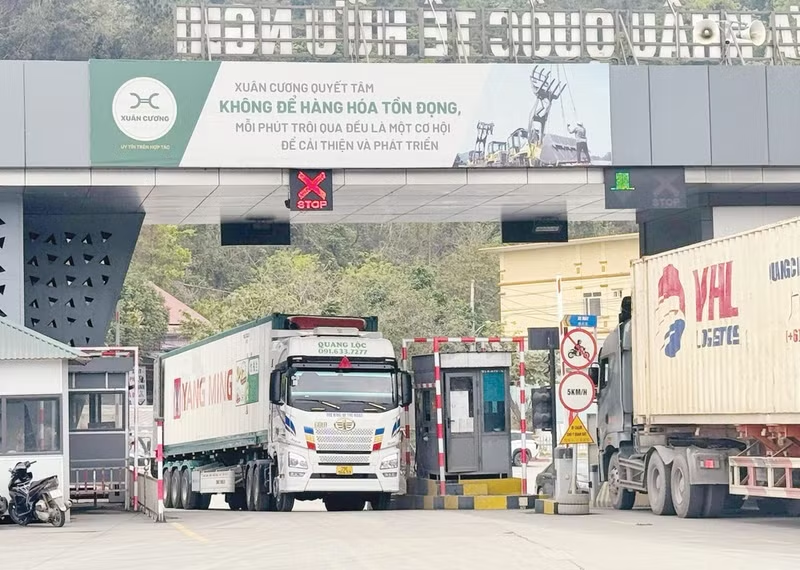
Alongside the development of logistics infrastructure, Viet Nam is advancing a range of important policies related to AI, digital logistics, and green logistics. National strategies on artificial intelligence development, intelligent transportation, and next-generation logistics services all prioritise greater technological application, enhanced supply-chain efficiency, and the development of a highly skilled workforce.
According to experts, fully seizing these opportunities will require comprehensive reforms in training. Programmes should be standardised, specialised foreign-language instruction strengthened, and greater emphasis placed on digital skills, data-analysis capabilities, and modern management thinking.
At the same time, expanding short-term training programmes, reskilling initiatives, and advanced training for the existing workforce will be particularly important. These measures will help workers adapt rapidly to technological changes.
As AI transforms the way the global logistics industry operates, the competitive advantage of enterprises will increasingly depend on workforce quality and technological mastery.
With logistics infrastructure steadily improving, smart border gates being introduced, and digital supply chains continuing to expand, building a workforce with strong professional expertise, innovative thinking, and the ability to adapt to technology will be a decisive factor in enabling Viet Nam’s logistics sector to make breakthroughs in the next stage of development.
Developing human resources for the logistics sector is therefore not merely a matter for universities or businesses. It is a strategic mission that will provide the foundation for national competitiveness in the digital era.
Author: NDO
RECOMMENDED TOPICS