VN
VN
 EN
EN
23/07/2026, 02:00
Business economics
Fiscal policy drives growth
Promoting growth will be one of the top priorities in Viet Nam’s economic development and policy planning in 2026. This will contribute to achieving double-digit growth targets in the 2026-2030 period and beyond.
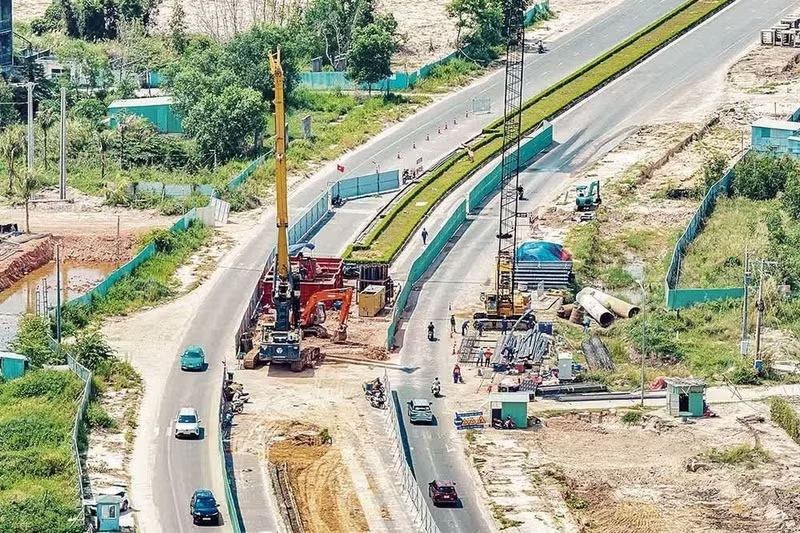
It is predicted that from the second quarter, the economy will begin to feel the adverse impact from the Middle East conflict, making the double-digit growth target more challenging. In response to this new situation, the Ministry of Finance has submitted major groups of solutions to the competent authorities to promote growth in the remaining quarters of 2026.
Cautious and flexible monetary policy
Dinh Xuan Ha, Deputy Director of the State Budget Department under the Ministry of Finance, the focus of fiscal policy in 2026 will concentrate on supporting the economy to promote growth, while implementing solutions to combat revenue losses, transfer pricing, tax evasion, and increasing the exploitation of potential revenue sources, as well as researching options for mobilising new loans and diversifying capital mobilisation channels for the economy.
Besides reducing recurrent expenditures by 10% to carry out social welfare tasks, the Ministry of Finance will focus on accelerating the disbursement of public investment capital, especially national key projects that promote growth; developing the carbon certificate market; and soon launching a cryptocurrency exchange to mobilise more resources for growth.
Based on the socio-economic growth results of the first quarter, the Ministry of Finance is continuing to refine the scenario for adjusting the growth for the whole year of 2026, coordinating monetary policy and other macroeconomic policies to aim for double-digit growth in 2026. This requires close coordination between fiscal and monetary policies to ensure both capital supply to the economy and macroeconomic stability.
Despite achieving impressive growth, Viet Nam’s economic growth in recent years has still depended significantly on credit expansion and capital investment. Notably, credit growth in 2025 has already reached over 19%, and the credit-to-GDP ratio exceeded 145%, indicating limited room for monetary policy adjustments as monetary indicators are already at high levels.
The shrinking policy space presented a more difficult challenge for the governing body: maintaining macroeconomic stability while supporting growth, but without continuing to expand the money supply and credit.
In this context, Professor To Trung Thanh, Head of the Science Management Department at the National Economics University, argued that monetary policy needs to shift to a cautious and flexible approach, focusing on stabilising interest rates and exchange rates to maintain inflation expectations, rather than pursuing credit growth at all costs.
The governing body needs to use credit growth tools more effectively, shifting from a credit allocation mechanism based on size to one based on quality and managing interest rates flexibly.
The focus should shift from expanding credit based on size to improving credit quality, directing capital flows into high value-added sectors such as manufacturing, high-tech industries, and the digital economy; and promoting the development of the capital market to reduce dependence on bank capital.
Supporting growth through an intensive approach
According to Professor To Trung Thanh, short-term growth support mainly comes from fiscal policy, as the room for manoeuvre in other policies has narrowed, especially monetary policy. In this context, fiscal policy is expected to play a more leading role in supporting economic growth with a general orientation towards targeted expansion, linked to improving the efficiency of resource allocation and ensuring national financial security.
Unlike previous short-term stimulus periods, fiscal policy in the current phase needs to aim at supporting growth with an intensive approach, boosting productivity and creating a foundation for long-term development, Professor To Trung Thanh noted.
In the recently published “Annual Viet Nam Economic Review 2025,” the research group from the National Economics University stated that one of the key pillars of fiscal policy in 2026 is to boost development spending, especially public investment focused on strategic infrastructure projects such as transportation, energy, green infrastructure, and digital infrastructure.
Alongside this, revenue collection policies need to be adjusted to support businesses and promote private sector development through selective tax deferrals and reductions, creating a favourable business environment, and reducing compliance costs for businesses. Thus, fiscal policy will shift from a supportive role to an active driving role in growth through a harmonious combination of targeted expansion of spending, budget structural reform, and improved resource efficiency.
According to Nguyen Ba Hung, Chief Economist of the Asian Development Bank (ADB), in order to cope with the volatile external factors, Viet Nam needs to focus on exploiting endogenous resources to maintain sustainable growth and improve the quality of development. Such efforts include maintaining a controlled but loose fiscal policy to support businesses and households in overcoming difficult times.
Public investment continued to be an important lever to compensate for the weakening of private investment and stimulate domestic aggregate demand, while institutional reform and improving the business environment are key factors in promoting the private sector and consumption to become endogenous growth drivers, instead of being overly dependent on exports and foreign investment.
Author: NDO
RECOMMENDED TOPICS