VN
VN
 EN
EN
25/07/2026, 10:00
Culture- travel
Hanoi Opera House brings the capital into Time Out’s list of the world’s 50 best cities
Recently, Hanoi has been named among the “50 Best Cities 2026” by Time Out (UK). Notably, the magazine highlighted the Hanoi Opera House – a project expected to become a new cultural symbol of Vietnam.
In the newly released list of the “50 Best Cities in the World” by Time Out, Hanoi is portrayed as a vibrant city undergoing a striking transformation. The British publication noted that while many Asian cities are gradually losing their identity amid rapid urbanisation, Hanoi still retains its distinctive character while also embracing bold, symbolic leaps forward.
International experts emphasise that now is the ideal time to visit Hanoi, before the city completes its reinvention. From decisive efforts to tackle pollution through electric mobility to the development of large-scale modern infrastructure, Hanoi promises a completely different experience for visitors. Within that broader picture, one of the most striking highlights is the new Hanoi Opera House in the West Lake area. For the British magazine, this is not merely an architectural project, but a symbol of Hanoi entering a new phase.
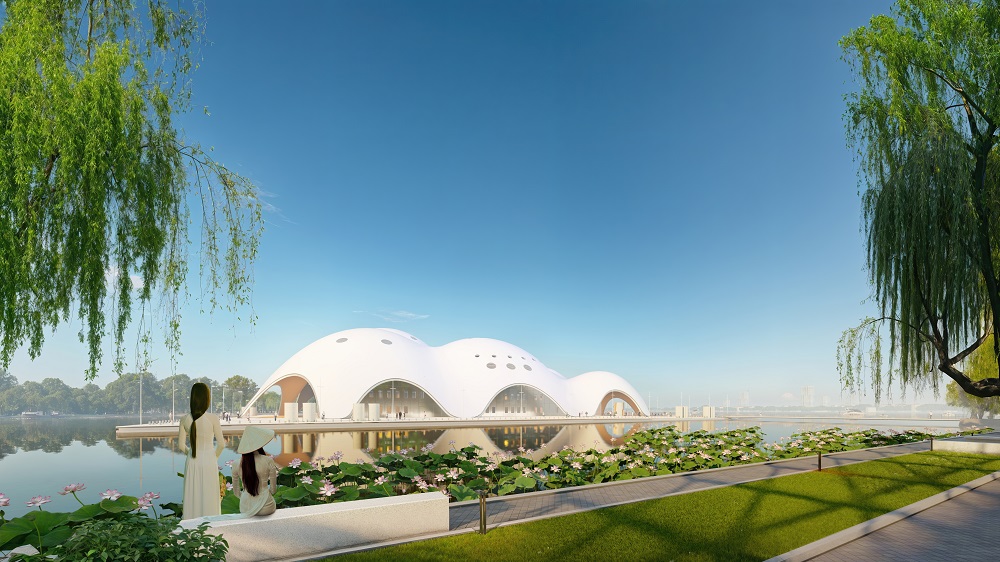
The British magazine is captivated by the “island of music” – Hanoi Opera House
Time Out describes the project as “a stunning ode to the ocean’s gems,” expected to become a new artistic hub of Hanoi – where music, architecture, and natural landscape blend seamlessly. Designed by Italian “architectural wizard” Renzo Piano – the mind behind iconic landmarks such as The Shard and the Pompidou Centre – the Hanoi Opera House embodies a design language that is both contemporary and poetic. With this project, Renzo Piano continues to express his signature philosophy, creating a structure that Time Out likens to “an island of music,” gentle yet rich in symbolic power.
Floating on the surface of Dam Tri Lake like an island, the opera house evokes the image of a pure pearl rising from the water, with undulating domes and a shimmering façade that reflects light differently throughout the day. According to the design, the total floor area is approximately 40,980 square metres – nearly six times the size of a standard football field. The venue will feature two main auditoriums: an opera hall with 1,797 seats and a multifunctional hall equipped with movable seating, allowing flexible configurations for standing events such as live performances and concerts, accommodating 1,430 standing guests and 216 balcony seats.
Beyond the two auditoriums, the complex will include multiple multifunctional spaces such as a grand lobby, rehearsal rooms, and a museum. It is envisioned not only as a venue for a wide range of performances – including symphonic concerts, Broadway-style shows, opera, classical ballet, award ceremonies, galas, and large-scale entertainment events – but also as a major cultural and recreational hub for the people of the capital.
In fact, this is not the first time the Hanoi Opera House has come into the spotlight of international media. Previously, several reputable platforms in the fields of music and architecture have shown strong interest in the project. Classic FM – one of the UK’s leading classical music broadcasters and platforms – described it as “the result of an in-depth study of mathematical patterns in nature,” highlighting the delicate interplay between architecture, music, and landscape. Meanwhile, Vogue France selected the Hanoi Opera House as a representative image of the capital’s emerging symbols that still retain cultural depth.
.jpg)
The Hanoi Opera House is expected to become a new symbol of the capital
Beyond the music world, the international architectural community has also paid close attention to the project. Italy’s Domus magazine described it as a statement of the intersection between modern technology and local identity, while Archilovers compared the opera house to “an architectural jewel suspended above the water.” Beyond its aesthetic value, the project is expected to become “a dynamic factor on the global cultural map,” positioning Hanoi as a new destination for classical arts worldwide.
Globally renowned opera houses such as the Sydney Opera House, La Scala, and the Royal Opera House are not only premier performance venues but also national icons that attract millions of visitors each year. With its distinctive design and prime location by West Lake, the Hanoi Opera House is expected to continue that legacy, becoming a new cultural symbol of the capital while introducing Vietnam to the world through a contemporary, refined, and deeply rooted identity.
Author: DUONG NAM HOANG
RECOMMENDED TOPICS