VN
VN
 EN
EN
20/07/2026, 11:07
Culture- travel
Like one rooted tree, like one family
Today is the Hung Kings Commemoration Day. Through thousands of years of nation-building and nation-defending by our forebears, the spirit of solidarity, “like one rooted tree, like one family”, has become sacred in the consciousness of every Vietnamese person and has grown into a precious national tradition.
Amid the current context of integration and development, that value of origin continues to be nurtured and spread, becoming a firm spiritual anchor that helps strengthen the great national unity bloc.
A sacred national belief
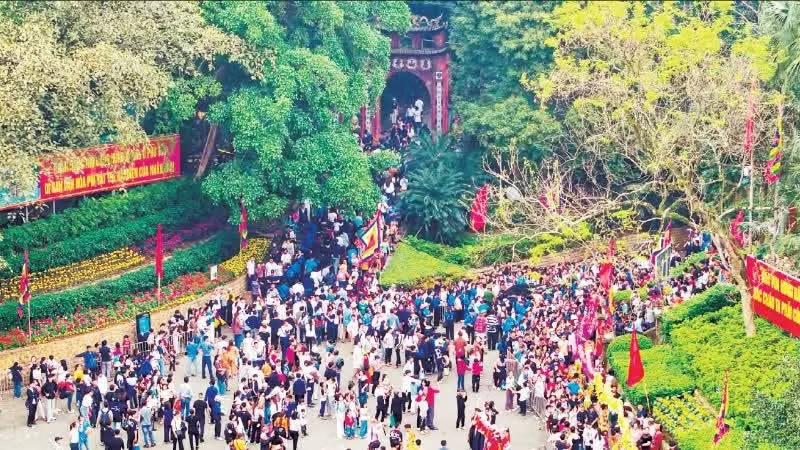
The Hung Kings Commemoration Day has become a sacred symbol in the hearts of every Vietnamese. Through thousands of years of history, each third lunar month, the hearts of millions of Vietnamese across the country beat as one in the direction of Hung Temple, where they offer incense in deep reverence to honour the merits of their ancestors.
According to Pham Ba Khiem, a folk culture researcher in Phu Tho Province, few peoples in the world have a common death anniversary for the entire community in this way. From ancestor worship within each family to the worship of the National Ancestors at Hung Temple, all of it forms a distinctive cultural whole, creating the strength of community cohesion and the unique identity of the Vietnamese nation. This is what gives the Hung Kings worship belief its special character, as a form of cultural practice that is both spiritual and deeply social in meaning.
In reality, the Hung Kings worship belief is not only solemnly practised at Hung Temple and more than 400 historical sites in Phu Tho Province, but has spread throughout all regions of the country and even to places where overseas Vietnamese communities live abroad. Wherever there is a Vietnamese community, there is the presence of the Hung Kings worship belief. On the Hung Kings Commemoration Day, millions of people from all parts of the country, together with overseas Vietnamese, turn towards their roots with profound reverence.
It is not only an occasion to honour the forebears, but also a “moment of connection” between generations, helping each individual feel more clearly their responsibility to themselves, to the community and to society, just as President Ho Chi Minh once reminded us: “The Hung Kings founded the nation; we together must protect it.”
The Hung Kings Commemoration Day is not merely a traditional holiday, but has become a symbol of national spiritual convergence, helping to nurture national pride while also awakening a sense of responsibility for the country’s future. This reflects the enduring vitality and strong adaptability of the Hung Kings worship belief in social life.
On the Hung Kings Commemoration Day and throughout the rest of the year, millions of pilgrims travel to the sacred Nghia Linh Mountain to commemorate the Hung Kings and remember the merits of the ancestors in founding and defending the nation.
At Hung Temple, traditional rituals such as incense offerings, palanquin processions and ceremonial rites are held each year in a solemn and proper manner, creating a vibrant festive space that allows the heritage to “live” alongside the community.
From Nghia Linh, the ethic of gratitude to one’s roots spreads through the life of the nation in ways that are simple yet enduring. From worshipping the National Ancestors at the national level to ancestor altars in every family. From the common death anniversary of the whole nation to the filial way of life in every home. Gratitude thus becomes a unifying thread running through the spiritual life of the Vietnamese people.
According to Associate Professor Dr Bui Hoai Son, standing member of the National Assembly’s Committee for Culture and Society, the Hung Kings worship belief is not a single ritual, nor is it confined to one place in Phu Tho. It is a broad system of cultural practice, stretching from communal houses, temples and shrines in the northern midlands to places of Hung Kings worship in central and southern Viet Nam, and even among Vietnamese communities overseas.
The distinctive feature of this belief lies in the fact that it creates a shared sense of national origin. The Hung Temple Festival is not only a cultural-spiritual event, but has become a symbol of national solidarity.
From Nghia Linh, the ethic of gratitude to one’s roots spreads through the life of the nation in ways that are simple yet enduring. From worshipping the National Ancestors at the national level to ancestor altars in every family. From the common death anniversary of the whole nation to the filial way of life in every home. Gratitude thus becomes a unifying thread running through the spiritual life of the Vietnamese people. For the current flowing from Nghia Linh to continue spreading in today’s life, it is necessary not only to preserve the values of the past, but also to ensure that the heritage lives with the times.
Spreading values in a new space
The Hung Kings Commemoration Day in 2026 takes place in a special context, as a new development space has been formed through regional linkages among Phu Tho, Vinh Phuc and Hoa Binh. Not only a major cultural and spiritual event, this year’s Hung Temple Festival carries deeper meaning as a point of convergence and diffusion of sacred root values to Vietnamese communities both at home and abroad. In that flow, Phu Tho, the ancestral land, now stands before a major opportunity to affirm its role as a cultural and tourism centre of the northern midlands and mountainous region.
Following the expansion of Phu Tho’s development space, this land of origins now has the opportunity to become a major cultural-tourism centre of the northern midlands and mountainous region. From the heritage of the Hung Kings era to the cultural identity of ethnic groups such as the Muong, Dao and Tay, all combine to form a richly coloured, deeply layered picture full of development potential.
Associate Professor Dr Bui Hoai Son, standing member of the National Assembly’s Committee for Culture and Society
According to Associate Professor Dr Bui Hoai Son, following the expansion of Phu Tho’s development space, this land of origins now has the opportunity to become a major cultural-tourism centre of the northern midlands and mountainous region. From the heritage of the Hung Kings era to the cultural identity of ethnic groups such as the Muong, Dao and Tay, all combine to form a richly coloured, deeply layered picture full of development potential.
A highlight of this year’s festive season is the Ancestral Land Culture-Tourism Week, featuring a wide range of activities that harmoniously combine traditional and modern elements. Visitors coming to Phu Tho not only have the opportunity to make a pilgrimage to their roots and offer incense in memory of the Hung Kings, but can also experience the distinctive cultural space of this ancestral land. The melodies of Xoan singing, recognised as an Intangible Cultural Heritage of Humanity, are performed at ancient communal houses and shrines, giving visitors an authentic sense of the spiritual and cultural life of local residents.
In the ceaseless flow of the times, the values of “a hundred trees from one root, a hundred children of one family” still retain their full meaning, becoming a spiritual support for the Vietnamese nation as it moves firmly forward on the path of development and builds an advanced culture imbued with national identity in the new era.
Beyond cultural activities, the Hung Temple Festival is also an occasion to promote Phu Tho’s tourism image through its outstanding destinations. From the sacred beauty of Tay Thien and the poetic charm of Tam Dao to the vast tea hills of Long Coc and the rare hot mineral springs of Thanh Thuy, the Hung Kings Commemoration Day in 2026 has opened up a new image, one that is both solemn and traditional, yet also dynamic and modern.
This is not only a journey back to the roots, but also a journey of discovery, experience and connection, where the past, present and future blend into a unified whole.
In the ceaseless flow of the times, the values of “a hundred trees from one root, a hundred children of one family” still retain their full meaning, becoming a spiritual support for the Vietnamese nation as it moves firmly forward on the path of development and builds an advanced culture imbued with national identity in the new era.
Author: NDO
RECOMMENDED TOPICS