VN
VN
 EN
EN
06/07/2026, 02:00
Business economics
Logistics human resource development in new era
As e-commerce expands, exports grow, and new-generation free trade agreements demonstrate their effectiveness, the need for a modern and efficient logistics system is becoming increasingly urgent. Alongside this, the issue of human resource development is emerging as one of the decisive factors shaping the sector’s competitiveness.
Within the broader picture of Viet Nam’s economic growth and integration, logistics is increasingly affirming its role as a foundational service industry, responsible for connecting production, goods circulation, and supply chains. However, logistics human resources are now facing the requirement to improve quality and adapt to digital transformation, artificial intelligence (AI), and the increasingly complex fluctuations of global supply chains.
High demand, but supply has yet to keep pace
According to statistics, Viet Nam currently has tens of thousands of enterprises operating in the logistics sector, employing more than half a million workers. However, the number of professionally trained personnel remains quite limited. The Viet Nam Logistics Report 2024 forecasts that by 2035, the sector’s additional workforce demand could exceed 350,000 people, while current training capacity is set to meet only around 10% of market demand.
Reality shows that most logistics enterprises have to retrain employees after recruitment. Up to 85.7% of enterprises must retrain workers through practical work. This reflects a certain gap between university training and the practical requirements of businesses.
Hoang Dinh Kien, General Director of Hoa Phat Logistics Joint Stock Company (Hoa Phat Logistics), stated that in recent years, logistics has received increasing attention from the state, universities, and the labour market. However, from the perspective of employers, there are still gaps that need to be filled.

According to Kien, universities currently equip students with a relatively solid knowledge foundation, but logistics is a highly “hands-on” field that is closely associated with the constant movement of goods and many unpredictable situations.
“The ability to solve problems is the decisive factor determining whether workers can perform well in the industry or not. This is not only about professional knowledge but also requires practical experience, diligence, dedication and passion for the profession,” Hoang Dinh Kien shared.
Unlike fields with highly standardised processes, logistics always contains many variables during transportation, warehousing, and goods delivery. A disruption in just one stage can affect the entire operational chain. Therefore, workers not only need to understand professional operations but also possess quick reaction capabilities and flexible problem-solving skills.
AI is redefining the logistics sector
One of the biggest changes currently taking place in logistics is the wave of digital transformation and AI application. According to Hoang Dinh Kien, AI is not only affecting logistics but is also changing the operational nature of most industries. However, in logistics, where many manual processes and uneven digitalisation still exist, the impact of AI can be particularly profound.
“AI will make major contributions to the management, operation, and optimisation of the logistics ecosystem. In the coming period, AI may change the nature of jobs in the industry, and this is something students as well as the labour market need to prepare for and adapt to,” Kien observed.
Accordingly, future logistics human resources will no longer rely solely on traditional professional knowledge, but will need to be equipped with systems thinking, data management capabilities, and the ability to use technology as a work-support tool.
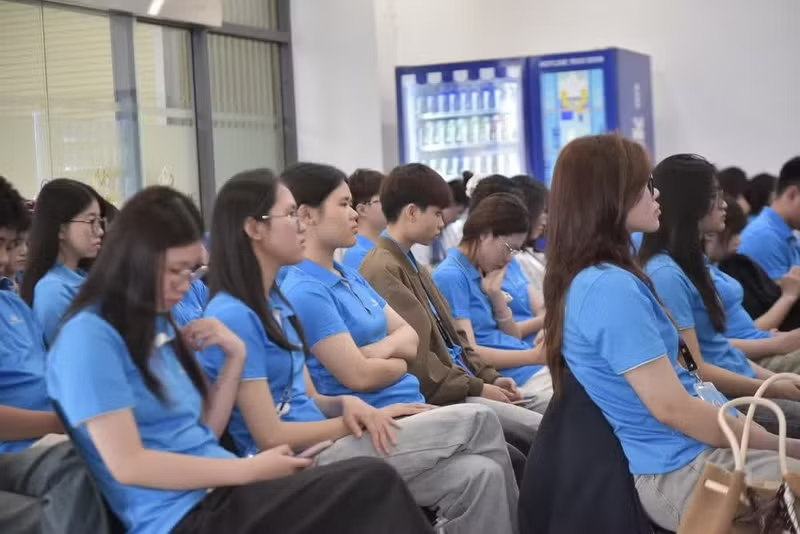
Kien believes that even while still at university, students should learn how to apply AI to management and operations, thereby creating added value for enterprises. To create opportunities for practical exposure, Hoa Phat Logistics is currently organising a competition on AI applications in business management with the participation of many universities in Ha Noi. Through this event, the enterprise is not only seeking new ideas but also aims to strengthen connections with students and educational institutions.
As logistics increasingly becomes associated with smart management models, demand for personnel capable of operating digital systems, exploiting data, and adapting to automation is forecast to continue rising. This also places strong demands for innovation on the training system.
Narrowing the gap between universities and enterprises
According to Doctor Nguyen Thi Van Ha, Secretary-General of the Viet Nam Logistics Human Resource Development Association (VALOMA), in recent years many logistics training institutions have made positive changes towards greater practicality. The association is coordinating with universities to review and adjust training programmes annually to ensure they closely align with labour market needs.
“In addition to theory, many universities now invite enterprises to participate directly in specialised modules so that students can access practical experience,” Van Ha said.
A notable trend is the incorporation of technology and management software into teaching. Many universities have begun implementing ERP systems, enterprise management software such as Odoo, or logistics operation simulation tools, thereby helping students gain a more comprehensive understanding of supply chains.
In addition, seminars, specialised conferences and the “Student Coffee” model organised by VALOMA are creating spaces for students to exchange ideas and learn from enterprises. From the learners’ perspective, practical experiences are considered an important foundation helping students shorten the gap between education and the labour environment.
Phan Truong An, a student at CMC University who interned at Foxconn Group, said that during his internship at foreign direct investment (FDI) enterprises, his work was directly related to automated production lines for electronic components. His tasks not only involved monitoring operational data but also identifying bottlenecks, evaluating machinery performance, and proposing adjustments to optimise production processes.
“Although enterprises certainly still need to provide additional training because each place has its own processes, if students have a solid foundation of knowledge from university, they will learn faster and become more proactive when entering real working environments,” Truong An shared.
Accordingly, alongside specialised knowledge, soft skills, communication skills, and problem-solving abilities are important values provided by the educational environment.
Investing in people to enhance national competitiveness
As Viet Nam aims to become a regional logistics hub, the issue of human resource development is no longer solely the concern of enterprises or educational institutions but requires coordinated participation from many stakeholders.

This means that logistics in the new era is no longer simply about transporting goods; it is shifting towards a smart supply chain management model in which workers must simultaneously understand operations, technology, foreign languages, and problem-solving skills. Investment in human resources is therefore not merely a short-term solution to address enterprises’ labour shortages but also a strategic foundation for enhancing national competitiveness within global supply chains.
According to Tran Thanh Hai, Deputy Director General of the Agency of Foreign Trade under the Ministry of Industry and Trade, alongside logistics infrastructure, Viet Nam is promoting smart border gate models and automating transportation, inspection, and customs clearance procedures. If implemented effectively, customs clearance times could be significantly shortened, opening new development space for Viet Nam’s logistics sector. However, modern infrastructure will struggle to achieve its full potential without a workforce capable of operating it.
In the context of the continuously developing digital economy and global supply chains, the demand for high-quality human resources in logistics and supply chain management is becoming increasingly urgent. This requires close connections between universities and enterprises through the coordinating role of associations, thereby creating a training ecosystem closely linked to practical realities and meeting the requirements of the modern labour market.
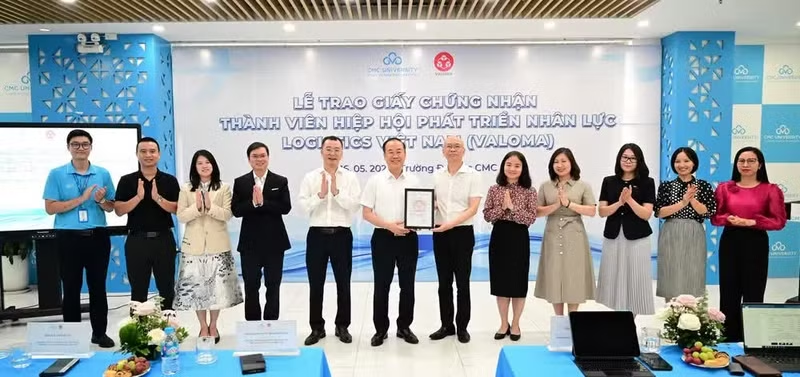
On May 16, the Viet Nam Logistics Human Resource Development Association (VALOMA), together with leaders of the association’s specialised committees and representatives of member universities and enterprises, visited, worked with, and presented a membership certificate to CMC University.
Strategic cooperation activities between the university and enterprises will help to open many practical opportunities for students in professional internships, enterprise experiences, professional skill development, and employment connections in professional environments. The signing of these MOUs is a substantive step, creating a foundation for CMC University and enterprises to coordinate in organising internship programmes, field visits, practical experience-sharing activities, and student recruitment even while students are still at university.
Author: NDO
RECOMMENDED TOPICS