VN
VN
 EN
EN
22/07/2026, 11:00
Business economics
New momentum for the economy
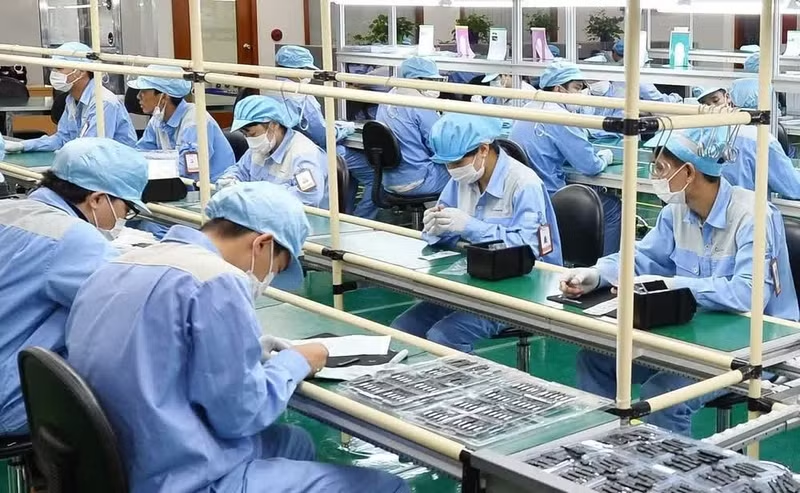
Amid rapidly shifting global trade conditions, import growth outpacing exports — and consequently pushing the trade balance into deficit — should not necessarily be viewed as a negative signal. This is because much of the increase in imports consists of machinery, equipment, and production materials for manufacturing and investment, indicating that businesses are expanding production capacity in preparation for future orders.
Trade deficit trend continues
After recording trade surpluses for 10 consecutive years (2016–2025), Viet Nam's merchandise trade balance has shifted into deficit. According to a report by Dr Can Van Luc and the research team from the BIDV Training and Research Institute, the reversal is driven by three main factors.
First, businesses have increased imports to build inventories of raw materials amid rising global uncertainties. Second, the prices of many imported goods — including energy, fertilisers, electronic components, electrical equipment, and production machinery — have increased. Third, the structure of the economy remains heavily dependent on exports generated by foreign direct investment (FDI) enterprises.
The FDI sector consistently records stronger import and export growth than domestic enterprises and maintains a trade surplus, while domestic firms continue to post trade deficits. Specifically, the domestic economic sector recorded a trade deficit of 20.76 billion USD, whereas the foreign-invested sector, including crude oil, posted a surplus of 6.96 billion USD.
Meanwhile, the latest figures released by the Customs Department under the Ministry of Finance show that the trade deficit has continued to widen. As of mid-June 2026, Viet Nam's total import-export turnover has reached nearly 497 billion USD, with the merchandise trade deficit standing at 16.8 billion USD. During the first half of June alone, the country recorded a trade deficit of 2.77 billion USD as import growth continued to outpace exports.
Rather than viewing this reversal with concern, economists believe it represents a positive signal for long-term growth. Imports remain concentrated in production-related goods, with computers, electronic products, and components accounting for more than 99.2 billion USD, while machinery, equipment, and spare parts exceeded 31.1 billion USD.
Businesses have also increased imports of key production inputs, including fabrics, metals, plastics, steel, and petroleum products. Notably, petroleum imports rose by nearly 59% and liquefied petroleum gas by almost 89%, while imports of maize and ethanol feedstocks surged by more than 213%, reflecting both the energy transition and the needs of manufacturing supply chains. In essence, this follows the familiar model of importing production inputs and exporting finished products.
According to Dr Le Duy Binh, Director of Economica Viet Nam, businesses are proactively stockpiling raw materials to support the next production cycle and meet expected growth in the coming quarters. This is clearly reflected in the import structure, with capital goods reaching 215.99 billion USD, accounting for 94.1% of total imports.
Speaking at the ministry's second-quarter press briefing, Deputy Minister of Finance Nguyen Duc Chi shared the government's perspective that although the trade deficit appears substantial, it reflects businesses taking advantage of favourable conditions to import machinery, equipment, and raw materials in preparation for production.
"Export turnover in the remaining months of 2026 is expected to grow strongly, helping expand total trade, gradually rebalance the trade account, and return Viet Nam to a trade surplus," Nguyen Duc Chi said.
Towards stronger transformation
These assessments are consistent with the findings of UOB's Business Outlook Study 2026, recently released by Singapore-based United Overseas Bank (UOB), which described market indicators as painting "an increasingly optimistic business landscape."
According to the report, business confidence in Viet Nam has rebounded strongly, with 85% of companies expressing optimism, compared with 48% in 2025. This renewed confidence is encouraging businesses to diversify supply chains and increase investment. Most Vietnamese enterprises also plan to expand overseas within the next two years while prioritising the establishment of additional production facilities at home.
As the economy strives to achieve ambitious growth targets, Viet Nam's trade performance in the opening months of 2026 has shown encouraging signs for its full-year objectives. More importantly, it reflects the economy's transition from growth driven primarily by scale to one based on productivity, technology, and innovation. This demonstrates the renewed momentum of the Vietnamese economy as it becomes more deeply integrated into the global economy.
Pham Nhu Anh, Head of Wholesale Banking at UOB Viet Nam, said: "This marks a clear transformation. Vietnamese businesses are not only recovering but are moving towards more fundamental changes and strengthening their supply chains to seize long-term opportunities."
From a macroeconomic perspective, however, a rapidly widening trade deficit over several consecutive months may place short-term pressure on exchange rates and the foreign exchange market as demand for US dollars to pay for imports increases. Nevertheless, Deputy Minister Nguyen Duc Chi argued that, viewed from the perspective of the production cycle, this is a necessary period of "building up reserves for the future."
Indeed, with geopolitical tensions and supply chain risks continuing to persist, businesses' decision to import production inputs early represents a strategic move. These imports are expected to be transformed into high-value export products, helping rebalance the trade account and support sustainable long-term economic growth.
Looking ahead, Dr Can Van Luc and the BIDV Training and Research Institute recommend that Viet Nam continue to strengthen its export sector, maintain trade surpluses in merchandise, reduce trade deficits where possible, and, in particular, narrow the deficit in services trade.
According to the National Statistics Office under the Ministry of Finance, during the first five months of 2026, Viet Nam's total import-export turnover reached 445.12 billion USD, up 25% year on year, with exports increasing by 19.5% and imports by 30.8%. Notably, the country recorded a trade deficit of 13.8 billion USD, compared with a trade surplus of 5.1 billion USD in the same period last year.
Author: NDO
RECOMMENDED TOPICS