VN
VN
 EN
EN
14/07/2026, 11:15
Culture- travel
Regional specialties — Preserving the flavours of traditional Tet
In the increasingly hectic pace of modern life, Tet (Lunar New Year) festival is a moment of quiet reflection, allowing each person to reconnect with familiar values, where traditional flavours become a thread connecting memories, family, and roots. Among these, regional specialties stand out — products that preserve the traditional flavours of Tet for generations of Vietnamese people.
The flavours of Tet — Irreplaceable memories
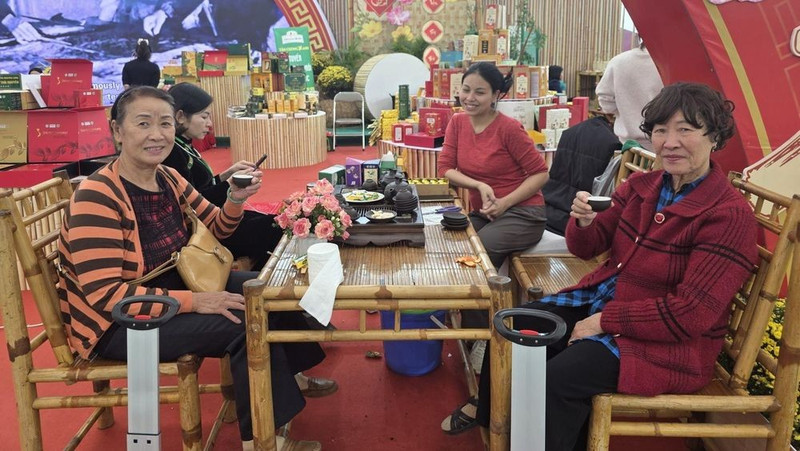
For many, Tet doesn’t begin at the moment of New Year’s Eve, but with the aroma of sticky rice cakes, the spicy taste of ginger jam, the rich flavour of pork sausage, or a hot cup of tea at the beginning of spring. These flavours not only create the festive meal but also awaken Tet memories, evoking images of re, togetherness, and the enduring values of Vietnamese families.
In a market increasingly diverse with many new and modern products, regional specialties still maintain their unique position because they are linked to long-standing customs, traditions, and ways of life. It’s no coincidence that every Tet, consumers seek out familiar products, made using traditional methods, that embody the true “Tet” flavour.
Visiting the Spring Fair 2026, Nguyen Thi Thanh Mai, a resident of Hoan Kiem Ward, Ha Noi, said that her family maintains the habit of drinking Thai Nguyen tea during Tet. According to her, the first cup of tea of the new year is not only for entertaining guests but also a part of traditional customs, contributing to the familiar Tet atmosphere in each family.
“Tet is a time for family res and entertaining guests, so we still choose products with familiar flavours that easily create a warm atmosphere. Thai Nguyen tea is not just a beverage; it’s also connected to our daily lives and Tet memories for many generations in our family. Although the packaging and sales methods may be more modern, the most important thing is that the flavour remains simple and consistent,” Mai shared.
While each region has its own way of celebrating Tet, it is the regional specialties that create the rich yet unified Tet identity of the Vietnamese people. From the sticky rice cake (banh chung) of the North, the cylindrical sticky rice cake (banh tet) of the Central and Southern regions, to pickled onions, pickled shallots, fish sauce, pork sausage, spring rolls, jams, each dish carries within it the story of the land and the cultural way of life.
The presence of these specialties in the Tet fair space or on the family feast table in urban areas shows a very clear need: Vietnamese people still want to preserve Tet in their own way, even if the form may change. Amidst modern cities, choosing a neatly wrapped banh chung (traditional rice cake), a box of traditional jam, or a bottle of traditional fish sauce is not just a consumer act, but a cultural choice.
At the Bo Dau Huong Lien banh chung stall within the framework of the 2026 Spring Fair, Nguyen Hung Duy said that his establishment sells about 100 banh chung each day.
“All the cakes we produce each day are sold out. The cakes are made daily and transported directly to the fair to ensure quality and meet the increased shopping demand of people during the Tet season,” Nguyen Hung Duy happily shared.
The Tet market in recent years has witnessed many changes in designs and sales methods, but what is noteworthy is that traditional values remain the most important “foundation”. Consumers may be willing to experience new things, but during Tet, they still give special priority to products with familiar flavours, associated with long-standing customs.
Therefore, Tet fairs are not just places for buying and selling, but become spaces to recreate traditional Tet, where regional specialties are placed in their rightful position: the centre of spring cultural life. The bustling activity at stalls selling banh chung, Tet jams, tea, and traditional wine shows that traditional Tet remains vibrant in contemporary life, not at all overshadowed by modern consumer trends.
Traditional Tet in the modern context
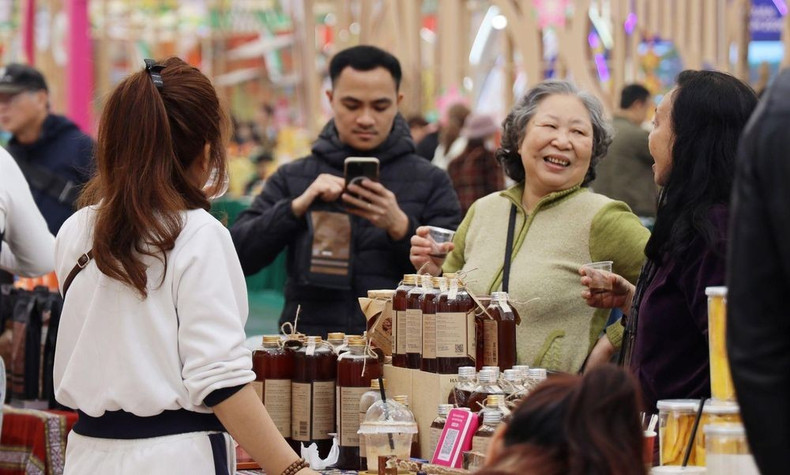
Rapid urbanisation may cause many Tet customs to change to better suit modern times. However, it is precisely in urban spaces that the need to preserve traditional Tet is more evident than ever. Bringing regional specialties to the city helps urban residents retain the familiar taste of Tet, even when they no longer have the means to return to their hometowns early or maintain all the traditional rituals.
Tran Van An, a resident of Tay Ho Ward, Ha Noi, believed that buying regional specialties during Tet is an increasingly clear need for young families. According to him, the urbanisation process and the busy pace of life have simplified many Tet customs, but that does not mean that the value of Tet is diminishing.
“Not every family has the means to return to their hometown early or prepare all the traditional dishes themselves. Therefore, buying banh chung, gio cha (Vietnamese sausage), Tet jam, or other regional specialties is a way for Tet in the city to still retain a familiar atmosphere. It’s also a way for the younger generation to better understand the meaning of Tet, instead of just seeing it as a holiday,” shared An.
Regional specialties thus become a bridge between the past and the present, between the countryside and the city. A traditional dish on the Tet feast table not only fulfils its culinary role but also helps the younger generation better understand Tet and the values that have shaped the national cultural identity.
The good news is that the traditional Lunar New Year is not outside the flow of modern times. Many regional specialties are introduced with more refined packaging and more convenient distribution methods, but the core flavours are still preserved. This harmonious blend of tradition and modernity has helped Lunar New Year products reach a wider range of consumers, especially young people, without losing their original value.
From this perspective, the Lunar New Year market not only reflects purchasing power but also demonstrates the adaptability of traditional culture. When the flavours of the Lunar New Year are preserved and renewed in moderation, the traditional Lunar New Year is not only preserved but also continues to spread in modern life.
The Lunar New Year is a time of new beginnings, where people look forward to good things in the new year. In that moment, familiar flavours bring a sense of peace and fulfilment, allowing each person to slow down, reflect on the past year, and prepare for the journey ahead.
Therefore, preserving the traditional flavours of Tet is not only culturally significant but also a way to safeguard a spiritual anchor in social life. As long as the spring feast still includes traditional dishes, and the kitchen still carries the familiar scent of Tet, the Vietnamese Tet retains its original value.
Looking at Tet fairs and early-year markets, it’s clear that regional specialties still play a central role in preserving the traditional Tet. Amidst countless choices, consumers still seek out flavours that have accompanied them since childhood, as a way of affirming their identity and the continuation of tradition.
As long as the flavours of Tet are cherished, the traditional Tet will not fade in the rhythm of modern life. And it is through these simple yet valuable products that the Vietnamese Tet continues to be preserved, spread, and remain vibrant in every family, every street, every spring.
Author: NDO
RECOMMENDED TOPICS