VN
VN
 EN
EN
25/06/2026, 12:00
Business economics
Restoring traditional crafts in Can Tho City
Traditional crafts in Can Tho City are being effectively restored through the combination of production and experiential tourism, such as the Thuan Hung rice paper village, the bamboo weaving craft in Thuan Hoa, and the flattened green rice flake making craft.
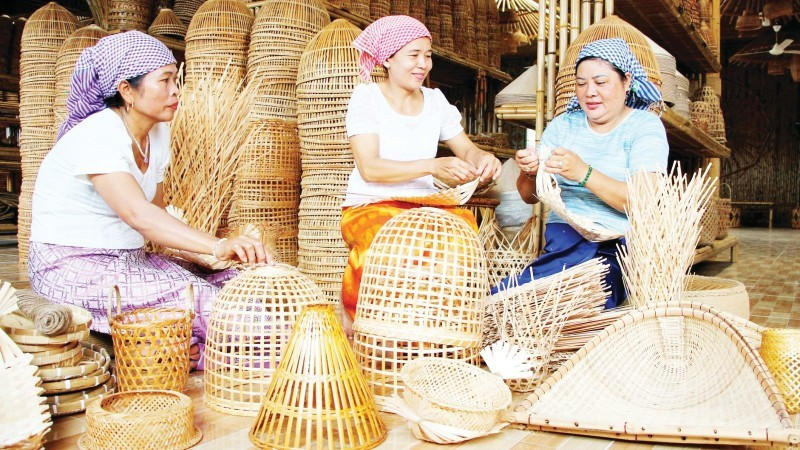
These craft villages are being “rekindled” thanks to improving product quality, promoting OCOP brands, and support from local authorities.
Many craft villages in Can Tho are making a strong comeback by innovating production methods, applying technology, and linking with experiential tourism. One notable example is Thuan Hung rice paper village (Thuan Hung Ward), which has a history of over 200 years. For local residents, rice paper making is not only a livelihood but also a crystallisation of experience, diligence, and passion for the craft, passed down through generations.
Life here differs markedly from other rural areas. At 2–3 a.m., while most people are still asleep , rice paper makers in Thuan Hung already get up to light their stoves. The village is constantly filled with the sounds of rice grinding, calls to work, and the fragrant mix of smoke and rice flour.
Skilled hands swiftly spread batter on moulds, carefully tending the fire and steam, before quickly removing the sheets onto bamboo racks to dry in the sun. The work continues until late evening, only stopping when stacks of white rice paper are neatly arranged, ready for consumers.
In Tan Phu area, the Ut Tho traditional rice paper facility is a highlight of the craft village. In her always-burning kitchen, Van Thi Tho meticulously watches over a pot of gently simmering palm sugar. She said that preparing the batter is crucial to product quality. Rice must be carefully selected and finely ground, then mixed with coconut milk and palm sugar according to precise ratios. Even a small deviation can affect the texture and distinctive flavour.
Evenly spread and properly grilled batches of rice paper, retaining a mild sweetness and characteristic aroma, have created the unique brand of Thuan Hung rice paper. During holidays and Tet, when demand surges, Tho’s family maintains selective production, focusing on two key products: coconut rice paper and sweet rice paper — traditional varieties favoured by consumers.
Currently, producers in Thuan Hung offer a wide range of rice paper types, including savoury, plain, spring roll wrappers, dipping rice paper, sweet rice paper, and coconut rice paper, to serve diverse market demands. Among these, products for festive occasions always see strong consumption, helping maintain stable incomes for local residents.
Although some products have achieved three-star OCOP certification, production scale in the village remains small and manual, with limited market linkages and promotion, meaning that Thuan Hung rice paper has yet to fully realise its value potential.
In Thuan Hoa Commune, the traditional weaving craft of the Khmer ethnic minority is also gradually being revived. From simple bamboo materials, skilful Khmer women create products such as baskets, trays, and handbags, which not only serve daily demands but also embody local cultural identity.
Previously, due to the rise of industrial and plastic products, the traditional weaving craft in Thuan Hoa faced decline. Many families abandoned the trade due to unstable market demand. “In the past, after making products, we had to sell them ourselves. No matter how much we made, we had to find buyers; it was very difficult,” an elderly cooperative member shared.
In that context, Truong Thi Bach Thuy, Director of Thuy Tuyet Bamboo and Rattan Weaving Cooperative, sought ways to revive and sustain the craft village. Born into a family with a weaving tradition, she developed an early attachment to the craft and decided to move the production facility to Thuan Hoa to utilise available materials and create jobs for Khmer women.
“I saw that this place has materials and skilful labourers, but the weaving craft was fading. I kept wondering: why not use local resources to create jobs? Bamboo can produce hundreds of different products; why let the craft disappear?” She shared.
From these reflections, Thuy Tuyet Bamboo and Rattan Weaving Cooperative was established and quickly became a bright spot in preserving traditional crafts. The cooperative now produces more than 700 product designs, from household items to decorative goods, supplying various localities and exporting to five countries. It provides stable employment for dozens of Khmer women, who receive materials at home, work flexible hours, and do not have to worry about market outlets, as their products are fully purchased.
“I learned weaving from my mother-in-law. Previously, after finishing products, I had to find buyers myself. Now I just deliver them to the cooperative and earn a stable income. Each month I earn an extra 4–5 million VND while still taking care of my family,” said Truong Thi Hong.
Beyond handicraft production, the cooperative has expanded into interior decoration, built bamboo works, homestays, resorts, and developed experiential tourism. “In the future, I want to link bamboo with community-based and educational tourism. Children and visitors can experience the entire process, from selecting bamboo to completing products. This is the best way to preserve culture and spread the traditional craft,” Thuy emphasised.
At the same time, the cooperative is collaborating to develop bamboo raw material areas and apply processing technologies to improve product quality, meeting export standards. For her outstanding contributions, Truong Thi Bach Thuy has been recognised as a national artisan in the bamboo and rattan weaving sector and has won many awards in start-up competitions.
Along with weaving, the traditional craft of making flattened green rice flakes of the Khmer ethnic minority in Phuoc Quoi Hamlet, Thuan Hoa Commune, also has a history of over 100 years and is closely associated with the Ooc Om Boc festival. Although the number of households practising the craft has declined, some facilities still maintain year-round production, creating jobs for local labourers. The family of Lam Minh Thoi is one outstanding example. As a fourth-generation practitioner, he has improved techniques by inventing a pounding machine, significantly reducing labour and costs.
“I have been attached to making flattened green rice since childhood, so I am passionate about developing this traditional craft. As all stages were manual and labour-intensive, I designed a pounding machine myself,” he shared. Despite being supported by the machine, he still preserves traditional elements during the production process to maintain the product’s distinctive flavour.
To promote the value of craft villages, Can Tho City is implementing the project “Preserving and promoting the traditional cultural values of ethnic minorities in association with tourism development” under the National Target Programme for the 2021–2030 period. This is seen as an important direction to integrate the cultural values of the Khmer community into the common flow of an advanced Vietnamese culture that is imbued with the identity and unified in diversity.
Author: NDO
RECOMMENDED TOPICS