VN
VN
 EN
EN
11/07/2026, 07:27
Business economics
Shaping the identity of global metropolis
Throughout its construction and development, Ho Chi Minh City has never lost its aspiration to join the nation in achieving great accomplishments, gradually realising the people’s dream of prosperity.
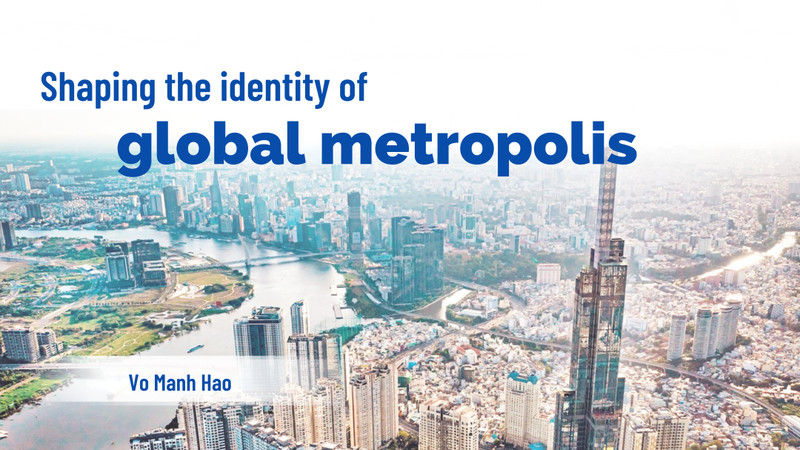
Its tradition of solidarity, dynamism, and constant creativity has been continuously nurtured and promoted, forming both the driving force and distinctive identity that enable the city named after President Ho Chi Minh to overcome obstacles and stride confidently towards the future.
At the end of 2025, Dr Tran Du Lich, a member of the City’s Scientific Council and of the Government’s National Financial and Monetary Policy Advisory Council, launched his book at a tranquil venue on Ho Chi Minh City’s Book Street. His work, Memory – Faith and Aspiration: A Journey of Awareness of Viet Nam’s Economic Development Model (Ho Chi Minh City General Publishing House), not only reveals the determination of a man from Binh Dinh (now Gia Lai Province) who harbours faith and a desire to contribute to the city and the nation, but also allows readers, through each page, to gain a deeper understanding of a Heroic City that embodies a spirit of renewal and creativity, daring to confront challenges in order to rise day by day.
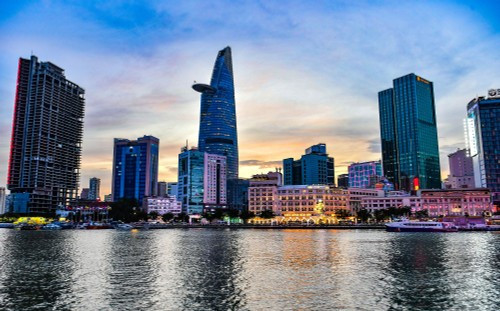
According to Dr Tran Du Lich, the city’s tradition of dynamism, creativity, and bold breakthroughs was most evident in the post-Doi moi (Renewal) period. Between 1990 and 1995, the city’s economy accelerated, achieving double-digit growth of 14–15%. It attracted people from across the country to settle and build their livelihoods, driven by the robust development of the private sector. This dynamic land became the testing ground and starting point for numerous pioneering economic models and policies.
It was home to Viet Nam’s first export processing zone, designed to attract foreign investment. The city was also the first locality to propose the establishment of an Investment Fund for Urban (HIFU) and to pilot the issuance of municipal bonds before a legal framework for local government bonds had been put in place. In addition, it proactively conducted research and prepared the necessary material conditions for the launch of the Ho Chi Minh City Securities Trading Centre (now the Ho Chi Minh City Stock Exchange), marking the birth of Viet Nam’s stock market.
Thanks to its persistence in closely adhering to practical realities, its dynamism, and its willingness to think boldly, act decisively, and take responsibility, the city has, over nearly 40 years of renewal, created and successfully implemented many innovative models and effective approaches. These have added vivid “living material” to the formation of the country’s reform path, contributing ever more to the nation’s journey of “venturing out to the open sea”.
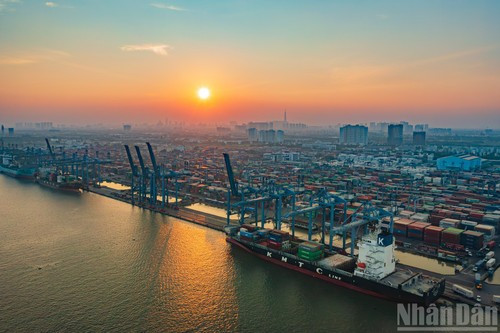
The identity of a dynamic and creative city was also upheld by the Party organisation, authorities, and people of Ho Chi Minh City during the post-COVID-19 economic recovery. From a metropolis that at one point recorded negative growth after months of battling the pandemic, the city rebounded swiftly and rose strongly, reaffirming its role as the country’s economic locomotive and a national hub across multiple sectors. In 2025, the city’s GRDP growth reached 8.3%, with total GRDP estimated at 3.03 quadrillion VND, accounting for 23.5% of national GDP.
The city’s tourism sector continued to demonstrate its leading role and status as a driving centre of the national tourism industry, with total tourism revenue estimated at approximately 279 trillion VND, fulfilling 101% of the 2025 target. It also maintained its position as the country’s largest destination for international visitors, welcoming 8.56 million arrivals over the past year.
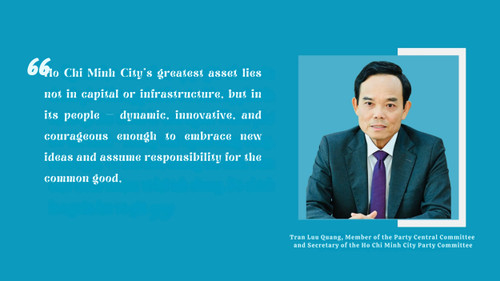
“Ho Chi Minh City’s greatest asset lies not in capital or infrastructure, but in its people — dynamic, innovative, and courageous enough to embrace new ideas and assume responsibility for the common good,” Tran Luu Quang, Member of the Party Central Committee and Secretary of the Ho Chi Minh City Party Committee.
In addition, the city has continued to promulgate numerous socially meaningful welfare policies, notably becoming a pioneer in establishing a comprehensive social security network covering all generations. It has introduced a policy to subsidise 100% of health insurance contributions for residents aged from 65 to under 75, demonstrating respect and care for the older generation. Furthermore, students in Ho Chi Minh City receive a 100% subsidy for health insurance contributions (50% funded by central policy and 50% by the city), ensuring the best possible healthcare entitlements for the younger generation.
These figures clearly demonstrate that Ho Chi Minh City consistently draws upon the fine traditional values forged and nurtured over generations as the driving force to overcome challenges, thereby continuing to shape the profile of a city that serves as the development nucleus of the region – increasingly modern, well-appointed, and compassionate.
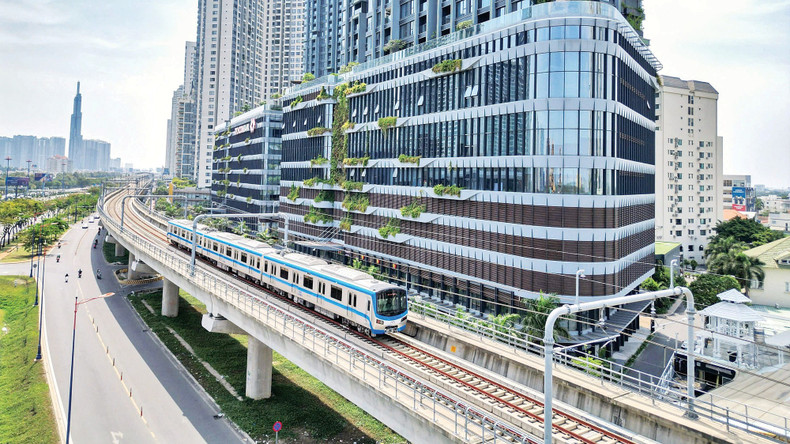
In 2026, Ho Chi Minh City enters a new chapter filled with aspirations. The city’s pulse today embodies not only the character of a particularly dynamic and creative urban heritage centre, but also the freshness and modernity of Binh Duong and the openness and maritime spirit of Ba Ria–Vung Tau. This consolidation has blended three cultural currents, creating strength and further enriching the city’s distinctive identity. The city’s space has expanded, revealing vast potential and room for development in the form of a super-urban area.
The Ho Chi Minh City Party Committee has set the goal of striving by 2030, with a vision to 2045, to transform the city into an “international super city” of Southeast Asia and among the world’s top 100 most liveable cities.
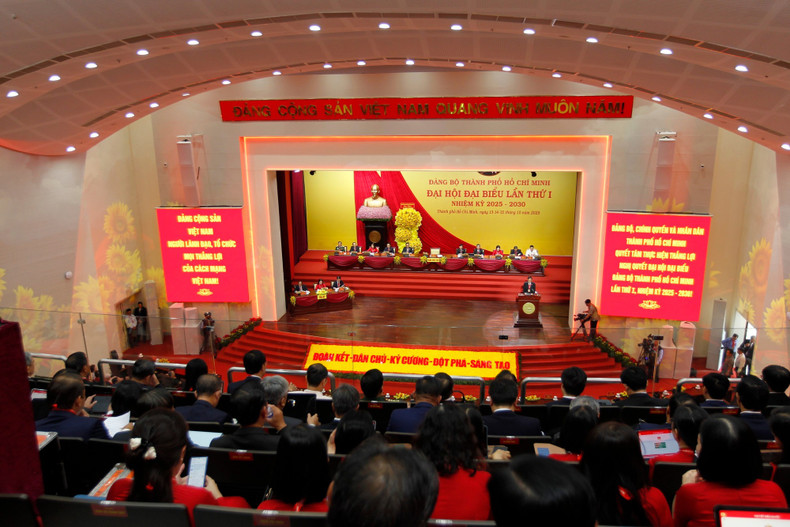
At the first Party Congress of Ho Chi Minh City for the 2025–2030 tenure, the city set out its objective of becoming, by 2030 with a vision to 2045, an “an international-level mega city” of Southeast Asia and among the world’s top 100 most liveable cities, fulfilling its pioneering mission to lead and spread development nationwide.
To achieve these goals, the city has outlined 10 key tasks, including: pursuing rapid and sustainable economic growth based on renewing the growth model and restructuring the economy with science, technology, and innovation as the primary drivers; accelerating comprehensive digital and green transformation; and developing a knowledge-based and creative economy capable of integrating into global value chains. The city will reorganise its development space according to a multi-polar, integrated, and super-connected approach to maximise its advantages, while mobilising all resources to build a synchronised, civilised, and modern infrastructure system.
At a time when conditions have never been more favourable, Ho Chi Minh City must more clearly define and further sharpen its identity, so that its fine traditions can continue to be effectively upheld, serving as a firm springboard to propel the city to new heights in this era of national rise.
In particular, Resolution No. 260/2025/QH15, which amends and supplements a number of provisions of Resolution No. 98/2023/QH15 of the National Assembly on piloting specific mechanisms and policies for the development of Ho Chi Minh City, has been adopted. This demonstrates the Central Government’s continued attention to, and high expectations for, the city’s transformation.
Resolution 260 effectively provides a broad institutional “runway”, removing long-standing bottlenecks and establishing a clearer legal framework. It marks a fundamental shift from a mindset of “seeking pilot mechanisms” to a more proactive model in which the city is granted greater autonomy while assuming fuller responsibility.
This presents a rare opportunity to achieve institutional breakthroughs and accelerate Ho Chi Minh City’s rapid and sustainable development.
“At a time when conditions have never been more favourable, Ho Chi Minh City must more clearly define and further sharpen its identity, so that its fine traditions can continue to be effectively upheld, serving as a firm springboard to propel the city to new heights in this era of national rise.”
Author: NDO
RECOMMENDED TOPICS