VN
VN
 EN
EN
26/07/2026, 02:38
Business economics
Taking the initiative in global agricultural market
Facing the risk of slower growth as the price cycle turns, the agricultural sector needs to rethink how it participates in the market in a more proactive manner.
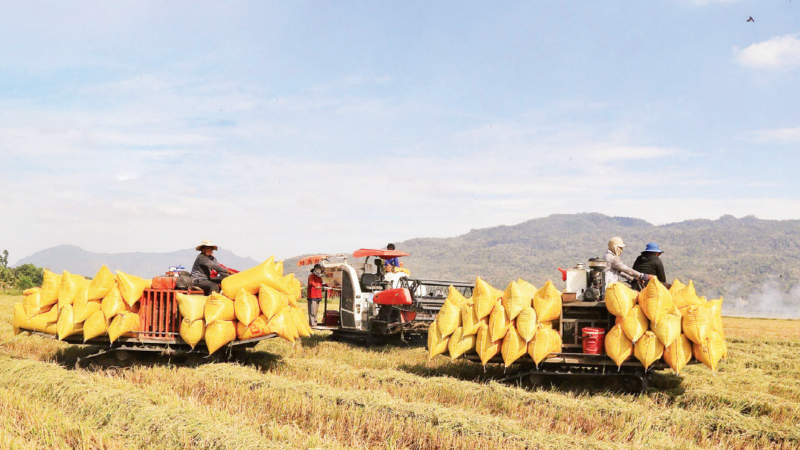
From developing export-standard raw-material zones and organising production in a more structured way to building brands for each product segment, creating a proactive position is a key condition for agriculture to reduce its dependence on global price swings and move towards substantive sustainability.
Price volatility drives growth
According to Do Ha Nam, Chairman of the Viet Nam Food Association (VFA), in 2025 Viet Nam exported more than 8 million tonnes of rice, with export turnover of around 4.1 billion USD, down 10.8% in volume and 27.6% in value compared with 2024. The sharper drop in turnover than in volume shows that export prices were the key factor dragging down growth as global rice demand and prices declined steeply.
By the end of 2025, Viet Nam’s rice export prices fell to below 400 USD per tonne, while the annual average was only nearly 509 USD per tonne. Meanwhile, in 2024 rice exports hit a record 9.18 million tonnes, worth 5.75 billion USD, with an average price of 627 USD per tonne. Although 2025 export volume decreased by just over 1 million tonnes compared with 2024, export value fell by as much as 1.65 billion USD, reflecting the very large impact of global rice price fluctuations on the growth of Viet Nam’s rice exports.
In contrast to rice, Viet Nam’s coffee exports posted strong growth in 2025, setting a record with 1.59 million tonnes and turnover of 8.9 billion USD, up 18.3% in volume and 58.8% in value compared with 2024. This result came from stable global consumption demand, import markets’ policies to diversify supply sources, and especially price factors, with the 2025 average export price reaching 5,661 USD per tonne, up 39.8%.
According to the Agency of Foreign Trade under the Ministry of Industry and Trade, in January 2026 global coffee prices continued to rise due to the combined impact of supply–demand dynamics and monetary policy. Supply remained tight as certified stocks on international exchanges stayed low, while major producers such as Viet Nam and Brazil sold cautiously. However, over the longer term, high prices may encourage production expansion in major supplier countries such as Brazil and Colombia, increasing supply; at the same time, certified stocks may recover, putting pressure on prices to adjust.
As Viet Nam’s coffee exports are still mainly in the form of green coffee beans, with export turnover highly dependent on prices, these are risks that need to be anticipated.
Taking control of supply chains and markets
Pham Thai Binh, Chairman of the Board of Directors of Trung An High-Tech Agriculture Joint Stock Company, said price volatility is an unavoidable factor in the global rice trade, so enterprises need solutions to reduce its impact. If they only export conventional commodity rice, businesses are almost entirely dependent on global prices; to achieve stability, they must shift to higher-end segments such as premium-quality rice, specialty rice, and rice with clear standards and clearly defined markets.
According to Binh, the project on the sustainable development of 1 million hectares of high-quality, low-emission specialised rice cultivation associated with green growth in the Mekong Delta is not only an environmental objective but also an important economic tool, helping the rice sector strengthen its position in the global value chain. When enterprises participate deeply in the project and can control raw-material areas under low-emission standards with transparent traceability, rice is no longer a purely commodity product but becomes a value-added product with its own markets, thereby gradually improving price-negotiation capacity and reducing risks from market shocks.
From the pepper sector’s perspective, Hoang Thi Lien, Chairwoman of the Viet Nam Pepper and Spice Association, said that in 2025 Viet Nam exported more than 247,000 tonnes of pepper worth over 1.6 billion USD, down 1.5% in volume but up 26.3% in value compared with 2024 thanks to higher export prices. However, the price advantage will be limited if raw-material shortages worsen, preventing many businesses from expanding exports. Notably, pepper imports kept increasing in recent years, and in 2025 alone stood at 266.2 million USD, rising 51.1% compared with 2024.
With domestic supply tightening, higher prices no longer guarantee a corresponding rise in export earnings, particularly as firms face ever tougher technical barriers in major importing markets. Likewise, despite achieving a record 5.3 billion USD in export turnover in 2025, the cashew sector risks missing out on the full benefit of higher prices because of raw-material shortages. Addressing the raw-material bottleneck and reshaping supply chains is therefore essential to create new growth momentum across product sectors.
In the new phase, the room for sustainable growth in agro-forestry-fishery exports does not lie only in increasing turnover in line with price swings, but more importantly in enhancing the intrinsic value of products. Therefore, product sectors should move quickly to stabilise raw-material supply through stronger value-chain linkages, so that rising prices do not coincide with a shortage of export-standard goods. At the same time, they need to step up deep processing and traceability to add value, widen access to high-end markets, and strengthen price-negotiation capacity amid continued global volatility.
Author: NDO
RECOMMENDED TOPICS