VN
VN
 EN
EN
26/07/2026, 02:38
Business economics
The journey towards Viet Nam’s carbon credit market
The carbon credit market is a key policy instrument that helps reduce greenhouse gas emissions through market-based mechanisms. However, for businesses to participate in the carbon market in a sustainable manner, relevant authorities need to promptly roll out concrete plans, solutions and an appropriate legal framework.
Million-dollar potential
In Viet Nam, when carbon credits first emerged in the form of certified emission reductions (CERs), a series of projects were implemented under the Clean Development Mechanism (CDM) and sold CERs to international partners. One example is the associated gas recovery project at the Rang Dong oilfield, launched in 1997. Under this project, associated gas was captured and used to produce liquefied gas, fuel additives or fertiliser, instead of being flared directly at the field.
According to statistics from the United Nations Framework Convention on Climate Change (UNFCCC), Viet Nam recorded nearly 260 CDM projects from 1997 to the end of 2022. Of these, 15 projects were successfully registered, selling more than 30 million CERs, mainly in the fields of energy, associated gas recovery, landfill gas and biogas.
More recently, at the end of 2023, more than 10 million tonnes of carbon emissions reductions from forests in the north central region were transferred to the World Bank (WB) through an Emission Reductions Payment Agreement (ERPA). Although this transaction cannot yet be considered a carbon credit project in the strict sense, the financial proceeds were shared directly with local people involved in planting and protecting forests in six former north central provinces, clearly demonstrating the real economic benefits of conserving forests to absorb carbon.
A similar project is being implemented in the south central region and the Central Highlands to provide payments for emissions reductions to forest-protecting communities. Meanwhile, many natural carbon-reducing ecosystems, such as mangrove forests in the Mekong Delta and coastal coral reefs, are also being actively conserved by local residents, pending official recognition through carbon credits.
Yet many loose ends remain…
In response to opportunities to mobilise resources for green and circular economic development, particularly in forestry, a sector with net negative emissions and extensive forest resources, the government and relevant agencies have established a foundational legal framework.
This includes the 2020 Law on Environmental Protection, which for the first time recognises a domestic carbon market; Government Decree 06 issued in 2022 on greenhouse gas emissions mitigation and ozone layer protection; and Prime Minister’s Decision 232 issued in 2025 approving the scheme for the establishment and development of the carbon market for the 2025-2030 period.
According to Associate Professor Nguyen Dinh Tho, Deputy Director of the Institute of Strategy and Policy on Agriculture and Environment (ISPAE), Decision 232 sets out an overall strategic orientation, specific objectives and key task groups for operating the carbon market.
In addition, Government Decree 119 issued in 2025, which amends and supplements several provisions of Decree 06, further clarifies technical and organisational requirements related to greenhouse gas inventory, monitoring, reporting and verification.
Currently, nearly 2,200 enterprises fall under mandatory greenhouse gas inventory requirements. In the 2025-2026 period, around 200 facilities in the cement, iron and steel, and thermal power sectors will be required to conduct inventories and be subject to emissions caps, laying the groundwork for a mandatory carbon market.
However, Tho noted that these legal frameworks are still insufficient to establish a fully functioning carbon market, where emissions and emissions reductions are recorded and remunerated through a fair and transparent market mechanism.
In practice, a sugar producer in Thanh Hoa Province had long planned to transfer carbon credits to a partner, but encountered obstacles at the project licensing stage, as authorities themselves were uncertain in the absence of specific legal guidance.
Furthermore, he pointed out the lack of a unified process for measuring, reporting and verifying greenhouse gas emissions. Even across sectors and industries, different forms of emissions persist without standardisation, something that could lead to discrepancies and incomparable results.
Moreover, a lack of synchronisation also exists among regulatory bodies, as there is no unified mechanism across ministries and sectors, creating potential conflicts between agencies and a lack of accountability. This is particularly concerning given that emitting entities and emissions reduction or carbon storage projects may fall under the jurisdiction of multiple ministries.
Another shortcoming highlighted by Tho is the absence of financial mechanisms to support greenhouse gas mitigation solutions, such as green credit and green bonds. Meanwhile, carbon credits are currently traded at low prices, insufficiently attractive to encourage business participation.
Sharing the same view, Dr Ho Quang Cua said that the rice-shrimp farming model on the Ca Mau Peninsula, implemented by him and his colleagues, although compliant with the Ministry of Agriculture and Environment’s criteria for low-emission rice cultivation, has yet to quantify the actual volume of emissions reductions achieved.
This remains a bottleneck for many emissions reduction projects, as there is no concrete measurement framework, and not all entities have sufficient technological, financial and technical capacity to conduct measurements independently.
He therefore hopes that his model can be properly verified and its carbon credits sold to enterprises, allowing farmers to benefit from emissions reduction achievements and to pursue climate-adaptive, circular agriculture.
Ensuring smooth market operation
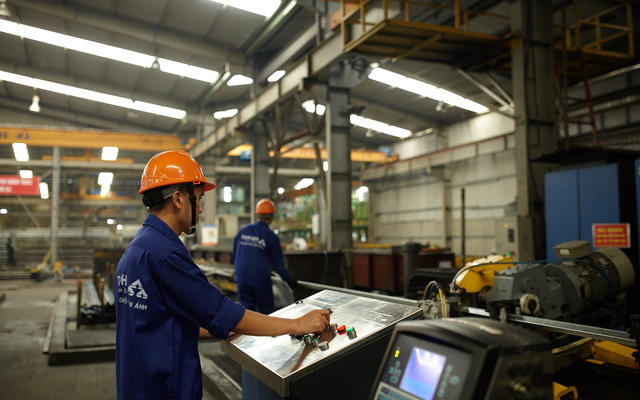
In reality, three industrial sectors, iron and steel, cement, and thermal power, account for more than 70% of Viet Nam’s total industrial greenhouse gas emissions. These are also the three key sectors targeted in the pilot phase of the carbon credit market.
Previously, under a draft decree amending and supplementing several provisions of Decree 06 on greenhouse gas emissions mitigation and ozone layer protection, around 150 enterprises in the iron and steel, cement and thermal power sectors would be allocated emissions quotas during the 2025-2026 period.
To support the pilot implementation of the carbon market, with assistance from the Southeast Asia Energy Transition Partnership, the Department of Climate Change under the Ministry of Agriculture and Environment conducted a project assessing the impacts of a greenhouse gas emissions trading system and carbon credits in Viet Nam. The project proposed two scenarios, allowing emissions quota offsets using carbon credits at levels of 10% and 20%, respectively.
Many experts believe that enterprises subject to emissions caps are typically large in scale, possess strong resources and will take the lead in deploying emissions reduction solutions through technological applications. However, the choice of the maximum allowable percentage for offsetting emissions quotas with carbon credits will significantly influence corporate efforts to implement greenhouse gas mitigation measures.
Drawing on international experience in operating carbon credit markets, Dr Le Xuan Nghia, Director of Consultancy on Development (CODE), argued that the first step is to establish a trading platform where sellers, buyers and investors can operate together.
For example, in Japan, regulators initially selected a number of carbon credit buyers and sellers to participate in an unofficial over-the-counter (OTC) trading platform. Once participants became familiar with carbon credit trading, this platform was integrated into the Tokyo Stock Exchange.
In this way, the carbon credit exchange could leverage existing stock market infrastructure, including investors and speculators, clearing and settlement mechanisms, and a central depository. These resources enhance the convenience of carbon credit transactions, thereby attracting organisations and individuals to participate.
Under such a mechanism, speculators can enter the carbon credit market and generate profits, helping to increase its liquidity. In other words, carbon credits can be more easily bought and sold when supply or demand is limited. In the future, carbon credits could be used as collateral, potentially even being favoured by credit institutions over real estate. This is because property collateral carries risks related to mispricing or market collapse.
With carbon credits, once a trading platform is operational, prices are transparent in the market and are expected to rise over time. In cases of default, banks can readily sell the carbon credits used as collateral, thereby reducing the risk of non-performing loans.
According to forecasts by the Ministry of Agriculture and Environment, Viet Nam could sell 57 million carbon credits annually, generating around 300 million USD or more, depending on carbon credit prices.
Author: NDO
RECOMMENDED TOPICS