VN
VN
 EN
EN
26/07/2026, 02:38
Business economics
Transition from petrol to electric vehicles: Infrastructure must come first
To move towards the roadmap of restricting and banning fossil fuel-powered vehicles within Ring Road 1 from July 1, 2026, and within Ring Road 2 from January 1, 2028, planning and developing a charging station network integrated with the power infrastructure across Ha Noi is critically important.
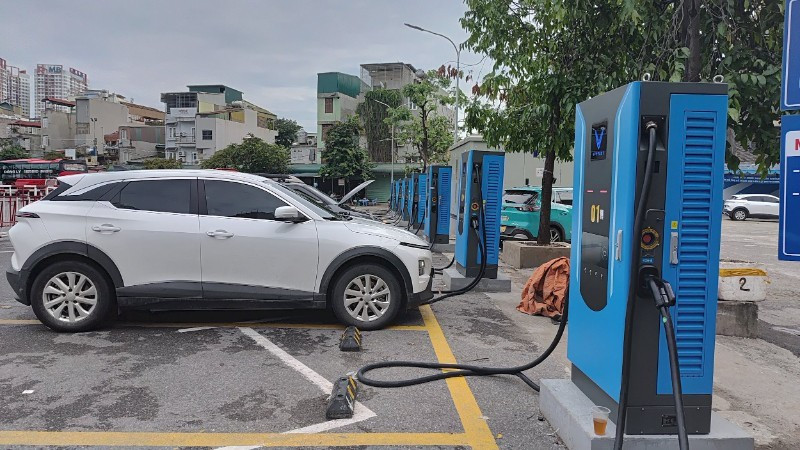
Concerns over the lack of charging facilities
Recently, many households, particularly residents in apartment buildings, have expressed concern following information that petrol-powered motorbikes will be restricted from circulation, while in reality there is a severe shortage of charging stations and parking spaces for electric vehicles. The management board of the HH Linh Dam apartment complex (Hoang Liet Ward) has even issued a document terminating the acceptance of electric motorbikes and electric bicycles in basement parking areas, highlighting that the concerns of residents and apartment management boards are well founded.
Representatives of several apartment management boards noted that basements were not originally designed for electric vehicle charging, yet residents still park vehicles and plug them in for charging. Some even extend, split or connect power sockets on their own to charge vehicles. If the number of electric motorbikes and bicycles increases rapidly, this could pose serious fire prevention and fighting risks. Meanwhile, Le Hai Long (Hoang Liet Ward) shared his thoughts: “The transition is necessary, but residents must be supported during the charging and parking process. Charging stations need to be arranged in a reasonable and convenient manner for people to use.”
According to the Ha Noi Department of Construction, the city currently has around 1,000 charging points, most of which are concentrated in central areas and still fail to adequately meet public demand. In response to this situation, Dao Viet Long, Deputy Director of the Ha Noi Department of Construction, said that the city is facing numerous difficulties and challenges. First is the limited charging infrastructure. There is currently no unified standard for charging stations and connectors, making it difficult for different vehicle brands to share charging facilities. Second, there is no comprehensive master plan for the power grid and charging station network, particularly in inner-city areas.
The leadership of the Ha Noi Department of Construction also pointed out that the socialisation of investment in charging infrastructure lacks a specific legal framework governing management and service pricing. At the same time, concerns remain over the durability and operating range of electric vehicles.
To avoid the current situation where some areas have an oversupply while others face shortages, many experts believe there needs to be a lead agency coordinating with the city’s 126 wards and communes to review and determine locations, land areas and land origins, serving as the basis for land-use conversion and planning for charging station construction.
Regarding power supply, a representative of the Ha Noi Power Corporation stated that with current capacity, the electricity sector can ensure sufficient supply to support the transport sector’s energy transition. However, during the 2026–2030 period, demand will be substantial, making it necessary to clearly identify the number of charging stations to be built each year, by capacity type, to ensure effective power coordination.
Scientific and convenient charging station arrangements
To ensure a sustainable green development trajectory, many experts argue that charging infrastructure should be codified into law. Dr Khuong Kim Tao, former Deputy Head of the Office of the National Traffic Safety Committee, proposed that in addition to planning centralised charging stations, Ha Noi should study regulations requiring mandatory charging stations in new apartment buildings. The construction of charging stations must be synchronised with power transmission lines and located in appropriate positions to ensure safety and convenience. “When electric motorbikes are developed, people can charge them at home. However, manufacturers need to provide detailed guidance, and even send personnel to inspect and guide the installation of charging points on site,” Dr Tao emphasised.
Sharing lessons from several countries around the world, Dr and Architect Ngo Trung Hai, Vice Chairman of the Viet Nam Association of Urban Planning and Development, suggested that China bans electric vehicle charging in enclosed public spaces, including basements. Viet Nam should also manage electric vehicles in a way that completely separates fire and explosion risks from living spaces. Accordingly, large outdoor charging station areas as well as battery-swapping points should be developed to serve residents.
To “green” the transport system, infrastructure must lead the way. According to many experts, it is necessary to build “energy belts”, in which power supply is guaranteed, acting as the “lifeblood” that delivers energy to electric vehicles.
Vice Chairman of the Ha Noi People’s Committee Nguyen Manh Quyen has assigned the Department of Construction to take the lead in comprehensively reviewing regulations, standards and technical codes related to charging stations. The development of charging stations must ensure consistency across the entire city. Enterprises wishing to deploy charging stations are required to coordinate with the Department of Construction to update qualified stations and remove those that fail to meet requirements, thereby enabling the charging station master plan to be completed as soon as possible.
Author: NDO
RECOMMENDED TOPICS