VN
VN
 EN
EN
23/07/2026, 02:00
Business economics
Viet Nam identifies challenges, growth drivers to hit 10% target
With GDP expanding by 8.18% in the first half of 2026, Viet Nam’s economy has shown encouraging signs, underpinned by the performance of major economic centres and key sectors. Nevertheless, mounting domestic and international pressures call for flexible and decisive policy responses.
Nhan Dan spoke with Nguyen Thi Mai Hanh, Head of the National Accounts Department at the National Statistics Office, about the key growth drivers, challenges, and solutions needed to achieve double-digit economic growth for the full year.
Q: The recently released GDP figures for the second quarter and the first six months of 2026 show impressive growth. How do you assess the contribution of provinces and cities to the country’s overall economic performance?
A: Viet Nam’s economy grew by 8.18% in the first six months of 2026, compared with 7.63% recorded during the same period in 2025. This is a highly encouraging result, especially against a backdrop of continuing global economic uncertainty and rising risks.
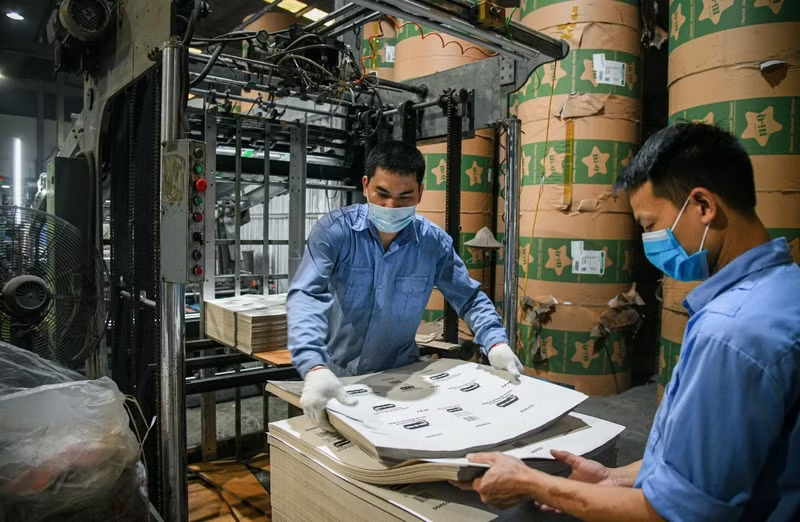
Growth in the second quarter and the first six months across the three main sectors was as follows: agriculture, forestry and fisheries expanded by 4.06% and 3.87%, respectively; industry and construction grew by 10.51% and 9.81%; and services increased by 7.87% and 8.09%.
These figures demonstrate that the economy has continued to recover and maintain relatively stable growth, reflecting effective economic management and the resilience of businesses.
Regarding regional growth, the fastest-growing localities were largely those with strengths in manufacturing, exports, and tourism.
Preliminary estimates show that nine of the country’s 34 provinces and cities recorded economic growth exceeding 10% in the first half of the year, namely Ha Tinh, Ninh Binh, Hai Phong, Quang Ninh, Hung Yen, Bac Ninh, Phu Tho, Tay Ninh, and Thai Nguyen.
The greatest contributors to national economic growth in both the second quarter and the first six months were Ho Chi Minh City, Ha Noi, Hai Phong, Bac Ninh, and Dong Nai.
The economic performance of provinces and cities has a direct and decisive impact on national GDP growth. Localities with large economies act as pillars, creating spillover effects and driving the country’s overall economic expansion.
Q: Despite these positive results, Viet Nam continues to face numerous domestic and international challenges. How are these likely to affect the goal of achieving double-digit growth?
A: The economy’s 8.18% growth in the first half of 2026 confirms that Viet Nam has maintained its positive recovery trajectory, providing a solid foundation for achieving this year’s growth target.
Besides long-standing institutional and structural constraints, the economy continues to face challenges arising from market pressures, changing development trends, and an increasingly volatile global environment.
Regarding macroeconomic stability, the economy will come under considerable pressure if the trade balance shifts from surplus to deficit as demand for imported raw materials increases or global commodity prices fluctuate. Such developments would strain the balance of payments and exchange rate management, deplete foreign exchange reserves, and stoke imported inflation.
Market pressures come from declining confidence and changing behaviour among both consumers and businesses.
Lower household incomes have weakened consumer spending, slowing the circulation of capital within the services and retail sectors and making it more difficult for businesses to maintain sales.
At the same time, fierce competition from imported goods and widening disparities in production capacity have left domestic firms, many of which already face capital shortages, more vulnerable and at risk of losing market share even at home.
Policy management has also become increasingly challenging. Policymakers must strike a delicate balance between competing macroeconomic objectives.
On the one hand, monetary policy needs to be relaxed through lower interest rates to stimulate consumption and support businesses; on the other, controlling inflation and maintaining exchange rate stability require tighter policy.
Shifts in the trade balance and global financial volatility mean that policy decisions must be carefully calibrated in both timing and scale to avoid causing shocks to the economy.
Meanwhile, the global economic environment continues to exert pressure as weakening demand in key export markets reduces orders and foreign currency earnings for export-oriented economies.
At the same time, persistently high interest rates among major central banks and rising global logistics costs are increasing imported inflation, while creating additional risks for exchange rates and domestic supply chains.
Q: Despite these challenges, what opportunities and growth drivers remain for the second half of the year?
A: As we move into the second half of 2026, Viet Nam’s economy faces both opportunities and challenges. The recovery is expected to strengthen further, supported by stable macroeconomic conditions, continued growth in industrial production and services, accelerated public investment, and an improving investment environment.
First, public investment will remain one of the most important engines of growth. Timely disbursement of major infrastructure projects will both stimulate aggregate demand and enhance the economy’s productive capacity.
Second, manufacturing industries will continue to be the principal engine of growth. As export orders recover and supply chains become more stable, the sector is well positioned to remain the leading contributor to growth.
The third growth driver is domestic consumption and tourism. With a market of nearly 100 million people and the continued recovery of tourism and services, domestic demand can help offset external uncertainties.
The fourth driver comes from the private sector and foreign investment. Ongoing improvements to the investment climate, together with business support policies, are expected to encourage further investment and production expansion.
Fifth, science and technology, innovation, and digital transformation have the potential to improve productivity, enhance resource efficiency, and create new sources of economic growth in line with the government’s long-term development strategy.
The economy clearly still has room for growth. The key challenge is to make effective use of existing growth drivers while removing bottlenecks in a timely manner so that potential can be translated into tangible economic results during the second half of the year.
Q: The government has set a target of at least 10% economic growth this year, meaning GDP in the second half of the year would need to grow by 11.9% — the highest rate ever recorded. What decisive measures are needed to achieve this goal?
A: Achieving double-digit growth will be a major challenge amid global uncertainty. To realise this ambitious goal, ministries, sectors, local authorities, and the business community should focus on the following priorities.
First, Viet Nam should continue implementing a targeted and appropriately expansionary fiscal policy. Priority should be given to extending tax and fee relief measures and, in particular, to accelerating VAT refunds to immediately improve cash flow for private enterprises.
For their part, local authorities must remove obstacles to ensure 100% disbursement of the 2026 public investment plan.
Monetary policy should remain flexible, maintain stable interest rates, and channel credit towards production and business activities, particularly export-import enterprises, supporting industries, and logistics.
Second, it is necessary to promote production and trade while improving the institutional framework. This requires further improvements to the investment climate, meaningful reductions in administrative procedures, and lower logistics costs.
The prompt issuance of documents guiding the implementation of new laws, including the Land Law, Investment Law, and Law on Real Estate Business, is essential to close legal gaps.
In the domestic market, demand stimulus programmes, and tourism promotion should be expanded. For exports, efforts should focus on diversifying markets, strengthening early warning mechanisms for technical trade barriers, making full use of free trade agreements, maintaining export growth, and addressing trade deficits effectively.
Third, Viet Nam needs to ensure major economic balances and sustainable development. Energy security must be guaranteed under all circumstances to avoid power shortages for production. Legal obstacles affecting real estate, social housing, and industrial projects should be resolved without delay.
In agriculture, contingency plans are needed to respond to natural disasters. Measures are also needed to remove the IUU “yellow card” and facilitate seafood exports.
Fourth, the business community should strengthen their resilience. Faced with supply chain disruptions and rising maritime freight costs, businesses need to improve risk management, diversify supply sources, and tighten inventory management.
More importantly, compliance with environmental, social, and governance (ESG) standards, together with a transition towards a circular, low-carbon economy, has become an essential factor for overcoming international technical barriers and integrating more deeply into FDI value chains.
Fifth, Viet Nam needs to cultivate new growth drivers. This includes completing and linking national databases, accelerating the application of science and technology, artificial intelligence (AI), innovation, and digital transformation in strategic industries, while expanding the use of cross-border e-commerce platforms to enhance productivity and competitiveness.
The coordinated implementation of these measures will provide a solid foundation for the economy to accelerate and successfully achieve its 2026 growth target.
Author: NDO
RECOMMENDED TOPICS