VN
VN
 EN
EN
08/07/2026, 02:00
Business economics
Vietnam–Russia Relations: New Drivers for Businesses
The Vietnam-Russia Comprehensive Strategic Partnership is entering a new phase, with many cooperation opportunities ahead. Amidst a shifting global geopolitical landscape, the two nations are not only improving their traditional friendly relations but also expanding cooperation in trade, investment, research and technology, and business connections.
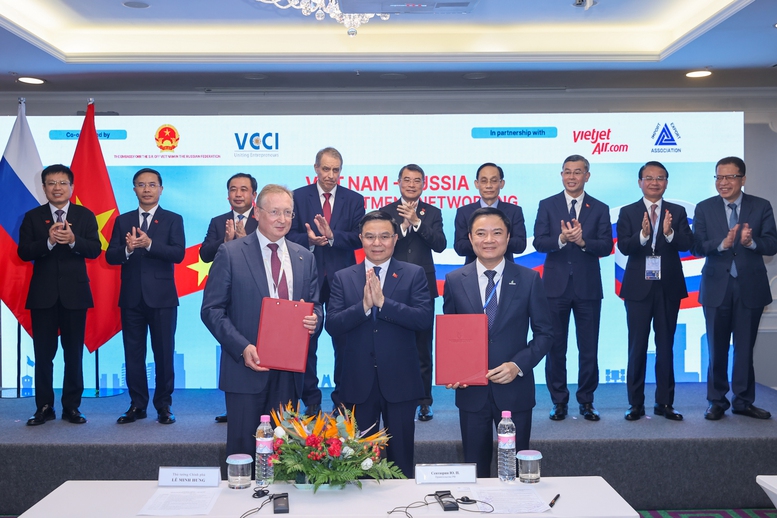
Prime Minister Le Minh Hung and Vietnam's officials witnessed the handover of the investment certificate for the PSC of Blocks 01/17 and 02/17 on Viet Nam’s continental shelf between Petrovietnam and Russia’s Zarubezhneft Group. (Photo: VGP)
These positive signs were clearly demonstrated during Prime Minister Le Minh Hung's working visit to Kazan, Republic of Tatarstan (Russian Federation), to attend the ASEAN–Russia Commemorative Summit celebrating the 35th anniversary of ASEAN–Russia relations.
Promoting business connections and local cooperation
Asso. Prof. Dr. Ho Sy Hung, President of the Vietnam Chamber of Commerce and Industry (VCCI), joined the Prime Minister's delegation and attended a number of important trade and investment promotion activities aimed at strengthening ties between the two countries' business communities. The signing of a Cooperation Agreement between VCCI and the Chamber of Commerce and Industry of the Republic of Tatarstan is a major feature. The agreement establishes a foundation for the two institutions' enduring partnership in supporting businesses, promoting trade exchanges, investing, and organizing business networking events.
The event is significant because it takes place in the context of Vietnam-Russia traditional friendly relations, which have been built and developed over the course of 76 years. Economic cooperation is becoming one of the most significant foundations of bilateral ties, built on the Comprehensive Strategic Partnership established in 2012 and consistently reaffirmed by both countries' high-level officials.
Expanded cooperation with the Russian Federation’s local regions, such as Tatarstan, is regarded as a strategically crucial approach. The new cooperation agreement will provide Vietnamese enterprises with an extra path to directly engage with Russian partners, enhancing cooperation prospects in high-potential industries such as manufacturing, logistics, energy, high technology, and digital infrastructure.
One of the highlights of this business trip was the Vietnam-Russia Trade and Investment Connection Program 2026, which was hosted by VCCI in partnership with the Vietnamese Embassy in Russia, the Russian Import-Export Association, and Vietjet Air.
Many businesses signed cooperation agreements in the presence of Prime Minister Le Minh Hung and senior officials from both nations. The agreements cover various topics, including oil and gas, energy, research and technology, infrastructure development, digital transformation, healthcare, tourism, and investment.
These agreements not only show the business community's growing interest in each other's markets but also establish the groundwork for a number of new cooperation projects in the future. This is seen as an essential step in implementing the strategic cooperation orientations agreed upon by both nations' top leaders, while also contributing to the development of bilateral trade and investment growth in the time to come.
In addition to signing events, the program also arranges direct meetings with firms from both nations, allowing them to exchange market information and seek partners. Many business-to-business (B2B) meetings have been scheduled, with an emphasis on high-growth industries such as energy, technology, logistics, manufacturing, and infrastructure development.
Exploiting the potential from the Vietnam-EAEU FTA
After more than a decade of implementing the Vietnam-Eurasian Economic Union Free Trade Agreement (Vietnam-EAEU FTA), trade and investment cooperation between Vietnam and the Russian Federation has yielded several benefits. However, the existing volume of trade and investment exchanges does not reflect the two economies' potential and complementary strengths.
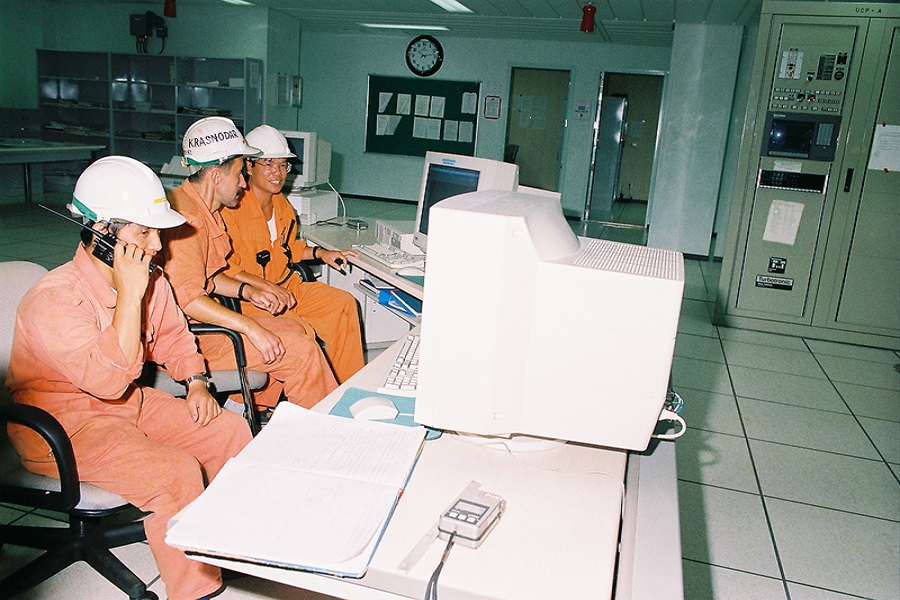
Operations at Vietsovpetro. Photo: Vietsovpetro
At the Vietnam-Russia Trade and Investment Connection Program 2026, Minister of Finance Ngo Van Tuan emphasized the importance of focusing on complementary sectors like energy, manufacturing, agriculture, logistics, science and technology, and innovation to maximize the benefits of the Vietnam-EAEU FTA. Therefore, VCCI must continue to assist firms in capitalizing on tariff preferences, developing market connectivity, and becoming more fully involved in emerging value chains.
This message is also consistent with the cooperation directions discussed by Vietnam and Russia in Kazan, which prioritize promoting logistics, transport, infrastructure, digital transformation, and resolving difficulties in international payments and technical barriers—factors that have a direct impact on the effectiveness of leveraging commitments from the Vietnam-EAEU FTA.
From high-level initiatives to business connection programs, Vietnam-Russia economic cooperation is being developed in a more meaningful and successful manner. Expanded cooperation with Russia's potential-rich regions, strengthened business connections, and leveraged cooperation mechanisms, particularly the Vietnam-EAEU FTA, will provide significant momentum for bilateral trade and investment growth in the coming years.
The bridging role of VCCI is affirmed through the activities carried out within the framework of the Prime Minister's working visit to Kazan, while also demonstrating the determination of both countries' governments, agencies, organizations, and business communities to promote long-term economic cooperation, thereby contributing to the deepening of the Vietnam-Russia Comprehensive Strategic Partnership.
Author: CAM ANH
RECOMMENDED TOPICS