VN
VN
 EN
EN
20/07/2026, 11:07
Culture- travel
Vietnamese patterns: From heritage to a source of creativity
Vietnamese patterns are not merely decorative elements but also preserve stories of culture, history, beliefs and aesthetics across many centuries. Yet in contemporary life, these motifs are largely confined to ancient architectural works or research materials.
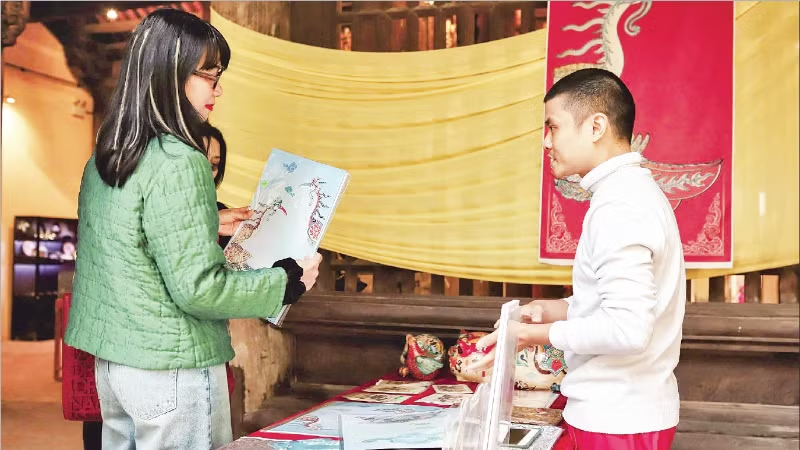
From that reality, Boi An—a creative company founded by young people—is seeking ways to revive patterns as a “storytelling language” that is enduring and full of vitality.
According to architect Bui Tien, founder of Boi An Design Joint Stock Company, Vietnamese patterns should be regarded as a language, as each motif carries layers of meaning—from conceptions of the universe and beliefs to the Vietnamese way of seeing the world. If not understood and used correctly, those values risk being reduced to mere form.
From this awareness, Boi An focuses on researching, decoding and transforming traditional motifs into contemporary products. The team begins by studying original documents, analysing formative structures, and understanding historical context and symbolism, before proceeding to transformation using a design language suited to modern life.
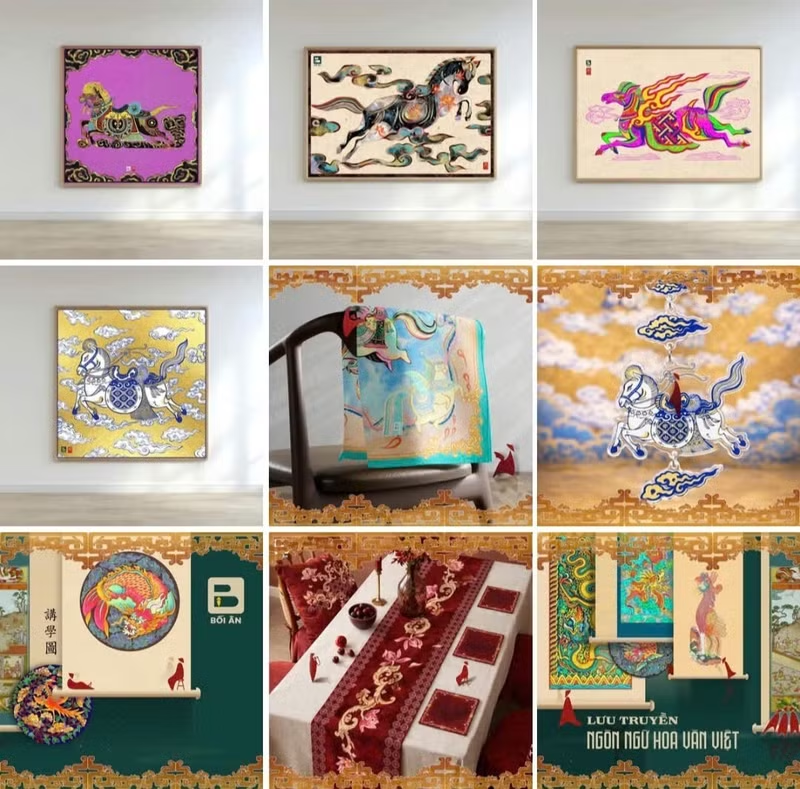
Patterns such as landscapes, mythical beasts or ancient friezes are restructured to appear on silk scarves, packaging, souvenirs, decorative items and calendars.
At the same time, motifs are incorporated into the design of spaces and venues, creating visually rich cultural experiences—becoming part of daily life, seen, used and felt.
Boi An has helped preserve paintings, strokes and print colours on woodblocks, making them clearer and more authentic
A notable aspect of Boi An’s approach is its collaboration with traditional craft villages. Instead of separating modern design from traditional handicrafts, the team seeks to create symbiotic products welcomed by the community.
At Thanh Lieu woodblock printing village in Hai Phong, which boasts 600 years of history in engraving and printing, collaboration between local artisans and young designers from Boi An is opening new directions.
Local artisan Nguyen Cong Dat praised the use of modern techniques, noting that Boi An has helped preserve paintings, strokes and print colours on woodblocks, making them clearer and more authentic, thereby enabling the restoration of many ancient blocks. As a result, the craft village has become lively again, with more activities and work suited to modern society.
Besides Thanh Lieu, Boi An has also collaborated with other craft villages such as Dinh Cong goldsmithing and silver jewellery, Dong Xam silver craft, and toy figurine making.
Having worked with Boi An on several projects, art researcher Dr Tran Hau Yen The commended the company as one of the pioneers in building a digitised motif database in Viet Nam, serving fields such as architecture, fashion, games and film—a necessary direction in the current context of cultural industry development. “What sets Boi An apart is its passion, systematic working capacity and inter-sectoral connectivity,” he said.
Notably, Boi An has shown flexible application by extracting motif clusters, such as a lotus flower or a cloud stroke, to incorporate into specific products. These details are simplified and coloured according to a new palette, suiting modern aesthetics while retaining the original spirit.
Boi An’s activities and products are gradually being welcomed by customers, especially young people. Experiences at heritage spaces or through applied products have helped many approach patterns in new ways.
Boi An is one of the pioneers in building a digitised motif database in Viet Nam, serving fields such as architecture, fashion, games and film—a necessary direction in the current context of cultural industry development.
Art researcher Dr Tran Hau Yen The
Nong My Phuong Thao from Ha Noi said she first encountered Boi An at an art event entitled Kim Ngan Temple Tells Stories about Arts. “Previously, I thought ancient patterns were outdated and quite distant; but through the event, I realised each motif contains profound stories of culture, history and philosophy. When those patterns appear on familiar products, they become closer and more accessible to young people,” Thao shared.
With ambitions to go further, Boi An is carefully laying the groundwork to bring Vietnamese motifs to wider international audiences. Instead of hastily expanding, the group chooses a cautious approach by standardising research, building a unique design language and creating convincing products. The team understands that to take Vietnamese culture to the world sustainably, it must first be clearly seen, beautiful and profound from within.
In the context of globalisation, identity must be expressed through concrete, life-close forms. Each motif placed on fabric, a product or a living space is not just a decorative image. It is a trace of culture and history, an expression of beliefs, a way the ancients viewed the world—continuing to exist in today’s life. When those lines are used, seen and understood, Vietnamese patterns continue to tell their stories in fresher and more vibrant ways in the new era.
Author: NDO
RECOMMENDED TOPICS