VN
VN
 EN
EN
26/07/2026, 02:00
Investment
Bac Ninh strives to attract global FDI flows
Foreign direct investment (FDI) has gradually transformed Bac Ninh into one of the country’s leading industrial hubs, affirming its important position in the global value chain and Vietnam’s national economic development strategy.
Amid globalization and the restructuring of supply chains, Bac Ninh is increasingly seen as a typical model for attracting and effectively utilizing FDI. Behind these achievements lies the convergence of multiple strategic factors, including geographic location, infrastructure, institutional reforms, and the quality of human resources.

Mr. Nguyen Hong Thai, Secretary of the Bac Ninh Provincial Party Committee, and Mr. Pham Hoang Son, Chairman of the Bac Ninh Provincial People’s Committee, visited and held a working session with Samsung Electronics Vietnam Co., Ltd. at Yen Phong I Industrial Park.
FDI as a Driver of Economic Transformation
FDI has played, and continues to play, a pivotal role in Bac Ninh’s economic growth. Beyond expanding production scale, it serves as a key driver in shifting the economic structure toward industrialization and modernization.
In an interview with Vietnam Business Magazine, Mr. Tran Son Tung, Deputy Head of the Bac Ninh Industrial Zones Authority stated that the FDI sector currently accounts for the majority of the province’s industrial production value, export turnover, and state budget revenue. Notably, in 2025, Bac Ninh ranked first nationwide in export turnover, with the FDI sector contributing over 80% of the total industrial production value. This figure reflects the scale, influence, and leading role of foreign capital in the local economy.
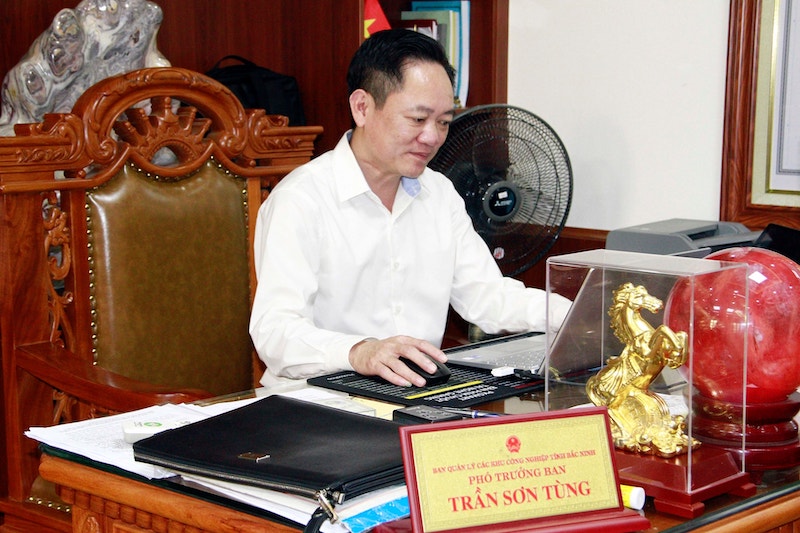
According to Mr. Tran Son Tung, Deputy Head of the Bac Ninh Industrial Zones Authority, the FDI makes a significant contribution to Bac Ninh Province’s socio-economic development.
Beyond economic indicators, FDI has also brought about structural changes. The presence of major multinational corporations such as Samsung, Foxconn, Amkor, and Luxshare has accelerated the transition from an agriculture-based economy to one driven by industry and services. This marks a strategic turning point, significantly shortening Bac Ninh’s path toward industrialization and modernization.
In addition, Mr. Tran Son Tung emphasized that the FDI sector has made substantial social contributions, particularly in job creation. Currently, industrial zones across the province employ approximately 568,000 workers, providing livelihoods for hundreds of thousands of families. At the same time, working in an international environment enables the local workforce to access modern technologies and advanced management practices, thereby sustainably improving human resource quality.
Clearly, FDI has become a strategic “lever,” helping shape Bac Ninh’s economic position in the global integration process.
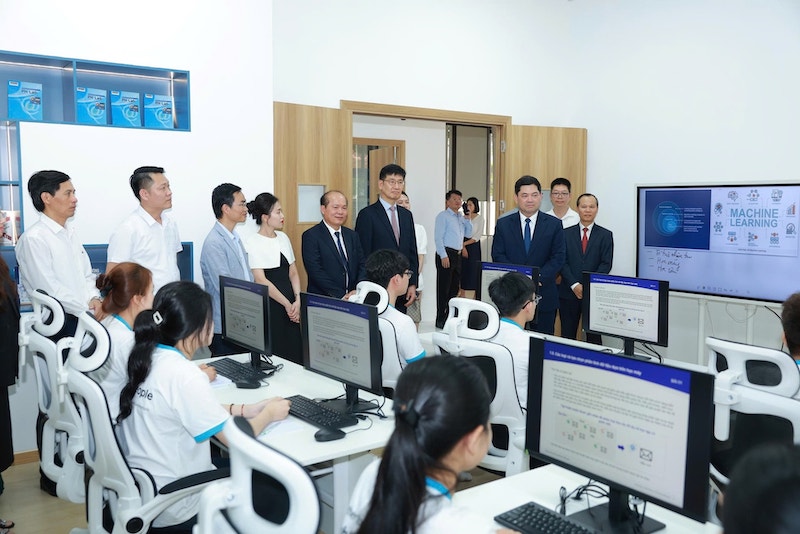
The training course on AI, IoT, and Big Data under the Technology Talent Development Project (Samsung Innovation Campus) at Viet Han College aims to improve the quality of human resources for Bac Ninh Province.
What Creates Bac Ninh’s Investment Appeal?
It is no coincidence that Bac Ninh has consistently ranked among the top localities nationwide in attracting FDI. This success results from the convergence of fundamental and strategic factors that create a strong competitive advantage in the eyes of international investors.
First and foremost is its geographical advantage. Located within the Hanoi Capital Region, Bac Ninh serves as a northern economic gateway with strong interregional and international connectivity. Its proximity to seaports, major economic centers, and raw material regions provides optimal conditions for manufacturing and logistics development, while enabling deeper participation in global value chains.
Alongside this is a well-planned, modern infrastructure system featuring key projects such as Gia Binh International Airport, Ring Road 4 of the Capital Region, and an interconnected expressway network. Additionally, industrial park infrastructure is comprehensively developed, with synchronized technical and social facilities that fully meet investors’ needs.
Notably, Bac Ninh is also at the forefront of digital infrastructure development, with advanced telecommunications systems, internet connectivity, data centers, electronic identification, digital signatures, and national data integration platforms. These factors are increasingly important in the context of digital transformation and the digital economy, enhancing the province’s competitiveness in attracting high-tech projects.
Another critical pillar is a transparent, friendly, and efficient investment environment. Bac Ninh consistently upholds the principle of placing investors and businesses at the center of service. Mechanisms such as “one-stop shop” and “interconnected one-stop shop” have been effectively implemented, alongside breakthrough administrative reforms such as the “24-hour green lane” and “60% green lane” mechanisms for key projects. These initiatives help shorten administrative processing times, reduce informal costs, and build investor confidence.
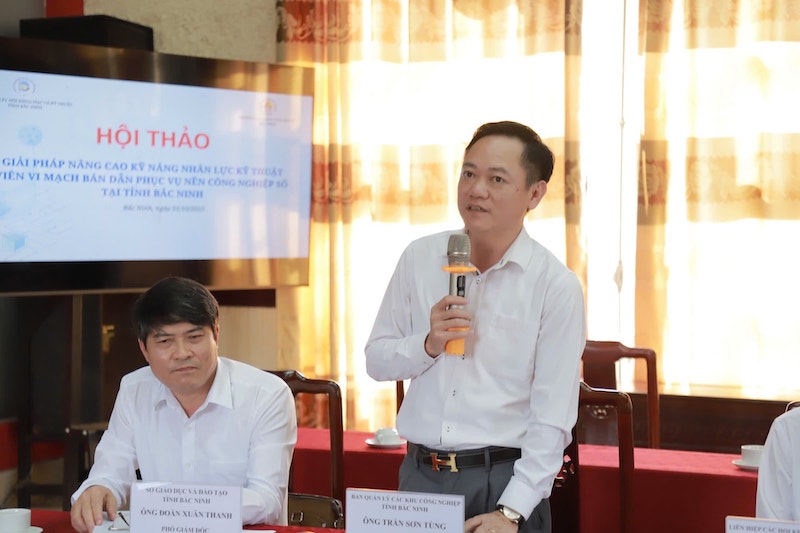
Mr. Tran Son Tung, Deputy Head of the Bac Ninh Industrial Zones Authority, delivered remarks at the workshop “Solutions to Enhance the Skills of Semiconductor IC Technicians,” jointly organized by the Bac Ninh Union of Science and Technology Associations and Bac Ninh College of Industry in October 2025.
Moreover, the Bac Ninh Industrial Zones Authority has played an effective role in advisory work and in organizing dialogue and business networking conferences. Through these activities, local authorities not only promptly address difficulties and obstacles but also foster close relationships with the investor community, thereby enhancing the effectiveness of both domestic and foreign investment attraction.
Human resources are also a key factor. Bac Ninh not only has an abundant labor force but also places strong emphasis on training and improving workforce quality, particularly in high-tech, digital industry, and digital transformation sectors. The workforce’s ability to quickly adapt to modern production environments has become a significant advantage in the eyes of international investors.
Assessing Bac Ninh’s investment environment, Mr. ChangKyun Seo, Global Import-Export Director of Amkor Vietnam Co., Ltd. stated.
“Before deciding to invest in Vietnam, we had certain concerns and uncertainties regarding the legal environment and customs procedures. However, once the project was implemented and put into operation, Amkor truly experienced the professionalism, strong support, cooperation, and openness of Bac Ninh’s local authorities. This support has laid an extremely important and positive foundation for Amkor’s development in Vietnam.
We highly appreciate and sincerely value the support provided by the Government of Vietnam and Bac Ninh Province over the past time. In the coming period, Amkor hopes to continue receiving guidance and support from relevant authorities, while committing to close cooperation, strict compliance with regulations, and making positive contributions to the development of the semiconductor industry as well as the local economy.”
Author: Kim Dung - Vu Phuong (Cam Anh translates)
RECOMMENDED TOPICS