VN
VN
 EN
EN
22/07/2026, 02:00
Business economics
Coordinated solutions to boost power supply capacity in the South
Amid rapidly rising electricity demand, mounting pressure from climate change and increasingly extreme heatwaves, the southern power sector has been implementing a wide range of synchronised measures to ensure stable electricity supply for socio-economic development and people’s daily lives.
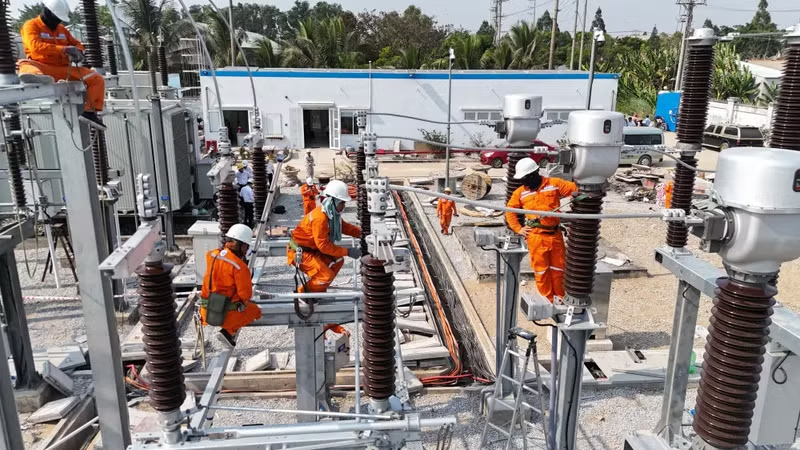
From accelerating investment in power grid infrastructure and promoting electricity conservation to developing renewable energy, these efforts not only demonstrate the strong determination of the power sector but also require the participation of society as a whole.
Dual pressure from demand growth and supply constraints
The year 2026 is forecast to remain highly challenging for the power sector in general and the southern power industry in particular. According to Associate Professor and Dr Mai Van Khiem, Director of the National Centre for Hydro-Meteorological Forecasting, this marks the 12th consecutive year of record-high temperatures and severe heatwaves, especially with the risk of increasingly frequent extreme heat events.
The southeastern region is forecast to experience higher temperatures than in 2025 due to the impacts of climate change and the El Nino cycle, leading to reduced rainfall, drought conditions and risks of water shortages for electricity generation.
In this context, the national power system is facing enormous pressure. Nguyen Quoc Trung, Deputy General Director of the National Power System and Market Operation Company Limited (NSMO), said electricity consumption reached 1 billion kWh per day on March 31. Notably, during the first days of April, average daily consumption continued to remain above 1 billion kWh, with a new record set on April 8 at 1.092 billion kWh and peak capacity reaching 52,225 MW.
According to NSMO forecasts, the threshold of 1.1 billion kWh per day could soon be reached. If heatwaves persist for four to five consecutive days, electricity demand could rise by an additional 800-1,000 MW per day.
In southern Viet Nam, where numerous industrial parks, urban areas and commercial activities are concentrated, pressure on commercial electricity consumption is becoming even more pronounced. According to Bui Quoc Hoan, Deputy General Director of the Southern Power Corporation (EVNSPC), electricity intake in April (as of April 19) was estimated at 4.08 billion kWh, up 10.94% year-on-year compared with the same period in 2025. Peak demand is expected in June and July, when both household and industrial consumption rise sharply.
In addition to demand-side pressure, the power sector is also facing supply challenges, particularly the risk of water shortages for hydropower generation during the dry season. This situation requires timely, effective and long-term response measures.
Proactive measures from the power sector
In response to these challenges, the Southern Power Corporation (EVNSPC) has implemented a series of synchronised solutions, ranging from operational management and infrastructure investment to mobilising public participation in electricity conservation.
According to Bui Quoc Hoan, Government directives have set very specific requirements for the power sector. In particular, electricity-saving targets have been raised from 1% to 2%, while during peak hot-season months, savings of up to 10% are required. At the same time, measures such as load adjustment, load shifting and the development of self-produced and self-consumed rooftop solar power are receiving significant attention and direction.
Notably, the target is for around 10% of household and business rooftops to install solar power systems annually, equivalent to approximately 50% during the 2026-2030 period. This is considered a highly ambitious target, requiring strong participation from the entire political system and society.
EVNSPC has already implemented numerous specific measures, including working with customers to sign commitments to save at least 3% of electricity consumption; signing load adjustment agreements with large enterprises, especially industrial and FDI businesses; and stepping up communication and support for rooftop solar installation.
To date, 1,581 self-produced and self-consumed rooftop solar systems have been put into operation, with a total capacity of 443MWp, equivalent to around 1% of commercial electricity output. In the first quarter of 2026 alone, these systems generated more than 161 million kWh, significantly easing pressure on the power grid.
At the same time, EVNSPC has strengthened technical support, energy audit consultancy and guidance on procedures for registering rooftop solar systems for individuals, businesses and administrative agencies, both directly and online.
Regarding power infrastructure investment, during the first four months of 2026, EVNSPC completed and energised 51 projects, including four additional 110kV projects connected to the grid on April 29 and 30 alone. These achievements have contributed to enhancing electricity supply capacity to meet the requirements of double-digit economic growth in southern provinces.
Hoan said that from the beginning of the year, EVNSPC had identified infrastructure investment and construction as a core mission. The corporation’s leadership has worked with a “no days off” spirit, regularly present at construction sites to accelerate progress and resolve obstacles.
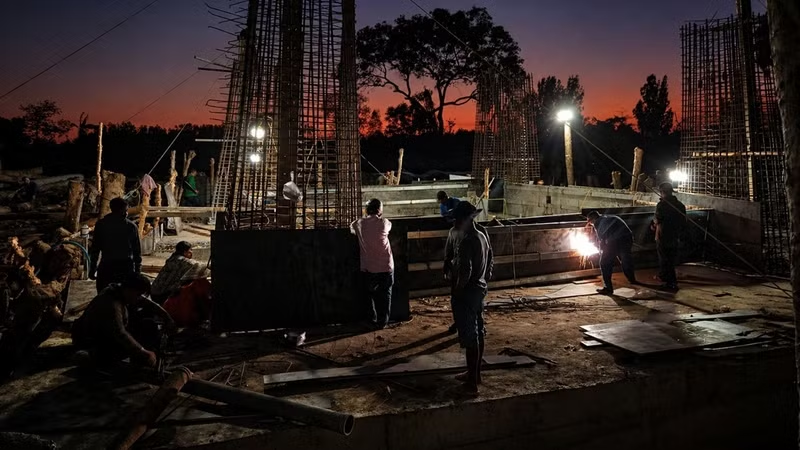
During implementation, measures such as close coordination with local authorities in site clearance, strict supervision of the entire project lifecycle, diversification of funding sources, and the application of technology and digital transformation in management have been carried out in a synchronised manner.
As a result, many important projects, including the 110kV substations at Tan Tru, Tan Thanh and Lai Son; 110kV transmission lines in Dong Thap, Lam Dong and Vinh Long; and the capacity upgrade of the Giang Dien Substation in Dong Nai Province, have been completed on or ahead of schedule, directly improving the reliability of electricity supply.
Vo Phuong Thuy, Director of the Dong Thap Department of Industry and Trade, said EVNSPC’s synchronised investment in electricity infrastructure had created an important foundation for socio-economic development, particularly as the province intensifies efforts to attract industrial investment and high-tech agriculture.
In Tay Ninh Province, Tran Thanh Toan, Deputy Director of the provincial Department of Industry and Trade, said the power sector had proactively forecast electricity loads and promptly upgraded the grid to meet local development needs, while also effectively coordinating with departments and sectors during project implementation.
During the Reunification Day and May Day holiday period on April 30 and May 1, thousands of engineers and workers remained at construction sites to maintain project progress. EVNSPC leaders directly visited all construction sites to encourage workers and inspect implementation, demonstrating strong determination to achieve the targets set.
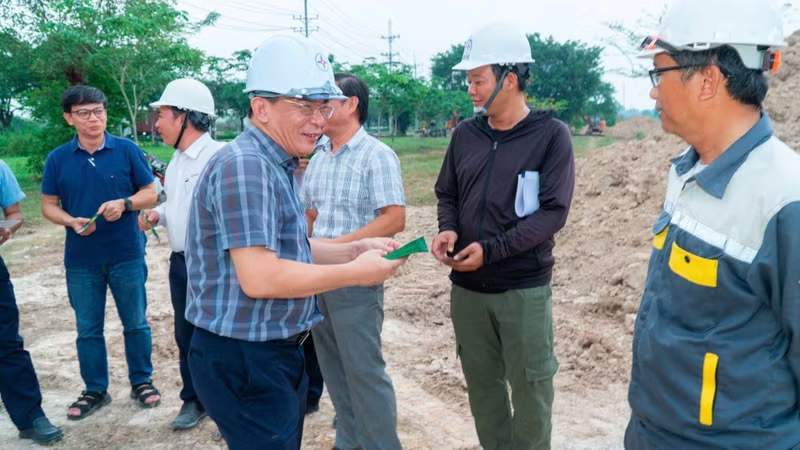
These efforts reflect a proactive, comprehensive and flexible approach by the power sector in responding to practical demands. From accelerating infrastructure investment and optimising system operations to promoting electricity conservation and renewable energy development, the solutions being implemented are synchronised and closely aligned with real-world conditions.
Author: NDO
RECOMMENDED TOPICS