VN
VN
 EN
EN
21/07/2026, 02:38
Business economics
Maintaining Viet Nam’s foothold in the Middle Eastern agricultural market
In the first six months of 2026, Viet Nam’s agricultural exports to the Middle East slowed as geopolitical conflicts drove up logistics costs and disrupted supply chains. However, with high import demand, substantial consumer potential, and advantages created by free trade agreements (FTAs), the region remains a strategic market for Vietnamese agricultural products.
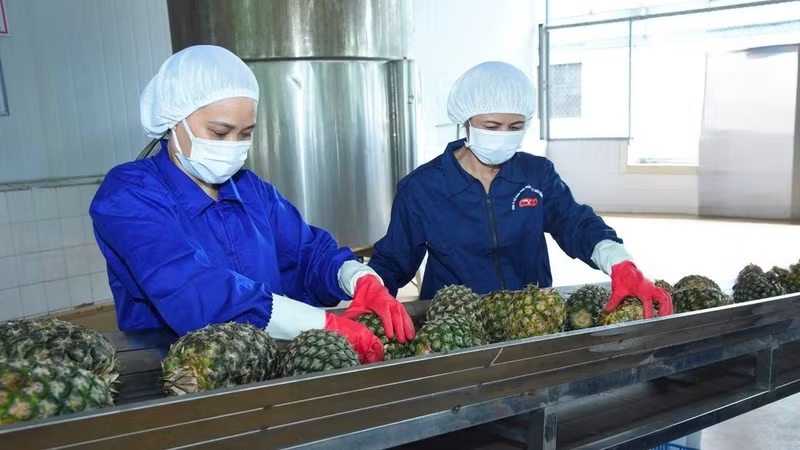
According to Truong Xuan Trung, Head of the Viet Nam Trade Office in the United Arab Emirates (UAE), Viet Nam’s goods exports to the UAE fell sharply in the first six months of 2026 compared with the same period in 2025.
Fruit and vegetable exports alone were estimated at nearly 35 million USD, down 41.88%; cashew nuts exceeded 25.1 million USD, down 70.71%; pepper reached nearly 6.2 million USD, down 50.16%; and seafood stood at approximately 16.1 million USD, down 33.88%.
However, as the UAE produces only around 10-15% of its domestic food requirements and remains heavily dependent on imports, the decline was temporary. Opportunities therefore remain substantial for Vietnamese agricultural products to increase their export turnover.
Beyond the UAE, Israel is also considered a market offering considerable potential for Vietnamese agricultural products.
Le Thai Hoa, Commercial Counsellor at the Viet Nam Trade Office in Israel, said Viet Nam’s key agricultural exports are also products for which Israel has strong import demand for consumption and production, particularly food, foodstuffs, and beverages.
Vietnamese seafood currently accounts for around 11-13% of Israel’s total seafood import turnover and still holds significant growth potential. It is also one of the few product groups to have maintained positive growth during the opening months of 2026.
Alongside strong consumer demand, FTAs are creating additional competitive advantages for Vietnamese goods in the Middle East.
In particular, the Viet Nam-UAE Comprehensive Economic Partnership Agreement (CEPA), which took effect on February 3, 2026, provides a positive basis for Vietnamese agricultural enterprises to strengthen their access to the UAE market.
Under its commitments, the UAE opened 94.9% of tariff lines, with 74.2% eliminated immediately upon the agreement’s entry into force. Many of Viet Nam’s major export groups, including seafood, cashew nuts, pepper, and timber and wood products, benefit from tariff preferences either immediately or under short phase-out schedules.
The Viet Nam-Israel Free Trade Agreement (VIFTA), which took effect on November 17, 2024, has also expanded market access opportunities. In 2025, Viet Nam’s key exports to Israel, including seafood, cashew nuts, and coffee, all recorded positive growth.
According to experts, to make effective use of tariff preferences, businesses must meet requirements relating to standards, certification, and market organisation.
Le Viet Anh, Secretary-General of the Viet Nam Pepper and Spice Association, said the Middle East has one of the world’s highest levels of spice consumption. The UAE is both a promising market and a major regional logistics hub linking the Middle East with Africa, Central Asia, and South Asia, enabling Vietnamese goods to penetrate more deeply into the wider region.
Viet Nam currently has an advantage as one of the world’s leading suppliers of pepper, cinnamon, and star anise. In the Middle Eastern market alone, Vietnamese pepper and cinnamon account for around 60% and 50% of market share, respectively.
However, increasingly stringent requirements concerning Halal certification, traceability, and sustainable development are posing considerable challenges for enterprises.
In addition, rising logistics costs and intensifying competition from similar products from Brazil, Indonesia, and China require businesses to improve quality and expand deep processing to build sustainable brands.
Against this backdrop, Vu Minh Tam, Head of the General Policy Division under the Agency of Foreign Trade at the Ministry of Industry and Trade, said enterprises should proactively review commodity codes, comply with rules of origin from the product design stage, and invest in quality by combining Halal and Kosher standards. They should also develop market-specific access strategies and make use of trade promotion programmes.
For management agencies, it is necessary to continue completing the national Halal legal framework, step up dissemination of commitments under CEPA and VIFTA, support logistics development and promote dialogue on issues relating to bilateral sanitary and phytosanitary measures (SPS).
As geopolitical conflicts continue to pose potential risks, maintaining Viet Nam’s foothold in the Middle Eastern market requires enterprises to improve their capacity to meet product standards, while optimising transport costs and establishing appropriate distribution systems.
Such efforts will help to build and expand the presence of Vietnamese agricultural brands in this highly promising market.
Author: NDO
RECOMMENDED TOPICS