VN
VN
 EN
EN
21/07/2026, 02:38
Business economics
Enhancing self-reliance and green transformation
Faced with unpredictable market fluctuations, Viet Nam’s fertiliser industry is facing many major challenges. According to Phung Ha, Chairman of the Fertiliser Association of Viet Nam (FAV), recent fluctuations in the global market have strongly impacted the development of the domestic fertiliser sector.
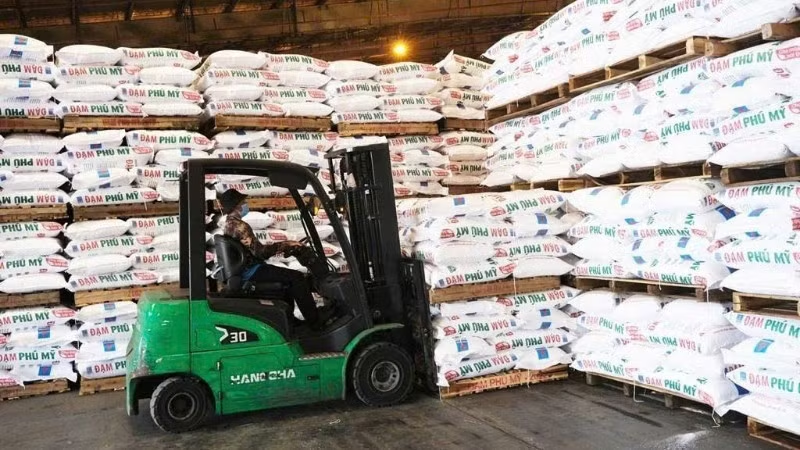
This industry is facing many challenges, especially regarding fluctuations in raw material and energy prices, competitive pressure from imported products, the risks of supply chain and logistics disruptions, and increasingly stringent requirements for green transformation and emission reduction.
Nguyen Anh Phong, Deputy Head of the Institute of Strategy and Policy on Agriculture and Environment (ISPAE), stated that the demand for fertiliser in Viet Nam is approximately 11 million tons, while production capacity only reaches about 8 million tons per year. Currently, Viet Nam still needs to import many types of fertilisers and a large volume of raw materials for fertiliser production from several major markets such as China, Russia, Laos, and the Republic of Korea. This makes domestic supply vulnerable to fluctuations in raw material prices, energy prices, exchange rates, transportation costs, or international geopolitical situations.
Currently, Viet Nam still needs to import many types of fertilisers and a large volume of raw materials for fertiliser production from several major markets such as China, Russia, Laos, and the Republic of Korea. This makes domestic supply vulnerable to fluctuations in raw material prices, energy prices, exchange rates, transportation costs, or international geopolitical situations.
Nguyen Anh Phong
Deputy Head of the Institute of Strategy and Policy
on Agriculture and Environment
According to Nguyen Thi Hien, Deputy General Director of Petrovietnam Ca Mau Fertiliser Corporation (PVCFC), strategic raw materials and fertiliser types such as sulphur, SA fertiliser, MAP fertiliser, SOP, and some raw materials for the production of high-quality NPK fertilisers are currently heavily dependent on imports. For example, with a demand of approximately 0.9-1.1 million tons/year for potassium fertiliser, Viet Nam is almost entirely dependent on supplies from Canada, Russia, Belarus, Laos, and Israel.
Therefore, any fluctuations in these key markets directly impact domestic production costs. Furthermore, the entire industry is facing pressures of green transformation with increasingly stringent requirements for carbon emission reduction, traceability, and sustainable production. On the other hand, climate change not only affects agricultural output but also alters crop structure and long-term fertiliser demand.
The proactive development of a new strategy to enhance the self-reliance and resilience of the fertiliser industry is becoming increasingly urgent.
According to Hien, the Vietnamese fertiliser industry needs to focus on five strategic pillars, including: enhancing the self-reliance and resilience of the fertiliser supply chain; promoting technological innovation and the development of green fertilisers; developing a data, forecasting, and early warning ecosystem; strengthening linkages between the fertiliser industry and the agricultural value chain; and improving governance capacity and international integration.
To achieve these goals, mechanisms and policies need to focus on supporting businesses, with a focus on diversifying raw material sources, strengthening strategic reserves, encouraging investment in stages that are still dependent on imports, and improving the ability to respond to unpredictable fluctuations in the international market. Developing appropriate support mechanisms to promote technological innovation, improve the efficiency of energy use, and reduce emissions in fertiliser production.
Deputy Head of the Institute of Strategy and Policy on Agriculture and Environment, believes that the fertiliser industry needs to accelerate innovation and improve domestic production capacity. It should strengthen research and development of fertilisers of natural origin, organic fertilisers, and microbial fertilisers derived from agricultural by-products, livestock waste, and post-harvest by-products. The state should prioritise support for technology, quality standards, product certification, and linkage models between farms, cooperatives, and fertiliser enterprises.
In addition, relevant units must closely monitor the level of dependence on major supply sources, thereby establishing early warning mechanisms regarding prices, inventory, import schedules, export policies of supplying countries, and logistical risks. Meanwhile, businesses should be encouraged to diversify their import sources, sign long-term contracts, establish seasonal commercial reserves, and develop fertiliser transshipment warehouses in key production areas such as the Mekong Delta, the Central Highlands, and Central region.
Author: NDO
RECOMMENDED TOPICS