VN
VN
 EN
EN
24/07/2026, 16:11
VCCI
Creating fresh chances for private enterprises to thrive
The private sector should be positioned as the primary force behind new growth in addition to playing a
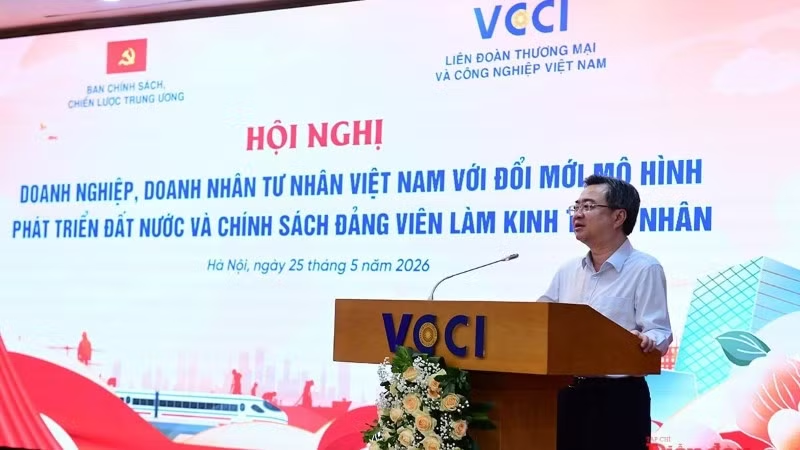
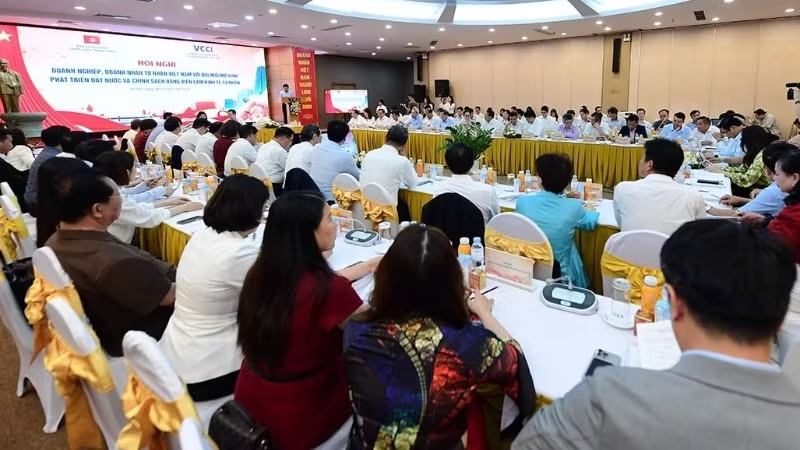
Based on that spirit, the conference "Vietnamese Private Enterprises and Entrepreneurs with the Innovation of the National Development Model and the Policy for Party Members Engaging in Private Business," organized by the Vietnam Chamber of Commerce and Industry (VCCI) in collaboration with the Central Policy and Strategy Commission on May 25th in Hanoi, raised many major issues concerning institutions, resources, technology, and business culture in the new development phase.
Pioneering a new development model
The conference made it abundantly evident that Vietnam's economic model, which is mostly dependent on low-cost labour, outsourcing, resource exploitation, and conventional investment incentives, is no longer adequate to produce breakthroughs as the country moves into a new stage of development. The economy needs to rely more on science and technology, innovation, digital transformation, green transformation, labour productivity, and contemporary governance capacities in order to advance more quickly and sustainably.
In such view, the private sector is viewed as more than just a force that boosts the economy, creates employment, and increases business and output. More significantly, it has to be a driving factor behind the development of a new growth model.
Comrade Nguyen Thanh Nghi, Politburo member, Secretary of the Party's Central Committee, and Head of the Central Policy and Strategy Commission, delivered a keynote address and opened the conference, emphasising the critical need to innovate the national development model based on science and technology, innovation, and digital transformation. This process necessitates the pioneering role of private firms, which are a dynamic, adaptable force capable of swiftly entering new markets.
Over over 40 years of reform, the Party's grasp of the private economy has expanded, deepened, and produced several advances. While Resolution No. 10-NQ/TW of 2017 recognised the private economy as "an important driving force" of the national economy, Resolution No. 68-NQ/TW on May 4, 2025 confirms and elevates the private economy to the most significant driving force of the national economy.
This is not only a step forward in theoretical thought, but it also reflects the political will to unlock resources, arouse the rightful desire for wealth creation, and promote the potential for contribution among Vietnamese entrepreneurs.
"The private sector currently accounts for approximately 97% of the total number of businesses nationwide, contributing about 50% of GDP, over 30% of budget revenue, and creating jobs for over 80% of the workforce. These figures show that the private sector has been and continues to play a very important role in promoting growth, innovation, international integration, and enhancing national competitiveness," Comrade Nguyen Thanh Nghi cited.
Despite its successes, the present growth model has exposed some drawbacks. Growth that is primarily based on resource extraction, processing, assembly, and low-wage labour no longer delivers a sustainable competitive edge. Labour productivity, technical capacity, and economic resilience remain restricted; the risk of falling behind and sliding into the middle-income trap exists, while demands for green transformation, digital transformation, and technological rivalry become more intense.
Based on this fact, the new development model must prioritise science and technology, innovation, digital transformation, green transformation, and holistic human development, while also balancing economic development with cultural, social, national defence, and security development.
Comrade Le Thanh Nghi also urged the business community and private entrepreneurs to focus on contributing ideas on key issues such as removing bottlenecks in institutions, administrative procedures, land, credit, taxes, technology, and markets; identifying strategic sectors where private enterprises can lead, such as R&D, artificial intelligence, semiconductors, clean energy, high-tech agriculture, logistics, and big data; and proposing solutions to ensure that major resolution.
Conducting business with integrity
The private sector is progressively taking the lead in innovation, digital transformation, investment in new technologies, green economic development, market expansion, and broader engagement in global value chains.
However, VCCI President Ho Sy Hung believes that, in the context of the country's goal of high growth, increased competitiveness, and progress toward becoming a developed, high-income country, private enterprises should be recognised as the central entity in the process of reforming the growth model.
Representatives from VCCI proposed expanding opportunities for the private sector to participate in large-scale infrastructure projects, key industries, and strategic technologies, while also cultivating leading private enterprises capable of driving domestic, regional, and global supply chains.
However, developing large enterprises does not mean neglecting small and medium-sized enterprises (SMEs). Leading enterprises need to be placed within an interconnected ecosystem, helping SMEs participate in the supply chain, learn management, raise production standards, and gradually grow.

Another significant focus is on releasing resources for innovation. In the new growth model, a company's assets comprise not only land, factories, and machines, but also data, technology, brands, patents, software, and R&D skills, among other things.
Thus, the credit system requires innovation and cannot rely simply on traditional collateral. Mechanisms such value chain credit, green credit, technological investment funds, venture capital funds, credit guarantees, and intellectual property-based credit must be researched and tested.
Participants at the conference also emphasised the need to create policy testing environments for emerging industries such as fintech, data, smart logistics, low-level economy, drones, smart agriculture, digital healthcare, and so on. Instead of the "if you can't manage it, ban it" mindset, there is a need for regulated testing processes with clear duties, timelines, and protection for enterprises operating within the allowed scope.
After 20 years of implementing Regulation No. 15-QĐ/, Party members can engage in private economic enterprises.TW, practice indicates that many Party members who are entrepreneurs, managers, or private-sector professionals have contributed positively to production, business, job creation, tax income, and social responsibility.
This policy must be examined and updated to reflect the changing circumstances, resulting in the formation of a team of outstanding Party member entrepreneurs who exemplify a corporate culture of honesty, respect for the law, creativity, and duty to the country.
Author: NGOC ANH
RECOMMENDED TOPICS