VN
VN
 EN
EN
16/07/2026, 02:00
Business economics
Enhancing capacity of textile and garment enterprises
Production and labour atmosphere in the early days of the Lunar New Year are vibrant across domestic textile and garment enterprises. Businesses are focusing on implementing specific and key solutions to strengthen internal capacity, improve overall labour productivity, and create a foundation for long-term growth.
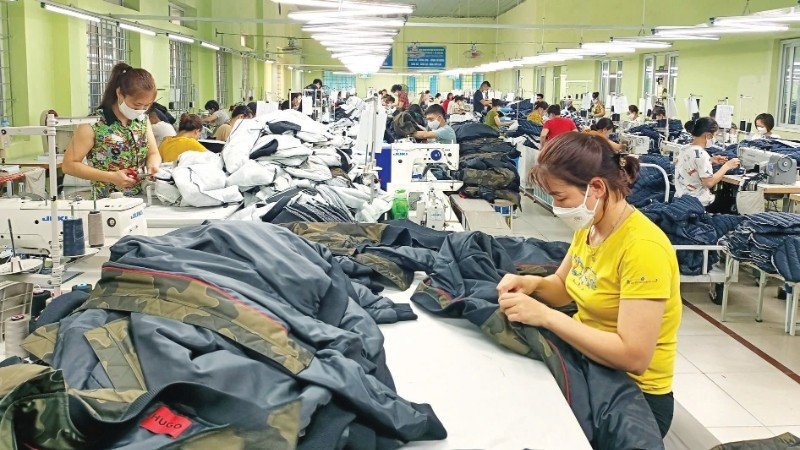
In the early days of the Lunar New Year, the Viet Nam National Textile and Garment Group (Vinatex) and its member units have promptly resumed operations, launched the new production year, presented Lunar New Year Festival (Tet) gifts to employees, and boosted output, striving to soon complete set targets and missions.
Accelerating productivity, quality and efficiency
During a Lunar New Year visit to Eight March Textile Company Limited, Le Tien Truong, Chairman of the Board of Directors of Vinatex, assessed that in the 2026–2030 period, Eight March Textile Company Limited continues to be among the key units which need to restructure and improve efficiency. In addition to resolving longstanding issues and accumulated losses from previous years when the yarn market faced crisis, and gradually enhancing its position within the system, the company’s key task in 2026 is to accelerate productivity, quality, and efficiency while strengthening governance and management capacity.
“Lessons from the previous period of hot growth show that when the market is favourable, results may come quickly, but when conditions change, the company’s internal capacity becomes clearly exposed. Therefore, the focus in the next phase must be on tightly controlling prices, optimising expenses, and increasing actual added value instead of just chasing absolute revenue,” Le Tien Truong noted.
After one year of official operation, the Vinatex Product Development and Business Centre (Vinatex PD&B) has established an operational foundation but still faces limitations that hinder its ambition to become a key unit in design and connecting enterprises within the supply chain for free on board (FOB) and original design manufacturing (ODM) products. Therefore, the centre needs to focus on improving governance methods and development strategies. According to Vuong Duc Anh, Director of Vinatex PD&B, in the first six months of 2026, the centre will review and complete its governance system and tighten discipline, starting from a foundation of culture and responsibility, not only business outcomes. In the long term, it will closely follow the development strategy of the design centre, connect units within the system, and gradually improve product development capacity towards FOB and ODM, increasing domestic value and making a substantial contribution to the group's overall value chain.
For Hoa Tho Textile and Garment Joint Stock Corporation, General Director Nguyen Ngoc Binh said that in 2026 the business will continue improving efficiency, tapping into growth potential in promising markets and developing new and higher value-added products with differentiated materials. At the same time, the business will continue to arrange its customer portfolio and identify key product lines for each factory based on evaluating the effectiveness, cooperation, and support and accompany of customer.
Sharing the same view, Vu Ngoc Tuan, General Director of Nam Dinh Textile and Garment Joint Stock Corporation, affirmed that the unit has built a production and business plan closely aligned with practical conditions and the resources of each unit, focusing on improving operational efficiency in each production segment as a foundation for long-term growth. To achieve revenue of 1.2 trillion VND and pre-tax profit of 12.2 billion VND this year, the unit is focused on innovating its leadership and governance according to the motto of decisiveness, discipline, science, and efficiency, while perfecting the salary and income mechanism and the KPIs system closely linked to productivity, quality, and work efficiency.
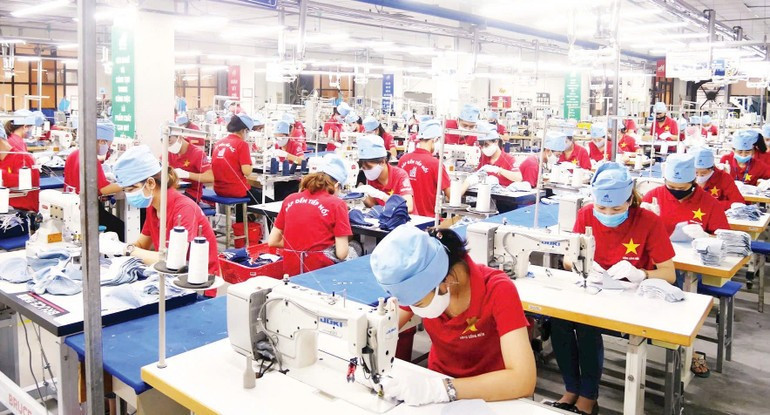
Applying flexible solutions
In 2026, Viet Nam’s textile and garment industry is forecast to continue facing pressure from slow international economic recovery, prolonged geopolitical conflicts, and increasing trade protectionism, resulting in subdued global consumer demand. Labour shortages and fierce labour competition remain major challenges, particularly in traditional production centres, forcing enterprises to accelerate automation and restructure production processes. Export orders continue to trend towards small quantities, with shorter delivery times and lower prices, requiring businesses to increase response speed and streamline operations to maintain profitability.
With a target of 5,393 billion VND in revenue, 222 billion VND in profit, and an average monthly income of 11.5 million VND per employee in 2026, Than Duc Viet, General Director of Garment 10 Corporation, said the unit will continue exploiting and expanding markets and customers; intensifying research into new products, new materials, more complex orders; and promoting sustainable fashion to meet the increasingly high demands of markets and customers. To achieve this, the company will enhance sample development speed and quality, increase its capacity to meet small and fast orders, and streamline production organisation towards a lean and automated system. It will also continue investing in automated equipment, green technology, and clean energy; apply environmental, social, and governance (ESG) standards; ensure traceability; and strengthen digital capacity in production management, planning, order processing, and finance.
Hoang Manh Cam, Chief of Office of the Board of Directors of Vinatex, noted that in addition to uncertainty over tariff policies, dramatically decreased consumer demand and prolonged low-price competition have led to increasingly thin profit margins for businesses. Besides, Vietnamese enterprises also face high input costs, while the domestic textile and dyeing sector remains limited in scale and capacity, failing to meet the requirements of competing through self-sufficiency in raw materials. Therefore, the industry hopes for a more favourable financial environment and lower interest rates in 2026 to support businesses to strengthen export.
Le Tien Truong, Chairman of the Vinatex Board of Directors, added that the year of 2026 is expected to remain a “test of endurance” for the global economy and the textile and garment industry. Many uncertainties in growth prospects and trade policies persist due to geopolitical instability, requiring continuous updates and analysis to determine appropriate orientations.
Growth potential remains for Viet Nam’s textile and garment sector, but the focus is no longer on expanding output; emphasis must be placed on improving efficiency, controlling costs, increasing value, and complying with rules of origin amid market volatility. Enterprises therefore need flexible production and business plans, as geopolitical instability can directly affect shipping costs and fuel prices.
The US remains the key export market in general and for textiles and garments in particular. Enterprises must closely follow US trade policies and brand requirements regarding tariff cost-sharing in order to adjust appropriate market strategies, production, and business organisation. At the same time, companies need to control borrowing and short-term debt prudently and apply necessary hedging measures to cope with unfavourable developments in interest rates and exchange rates.
Author: NDO
RECOMMENDED TOPICS