VN
VN
 EN
EN
26/07/2026, 02:38
Business economics
From labor-intensive to high-tech: Hanoi retrains for global edge
Raising the skill standards of high-tech workers is emerging as a decisive factor in strengthening Hanoi’s competitiveness as the capital accelerates its shift toward a knowledge-based industrial economy.
As factories resume full operations following the 2026 Lunar New Year holiday, industrial parks and high-tech zones across Hanoi are racing to meet new production targets while recalibrating long-term strategies.
At the center of this shift lies a common priority: upgrading the direct production workforce to lift productivity and strengthen the capital’s position in global supply chains.
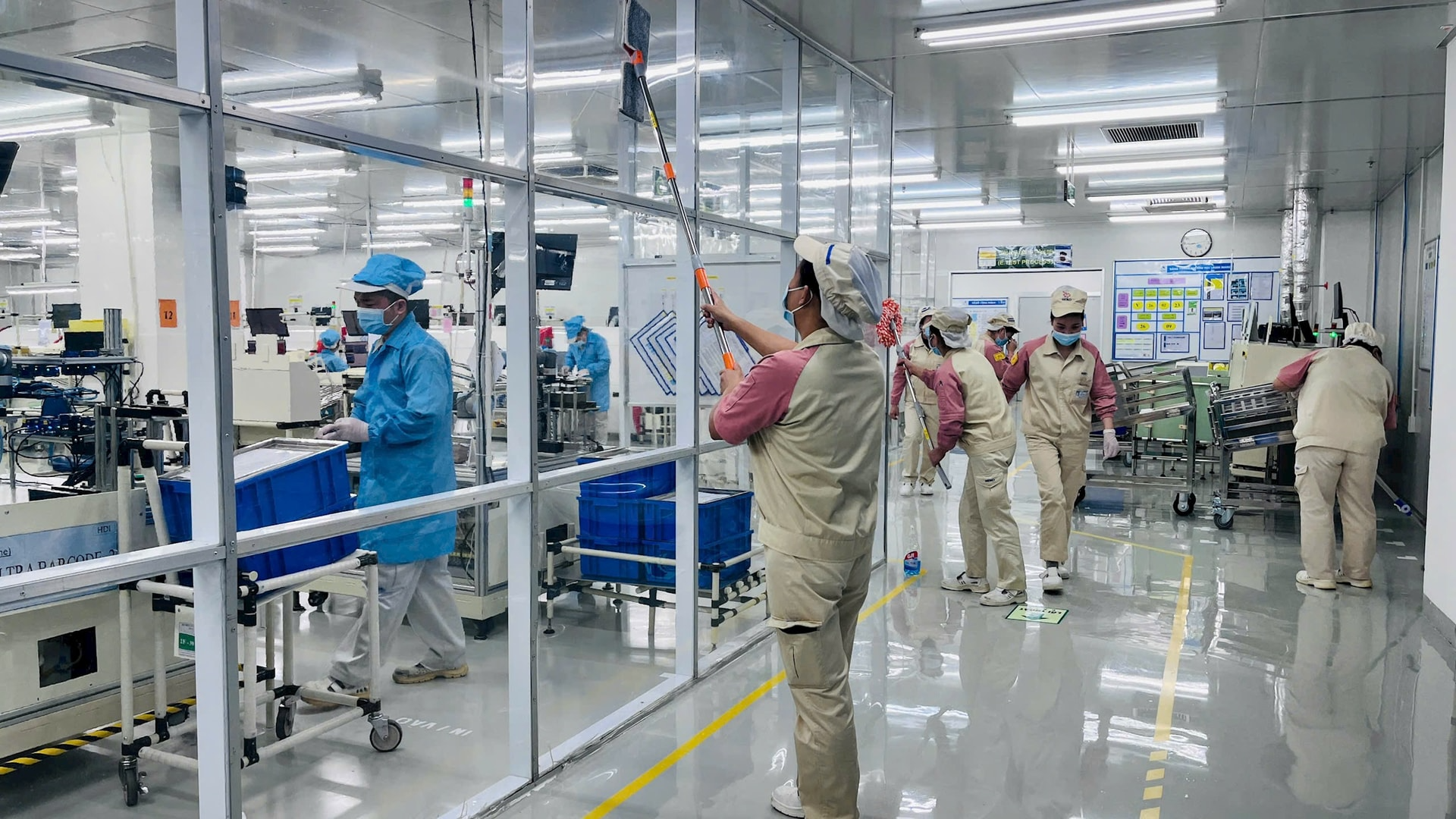
Workers at Meiko Electronics Vietnam prepare for their first working day after the Lunar New Year holiday. Photos: Hanoimoi Newspaper
In recent years, labor structures in Hanoi’s industrial zones have changed markedly. Where unskilled labor once dominated, demand now rises for technicians, multi-skilled workers and employees able to run automated systems. Training, once considered supplementary, has become a strategic necessity.
At Meiko Electronics Vietnam Company Limited, workforce development follows a structured long-term roadmap. The company treats skill upgrading as a core mission rather than a short-term initiative.
Internal instructors deliver regular courses, while external experts provide specialized training, said Phan Thanh Hai, Head of the Executive Office and Risk Management Department and Chairman of the company’s Trade Union.
Programs range from human resource management, teamwork and communication to foreign languages including Japanese, Chinese, English and Korean, reflecting the multinational workplace.
Technical courses cover abnormality handling, assembly line troubleshooting and preventive equipment maintenance. Some technical staff have begun studying artificial intelligence to align with smart manufacturing trends.
“Amid rapid technological change, investing in people remains the only sustainable way to maintain competitiveness. Machinery can be upgraded, but productivity depends on workers who can master it,” Hai said.
A similar approach guides Ogino Vietnam Company Limited, a Japanese-invested precision engineering firm.
With a large workforce operating under strict technical standards, the company sees human capital as the foundation of its development strategy, said Nguyen Van Lieu, chairman of the company’s trade .
The company focuses on high-tech skills and adaptability in the face of digital transformation. Its trade works closely with management to design systematic training plans.
Courses emphasize advanced CNC operation, Japanese-standard quality control, automation technologies and modern production management.
Technicians travel to Japan to study automation models and robotics in manufacturing lines. The company also organizes AI-related training and partners with automation solution providers to digitize production data, monitor quality in real time and optimize operations.
Annual skills competitions allow workers to practice new techniques and engage with emerging technologies. Pre- and post-training assessments guide decisions on salaries, bonuses and promotions.
Innovation campaigns encourage employees to propose technical improvements. Many initiatives have reduced defect rates, saved materials and increased productivity.
The coordinated focus on professional training, digital skills and innovation has enabled Ogino’s workforce to take greater control of modern production lines and meet tougher market standards.
This shift extends beyond a handful of companies.
Canon Vietnam Company Limited and Yamaha Motor Vietnam Company Limited have embedded regular training into long-term strategies.
Internal programs on management, languages, automation, equipment maintenance and AI applications follow clear evaluation systems tied to career progression and income growth.
Upgrading oneself becomes essential for workers
Enterprise programs represent only part of the transformation. Workers’ determination to upgrade their own skills often proves decisive.
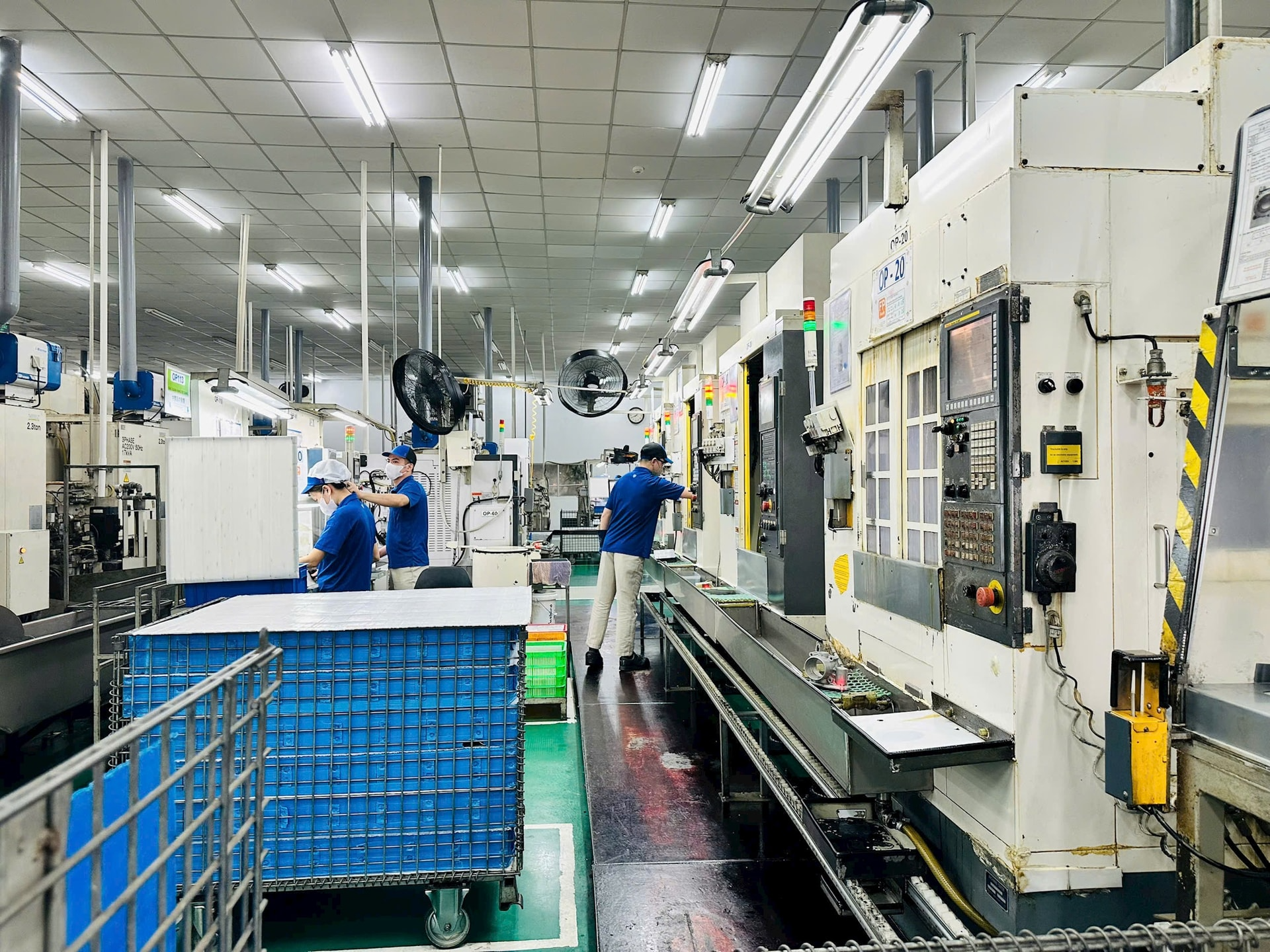
Employees of Ogino Vietnam quickly resume production following the Lunar New Year break.
Many employees study foreign languages, information technology and programming outside working hours. Some adopt automation tools such as macros and robotic process automation to adapt quickly to technological change.
Nguyen Van Tuan, a maintenance technician at SWCC Showa Vietnam Company Limited, exemplifies this shift.
He received a national trade award in 2023 for practical improvement initiatives. Tuan said highly automated production lines require deep understanding of operating principles and the ability to address unexpected issues.
His company organizes regular training on operating, programming and maintaining automated equipment, PLC systems and industrial robots.
When new production lines are installed, Japanese experts conduct technology transfer training. The company encourages self-study and provides partial financial support for advanced programming courses.
For Tuan, continuous learning is mandatory. Workers who rely solely on past knowledge risk falling behind in the digital era.
By mastering PLC programming, improving processes and strengthening English to work with foreign specialists, he has positioned himself to adapt quickly to new technologies.
Nguyen Ngoc Ha at Canon Vietnam reflects a similar journey.
She began as a support worker in the accounting department with limited expertise and modest English. Through persistent self-study and company training, she advanced her skills.
Although not formally trained in IT, she learned macro programming to automate workflows, easing pressure on the IT department and improving cost control.
Today, more than half of her department can independently program tools to optimize tasks.
Her initiatives over two decades have generated significant financial gains, showing how individual effort can translate into corporate value.
These stories signal a broader embrace of lifelong learning across Hanoi’s industrial workforce.
Many workers devote personal time to study languages, digital tools and equipment operation, steadily upgrading their competencies. This effort improves income prospects and opens clearer career pathways.
As Hanoi pursues deeper industrialization with higher technological intensity, high-quality human resources sit at the center of its strategy.
Enterprises’ proactive investment in training marks a tangible shift from labor-intensive production to technology-driven manufacturing.
In this transition, raising skill standards for high-tech workers stands as a strategic imperative for the capital’s sustainable growth and its ambition to move up the global value chain.
Author: Hanoitimes
RECOMMENDED TOPICS