VN
VN
 EN
EN
26/07/2026, 11:20
Investment
Europe faces double whammy
Europe faces a double whammy of trade threats from US tariffs and Chinese export redirection.
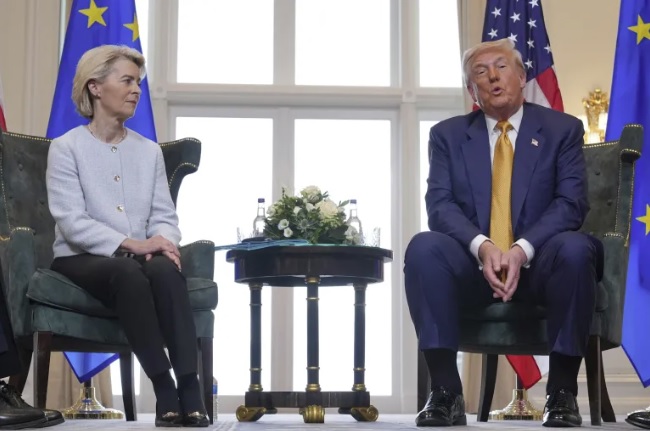
US President Donald Trump and European Commission President Ursula von der Leyen
Its trade data is already starting to creak. But does this pressure imply persistent economic underperformance and political weakness, or might it be the shock that galvanizes the region into action? There are some signs that it might be the latter.
Europe is seen as weak and slow, not least by President Trump, who repeated these claims at Davos this month, and, perhaps more importantly, by Ukraine's President Zelenskiy. There is a good deal of truth in this. But, at the same time, policymakers have shown that any inbuilt tendency to procrastinate rather than act can vanish when their backs are against the wall.
In short, policymakers tend to come good in a crisis. So, if it is a crisis that Europe faces now, not just on trade but on global relations with the likes of the US and China, then there may be hope that something positive can come out of it that lifts the economy and makes the region's asset prices outperform. Instances of when Europe is pushed into action include the response of the ECB—and Eurozone finance ministers—during the debt crisis between 2010 and 2012. Resolute action by the ECB to end that crisis helped initiate a 20-cent rise in the euro against the US dollar over the subsequent two years.
More recently, European countries have acted to bolster defense spending, this time under pressure from Russia's conflict with Ukraine and political persuasion from the US. The issue now is whether trade is the new crisis because of the double whammy of US tariffs and the expected flood of cheap imports from China as it re-orients its own trade away from the US.
The trade balances of the US and China have improved notably. If it continues, it seems likely to force European policymakers to redouble their efforts to generate more domestic demand to fill the gap left by the deterioration in trade. In short, this double whammy from the US and China might actually prove to be the crisis Europe needs to produce the economic vibrancy that it has lacked for long periods. Of course, such economic pressures dovetail with the political strains that have developed, particularly with the US.
The furor over the US's wish to acquire Greenland might have died down, but, as Canadian PM Carney made quite clear in his Davos speech last week, policymakers around the world need to see US developments as a structural change and plan accordingly. For Europe, that seems to mean learning to stand on its own two feet a bit better, in both economic and political terms.
One part of that is to use its economic weight to push back, as indeed it has started to do. For not only can the region threaten tariffs but also its own two-year-old so-called trade ‘bazooka' the anti-coercion instrument. But if it does take such a stand, then it must accept that more of the region's growth will have to come from domestic sources. This undoubtedly means getting on with implementing the sorts of changes contained in former ECB President and Italian PM Mario Draghi's report from 2024. Progress on removing fragmentation across many aspects of the eurozone economic and financial landscape remains too slow.
Just whether the jolt from this trade double whammy forces the EU's hand remains to be seen. But what does seem evident is that global investors are looking away from the US, seeking diversification and, perhaps, safety. What helps is a strong, or at least strengthening, economic story. Europe does not have this to any significant degree, but it could have.
A rise in global confidence in Europe could create a tsunami of inflows into its assets, especially stocks, with the region not just seen as an escape route from the US but desirable in its own respects. There could be positive benefits to the euro as well. So far it is other currencies that have made the most of the US dollar's vulnerability, not the euro. Steven Barrow, Head of Standard Bank G10 Strategy, expects this to steadily change, which is one reason why he thinks the euro will rise to the 1.25-1.30 range given time. But ‘time' is the key here because Europe's policymakers are not going to turn on a sixpence.
Author: NGOC ANH
RECOMMENDED TOPICS