VN
VN
 EN
EN
26/07/2026, 02:00
Investment
Green data centres: An inevitable driver of national competitiveness
Viet Nam is entering the race to “greenify” data infrastructure, guided by national policies and the strong engagement of technology enterprises. Green data centres are no longer a choice but an inevitable trend to strengthen national competitiveness.
Businesses at the forefront of the green transition
Green data centres are designed and operated on principles of energy efficiency and environmental sustainability, helping to cut carbon emissions and enhance system performance. In the digital era, data centres form the backbone of digital transformation, yet they also pose significant challenges in energy consumption.
As a result, “greenifying” data infrastructure has become an essential solution, ensuring efficient operations while meeting sustainable development goals.
The rapid growth of cloud computing, artificial intelligence (AI), the Internet of Things (IoT), and 5G technologies is driving demand for expanded data infrastructure, placing mounting pressure on electricity consumption. In response to market trends, Viet Nam has introduced a series of strategic policies for this sector.
The Telecommunications Law 2023 promotes the development of modern, sustainable data centres, closely linked to national security and the digital economy.
“Greenifying” data infrastructure has become an essential solution, ensuring efficient operations while meeting sustainable development goals.
The Information and Communications Infrastructure Plan for 2021–2030, with a vision to 2050, set out in the Prime Minister’s Decision 36/QD-TTg dated 11 January 2024, requires new data centres to comply with international green standards, including a Power Usage Effectiveness (PUE) index not exceeding 1.4.
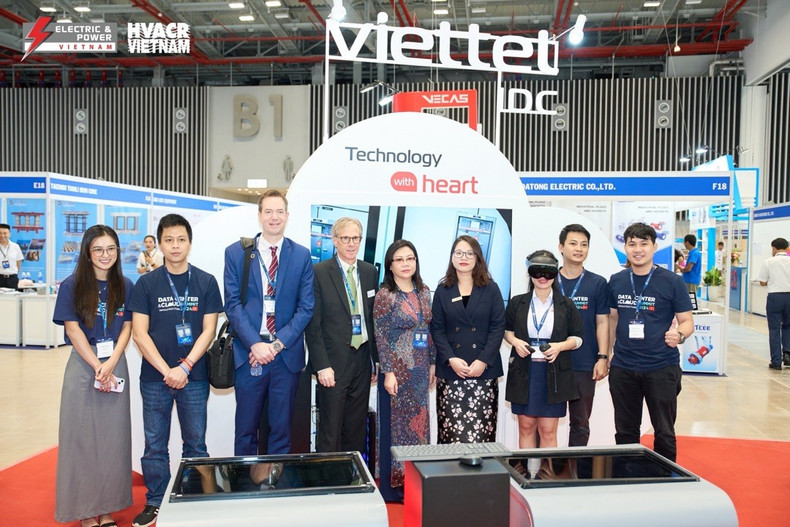
Domestically, Viettel IDC was an early adopter of energy-saving solutions and renewable energy to reduce carbon emissions. Its Hoa Lac data centre operates to green standards, employing high-efficiency cooling systems and solar energy, and meets international Tier III standards.
Viettel IDC also integrates AI, IoT, and blockchain into operations management, optimising energy use, enhancing stability and security, and meeting ESG criteria (environmental, social, and governance standards for sustainable business development).
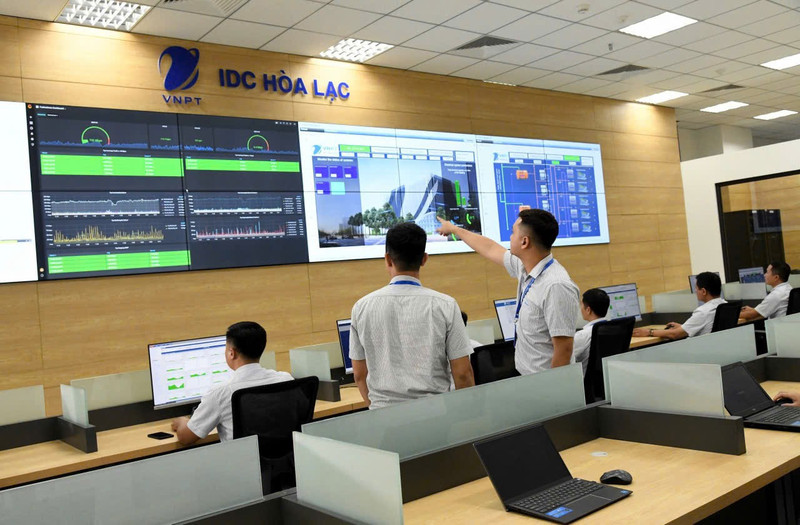
Viet Nam Posts and Telecommunications Group’s Data Centre (VNPT IDC) is likewise accelerating the greening of infrastructure across eight major centres nationwide. The company is investing in intelligent energy management systems and transitioning to renewable sources such as solar and wind power to reduce emissions and ensure sustainable operations.
VNPT’s data centre system applies the ISO 50001 energy management standard alongside international security standards, improving energy efficiency and lowering operating costs for customers.
With the development of Tier III-standard centres, FPT prioritises high-efficiency cooling solutions, energy-saving equipment, and renewable energy.
Notably, FPT has developed VertZéro, a platform for automated greenhouse gas inventory and management, enabling businesses to meet Net Zero standards and improve transparency in ESG reporting.
Tuan Pham, Product Director and Co-founder of VertZéro at FPT Corporation, explained that VertZéro automates more than 80% of internal greenhouse gas inventory processes, from data collection and emission factor updates to automated analysis and reporting.
Inventory time has been reduced from weeks to just days, thanks to API (Application Programming Interface) integration with internal management systems such as Enterprise Resource Planning (ERP), building management, and infrastructure operations.
Greening data centres to secure long-term competitiveness
Amid the AI boom, data centres worldwide and in Viet Nam are facing unprecedented energy pressures. According to the International Energy Agency (IEA), by 2028 AI could account for 15–20% of total data centre electricity consumption.
Deloitte forecasts that Viet Nam’s AI market could reach USD 65 billion by 2035, with data infrastructure as the decisive factor in national competitiveness.
Experts highlight that the rapid expansion of the data centre market brings challenges in electricity demand, cooling systems, carbon emissions, and waste management.
Domestically, the greening of data centres still faces obstacles: the absence of specific national standards, unstable renewable energy infrastructure, limited investment incentives, and a shortage of highly skilled technical personnel. These bottlenecks must be addressed urgently to enhance competitiveness.
Deloitte forecasts that Viet Nam’s AI market could reach USD 65 billion by 2035, with data infrastructure as the decisive factor in national competitiveness.
Moreover, ESG (Environmental, Social, and Governance) has become a mandatory standard for businesses engaged in global value chains. Within the Net Zero 2050 roadmap, ESG compliance is not only an environmental obligation but also an opportunity for Vietnamese enterprises to build reputation and attract green investment capital.
Le Ba Tan, Director of Viettel IDC, noted that Viet Nam’s data centre market is experiencing strong growth. Viettel IDC is pursuing infrastructure innovation, cloud computing development, and AI integration in management to optimise resources and strengthen security. This aligns with global trends, laying the foundation for efficient, environmentally friendly operations.
The company aims to source 30% of its data centre energy from renewables by 2030 through direct power purchase agreements (DPPA), combined with on-site energy systems and partnerships with green energy providers.
Experts argue that systemic change requires green planning from the outset: from site selection, design, and construction to operations. The fundamental solution is to prioritise high-efficiency technologies and equipment, renewable energy, and the integration of AI, Big Data, and IoT to optimise operations and conserve energy.
Alongside corporate initiatives, the State must swiftly complete the legal framework, issue specific national standards for green data centres, develop a clean electricity market, and expand incentive packages for green investment.
Strengthening and upskilling technical teams will also be a decisive factor in helping Viet Nam maintain its competitive edge in the race for green data infrastructure.
Author: NDO
RECOMMENDED TOPICS