VN
VN
 EN
EN
11/07/2026, 02:00
Business economics
Historic springs under leadership of Party
In the flow of Vietnamese history, spring is not merely the beginning of nature, growth, and renewal, it is also a symbol of major turning points and decisions of historic significance, closely associated with the leadership role of the Communist Party of Viet Nam.
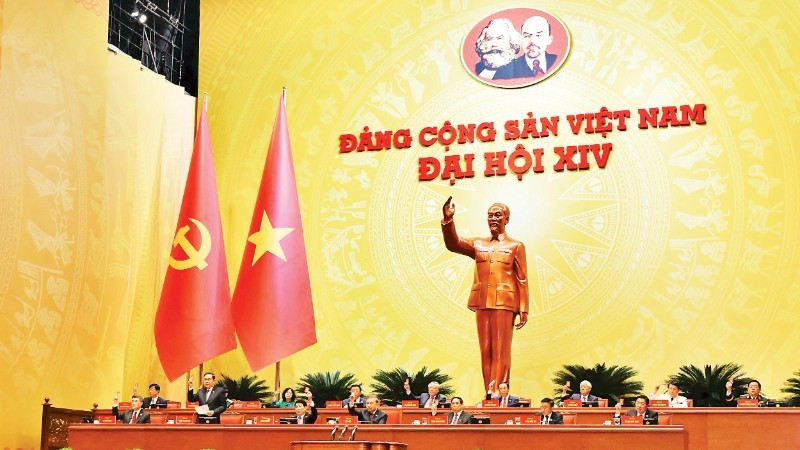
Looking back over the past nearly a century, it can be affirmed that every “historic spring” of the nation bears the deep imprint of the Party’s mettle, intellect, and leadership mission, opening new stages of development for the Vietnamese revolution, from winning national independence to building and defending the Fatherland, and advancing towards the aspiration of a prosperous and happy nation.
The spring of 1930 was the founding spring of the modern Vietnamese revolution. At a time when the patriotic movement in the early 20th century was mired in a profound crisis of political line and leadership organisation, the establishment of the Communist Party of Viet Nam was a historical necessity, responding to the nation’s urgent demands. From that point on, the Vietnamese revolution had a genuine revolutionary party of the working class, imbued with Marxism-Leninism and possessing the mettle and intellect to lead the entire nation.
That spring marked a fundamental turning point: for the first time, the nation’s path of development was clearly defined — national independence inseparably linked with socialism. This was not only a choice in line with the laws of historical development, but also the crystallisation of the age-old aspiration of the Vietnamese people for a society of justice, freedom and happiness. From the spring of 1930, the Vietnamese revolution entered a new chapter — a chapter of unity in will and action under the Party’s leadership.
The spring of 1941 held a particularly sacred significance for the nation’s destiny. After nearly 30 years of travelling abroad in search of a path to national salvation, Nguyen Ai Quoc returned to the homeland to directly lead the Vietnamese revolution. This return was not merely the homecoming of an outstanding son of the nation, but the convergence of revolutionary theory with domestic revolutionary practice.
At Pac Bo, Cao Bang, together with the Party Central Committee, he identified national liberation as the supreme task, established the Viet Minh Front, built revolutionary bases, and prepared forces for a general uprising. The spring of 1941 laid the decisive foundations for the victory of the August Revolution in 1945. Under the leadership of the Party and President Ho Chi Minh, the Vietnamese people rose up to seize power nationwide, giving birth to the Democratic Republic of Viet Nam and opening a new era — an era of national independence associated with the people’s mastery of their own destiny.
Continuing this trajectory, the spring of 1946 marked a political and legal event of great historic significance: the first general election to elect the First National Assembly of independent Viet Nam, held on January 6, 1946. For the first time in history, the Vietnamese people fully exercised their rights and obligations as citizens, directly choosing representatives to voice their will and aspirations. This was vivid proof of the democratic and progressive nature of the new regime led by the Party, while also affirming the legitimacy of the fledgling revolutionary state amid extremely complex internal and external challenges.
The democratic spring of 1946 laid the foundations for a revolutionary law-governed state, affirming citizens’ rights and the people’s mastery — values consistently upheld in the Party’s thinking and line.
The spring of 1951 was another important milestone in the Party’s leadership history. The Second National Congress of the Party was convened in February 1951, at a time when the resistance war against French colonialism had entered a fierce phase. The congress reviewed practice, further developed and refined the line of an all-people, comprehensive, and protracted resistance, relying primarily on the nation’s own strength; it also decided to bring the Party into open operation under the name of the Viet Nam Workers’ Party. The strategic decisions made in the spring of 1951 provided a firm political, ideological, and organisational foundation for the entire nation to move towards decisive victory.
Nine years of protracted resistance culminated in the Dien Bien Phu Victory in 1954 — “resounding across the five continents and shaking the globe” — bringing an end to the old-style colonial regime and affirming the Party’s leadership intellect and resolve at the most arduous and testing moments.
The pinnacle of the “historic springs” of the 20th century was the spring of 1975 — the spring of great victory. After 21 years of protracted resistance against the US for national salvation, under the Party’s leadership the army and people achieved the Great Spring Victory of 1975, completely liberating the South and reunifying the country. This triumph was the result of a correct and creative revolutionary line, the strength of great national unity, and the burning aspiration for independence and freedom embodied in the spirit that “Nothing is more precious than independence and liberty”. From the spring of 1975, the Vietnamese nation entered a new period — one in which the whole country advanced towards socialism, healed the wounds of war, and embarked on national reconstruction.
Notably, following the Sixth National Party Congress in 1986, a “spring of renewal” was launched. With the spirit of “looking straight at the truth and speaking the truth”, the Party courageously renewed its thinking and led the comprehensive renewal of the country. Over nearly 40 years, under the Party’s leadership, Viet Nam has achieved great and historically significant accomplishments: sustained economic growth, marked improvements in people’s living standards, steadily enhanced international standing and prestige, and the firm safeguarding of independence, sovereignty, and territorial integrity. These achievements further affirm the Party’s irreplaceable role in leading the Vietnamese revolution.
More recently, the Party has issued a series of important strategic decisions, clearly demonstrating its leadership role, long-term vision, and political resolve in guiding the country through challenges, seizing opportunities and creating momentum for a “national spring” in a new stage of development.
Notable among these are the continued concretisation and effective implementation of the Resolution of the 13th National Party Congress, in conjunction with Central Committee resolutions on stepping up the building and rectification of the Party and the political system; the rapid and sustainable development of the country on the basis of science, technology, innovation, and national digital transformation; the completion of a synchronous, modern, and internationally integrated socialist-oriented market economy; policies on cultural development and the building of the Vietnamese people; the assurance of social security; the improvement of human resource quality; and the strengthening of an all-people national defence and people’s security posture. These priorities underscore a harmonious development between the economy and society, between growth and progress and social equity.
In particular, the thorough preparation in political, ideological, organisational, and personnel terms for the 14th National Party Congress reaffirms the Party’s role as the nucleus of leadership in consolidating social trust, promoting democracy, and powerfully inspiring the aspiration for a prosperous and happy country.
Looking ahead, the spring of 2026 carries new momentum, renewed confidence and fresh opportunities for the nation. The whole country will joyfully welcome the 14th National Congress of the Party — a major political event of strategic significance for the next stage of national development. Alongside it will be the election of the 16th National Assembly and People’s Councils at all levels, further affirming the people’s mastery within the socialist rule-of-law state. The spring of 2026 is not only a continuation of the tradition of historic springs but also opens expectations of ushering the country into a new era of development, realising the aspiration of a strong and prosperous Viet Nam by 2030, with a vision to 2045.
From the founding spring of 1930 to the aspirational spring of 2026 is a journey of continuous renewal, steadfast adherence to the goals of national independence and socialism, for the happiness of the people and the enduring vitality of the nation-state. This very confidence will continue to serve as a powerful spiritual resource, guiding Viet Nam forward on its development path in the springs of the future.
Reflecting on the “historic springs” under the Party’s leadership, one enduring truth stands out: every victory of the Vietnamese revolution has been inextricably linked to the Party’s correct and creative leadership and the unity and concerted efforts of the people. From the founding spring of 1930 to the aspirational spring of 2026, this has been a journey of unceasing renewal and steadfast commitment to national independence and socialism, for the people’s happiness and the nation’s longevity. It is this faith that will continue to be a great source of spiritual strength, leading Viet Nam confidently forward into the springs yet to come.
Author: NDO
RECOMMENDED TOPICS